

Q&A
Darshana M. Baruah, Satyendra Prasad, Denghua Zhang
{
  "authors": [
    "Darshana M. Baruah"
  ],
  "type": "other",
  "centerAffiliationAll": "",
  "centers": [
    "Carnegie Endowment for International Peace",
    "Carnegie India"
  ],
  "collections": [],
  "englishNewsletterAll": "",
  "nonEnglishNewsletterAll": "",
  "primaryCenter": "Carnegie India",
  "programAffiliation": "",
  "programs": [],
  "projects": [],
  "regions": [
    "Asia",
    "South Asia",
    "India",
    "East Asia",
    "China"
  ],
  "topics": [
    "Foreign Policy"
  ]
}
Source: Getty
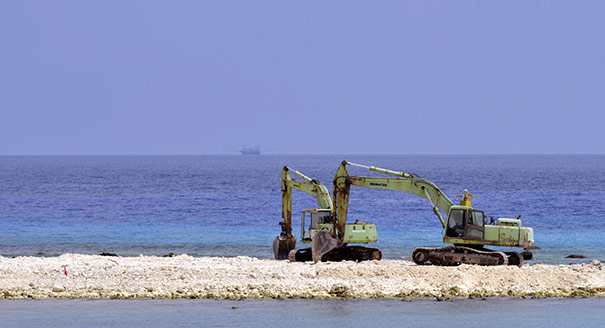
New Delhi’s stance on the South China Sea has gone through prominent changes under the leadership of Narendra Modi in line with India’s changing outlook on maritime security as a whole.
Source: National Asian Security Studies Program
As the environment in the SCS grows increasingly hostile, managing tensions in these waters has become crucial. This essay examines India’s approach towards the South China Sea dispute and the role it can play as a middle power in the region. The paper argues that New Delhi’s stance on the issue has gone through prominent changes under the leadership of Narendra Modi in line with India’s changing outlook on maritime security as a whole. The first section examines India’s approach towards the South China Sea, underlining the changes in its policies. The second section explores the role of a middle power and New Delhi’s contribution in stabilising the situation. The conclusion briefly suggests further avenues for cooperation that would establish a constructive role for New Delhi in its relationship with Southeast Asia.
This article was originally published as a National Asian Security Studies Program Issue Brief.

Former Nonresident Scholar, South Asia Program
Darshana M. Baruah was a nonresident scholar with the South Asia Program at the Carnegie Endowment for International Peace where she directs the Indian Ocean Initiative.
Recent Work

Darshana M. Baruah, Satyendra Prasad, Denghua Zhang
Darshana M. Baruah
Carnegie does not take institutional positions on public policy issues; the views represented herein are those of the author(s) and do not necessarily reflect the views of Carnegie, its staff, or its trustees.

In an interview, Ian Lustick and Eli Clifton discuss their new book on why a prominent ally has so much influence in America.

Michael Young

By failing to address Palestinian representation, the current process is bound to lead to just another temporary arrangement.

Nathan J. Brown

Just look at Iraq in 1991.

Marwan Muasher

A coalition of states is seeking to avert a U.S. attack, and Israel is in the forefront of their mind.
Michael Young

Baku may allow radical nationalists to publicly discuss “reunification” with Azeri Iranians, but the president and key officials prefer not to comment publicly on the protests in Iran.

Bashir Kitachaev