

Q&A
Matt Ferchen
{
  "authors": [
    "Matt Ferchen"
  ],
  "type": "legacyinthemedia",
  "centerAffiliationAll": "",
  "centers": [
    "Carnegie Endowment for International Peace",
    "Carnegie China"
  ],
  "collections": [
    "China and the Developing World",
    "China’s Foreign Relations"
  ],
  "englishNewsletterAll": "",
  "nonEnglishNewsletterAll": "",
  "primaryCenter": "Carnegie China",
  "programAffiliation": "",
  "programs": [],
  "projects": [],
  "regions": [
    "North America",
    "South America",
    "East Asia",
    "China"
  ],
  "topics": [
    "Economy",
    "Foreign Policy"
  ]
}
Source: Getty
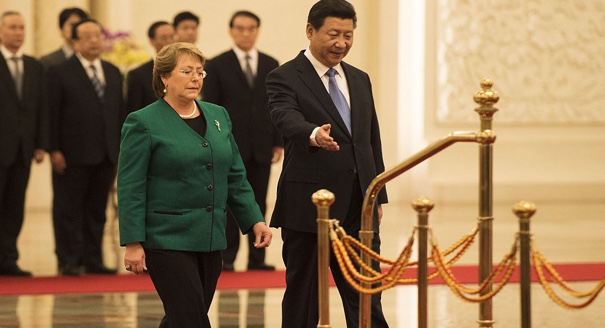
A meaningful change in China-Latin America relations requires inducing development and sustainable economic ties between the two players, notably through standardized protocols.
Source: Latin America Advisor
Inter-American Dialogue: Chinese President Xi Jinping visited Ecuador, Peru, and Chile in mid-November during a trip that also included his participation in the Asia-Pacific Economic Cooperation summit in Lima. The visit was Xi’s third to Latin America since he took office in 2013. What did he accomplish for China during the trip, and what was the trip’s significance for the Latin American countries he visited? What is the future of Chinese influence in Latin America as compared to U.S. influence in the region as the world looks ahead to Donald Trump assuming the presidency of the United States? How is China’s economy and the country’s currency, currently trading at multiyear lows, factoring into Latin America’s economic outlook?
Matt Ferchen: The key headline from Xi Jinping’s recent trip to Latin America, repeated in many major western and Chinese media outlets, was that China was taking over the role of economic leadership in the Asia-Pacific just as the United States is setting to embark on a new period of isolationism and protectionism. Even before Xi’s trip, the official Chinese press was trumpeting a ‘new era’ of China-Latin America relations. Yet, what these headlines missed was that the end of the commodity boom, from about 2003-2013, had already ushered in a new period of China-South America economic relations. China-South America trade, dependent as it has been on the export of South American mineral, energy, and agricultural goods and the import of Chinese manufactures and capital, has been a case study in both the upsides and the downsides of classic comparative advantage relations. All the discussion about Chinese-led efforts to promote greater Asia-Pacific trade misses the point that South American exports to China, and most Chinese investment in the region, will continue to be largely focused on raw materials. Neither in the immediate wake of the end of the commodity boom nor during Xi’s recent trip has there been much serious discussion about what Latin American governments, citizens, and businesses propose as a more sustainable, development-enhancing relationship with China. Such discussions might begin with a focus on region-wide efforts at standardizing environmental and social protocols for extractive industry and infrastructure investments from China and elsewhere, and ensuring those are consistent with similar protocols in Chinese-led institutions like the Asian Infrastructure Investment Bank and the New Development Bank.

Former Nonresident Scholar, Carnegie-Tsinghua Center for Global Policy
Ferchen specializes in China’s political-economic relations with emerging economies. At the Carnegie–Tsinghua Center for Global Policy, he ran a program on China’s economic and political relations with the developing world, including Latin America.
Recent Work
Matt Ferchen
Matt Ferchen, Anarkalee Perera
Carnegie does not take institutional positions on public policy issues; the views represented herein are those of the author(s) and do not necessarily reflect the views of Carnegie, its staff, or its trustees.

Huawei pushed hard to enter the Egyptian data centers market, until the Americans made a better offer.

Angie Omar

By failing to address Palestinian representation, the current process is bound to lead to just another temporary arrangement.

Nathan J. Brown

The armed forces champion a form of capitalism that is generating revenue, but its reliance on rent faces diminishing returns, leaving the country with massive sunk costs and deferred returns, deepening dependency on external borrowing.

Yezid Sayigh

Just look at Iraq in 1991.

Marwan Muasher

A coalition of states is seeking to avert a U.S. attack, and Israel is in the forefront of their mind.

Michael Young