

Commentary
Reconciliation councils are emerging throughout the country to mediate in intracommunal disputes, many from the war years.
Natacha Danon
{
  "authors": [
    "Michele Dunne",
    "Jake Walles"
  ],
  "type": "legacyinthemedia",
  "centerAffiliationAll": "dc",
  "centers": [
    "Carnegie Endowment for International Peace",
    "Malcolm H. Kerr Carnegie Middle East Center"
  ],
  "collections": [],
  "englishNewsletterAll": "menaTransitions",
  "nonEnglishNewsletterAll": "",
  "primaryCenter": "Carnegie Endowment for International Peace",
  "programAffiliation": "MEP",
  "programs": [
    "Middle East"
  ],
  "projects": [],
  "regions": [
    "North America",
    "United States",
    "Middle East",
    "Israel",
    "North Africa",
    "Egypt",
    "Palestine",
    "United Arab Emirates",
    "Levant"
  ],
  "topics": [
    "Political Reform",
    "Foreign Policy"
  ]
}
Source: Getty
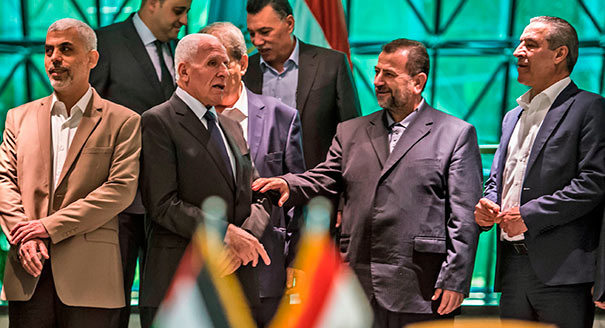
The recent Hamas-Fatah reconciliation may reflect shifting dynamics in negotiations on Gaza, both regionally and internationally.
Source: Al Jazeera
The Hamas-Fatah reconciliation announced October 12 in Cairo surprised many observers, who understandably expected another failure after a dozen or so unsuccessful efforts at reconciliation in the decade-long rift between the two main Palestinian factions. Many of the details of the latest Cairo deal have not emerged, there will be further talks November 21, and there is plenty of time for the agreement to encounter problems before its scheduled implementation. But from what is known now, the two sides seem more optimistic than in the past, based likely on Egypt's strong push for an agreement.
Certainly, weary and disgruntled Palestinians would welcome reconciliation, seen as essential to strengthening their hand vis-a-vis Israel as well as returning a semblance of normal life to battered Gaza. Fatah representative Azzam al-Ahmad and Hamas' Salah al-Arouri said during their joint press conference that this was not a new deal, but rather a new commitment to implementing previous agreements (of which there have been several, for example in 2011, 2014, and as far back as 2005.
The agreement reached this week appears to focus on concrete issues relevant to the local population, as well as to Egypt and Israel - specifically who pays for what and who runs what in Gaza. The initial phase would include the reopening of the Rafah crossing to Egypt under the control of Palestinian Authority (PA) Presidential Guards on November 1, the resumption of PA governance in Gaza starting on December 1, and the reintegration of Hamas officials into the PA ministries in Gaza.
A joint committee would be established to implement the third point. As part of the resumption of PA authority in Gaza, President Mahmoud Abbas would end the sanctions he imposed on Gaza in August and resume funding of essential governmental functions, such as electricity and employee salaries.What the new agreement does not seem to include is implementation of broader, more political aspects of previous reconciliation deals, such as incorporating Hamas into the Palestinian Liberation Organization (the body that negotiates with Israel, dominated by Fatah), reconvening the elected Palestinian Legislative Council, or holding general elections.
And there does not seem to be even lip-service paid to the idea of Hamas arms and fighters being incorporated into a broader force under PA control. Despite a recent avowal by Abbas that he would not accept a "Hezbollah model" - a political movement with a separate militia and limited involvement in governance - in Gaza, that is what seems to be emerging.In fact, a peculiar combination of weakness and invincibility on the part of Hamas is one of the factors that made this mini-breakthrough possible. Ten years after Hamas took control of Gaza from the PA, the Strip teeters on the edge of a humanitarian crisis.
Electricity has been limited to a few hours a day, the Rafah crossing point to Egypt remains closed, and economic conditions remain bleak. Without greater assistance from somewhere - the PA in Ramallah, the Gulf, or the international community - Gaza could face a genuine human disaster for which Hamas would bear responsibility.
At the same time, various attempts to eliminate Hamas from the equation, or at least disarm it, by Israel, Egypt, and the PA have come to nought. Abbas, likewise a political survivor against the odds, appears by participating in this reconciliation to have outflanked his Fatah rival Mohammed Dahlan, who was the focus of another recent reconciliation attempt. The regional power struggle is also driving Palestinian reconciliation, with Egypt and the UAE having to stretch their policies (and for the UAE, pocketbook) in order to reduce Qatar's influence in Gaza.
While on the surface Egypt appeared to be playing its typical reconciliation role, upon closer inspection that role was actually rather different from episodes in the recent past - and in fact, al-Ahmad and al-Arouri even remarked upon that in their press conference. After President Abdel Fattah al-Sisi came to power via a 2013 military coup, he initially abandoned the pretence at even-handedness his predecessors had adopted and instead took an explicitly partisan approach, treating Hamas as a terrorist organisation affiliated with the Muslim Brotherhood and also siding with Dahlan against Abbas.
But Sisi had to revert to a more typical Egyptian realpolitik position of dealing with those actually in power in Hamas and Fatah in order to make the new agreement possible. The Egyptian shift in position towards Hamas, no longer treated as a terrorist entity but rather a security partner, appears to be based on a calculation that Egypt needed Hamas cooperation in order to curtail the flow of arms and fighters to the insurgency in the Sinai Peninsula.
Perhaps the most intriguing question is whether Israel and the United States will take a more positive attitude towards Fatah-Hamas reconciliation now than they have in the past. Prime Minister Netanyahu began to answer that question with a statement on Facebook late on October 12.
Netanyahu insisted that Palestinian reconciliation must be based on the three Quartet conditions: any Palestinian government must renounce violence, recognise Israel, and accept the agreements negotiated between Israel and the PLO since 1993. But Netanyahu also went further, demanding that Hamas must disarm and denouncing reconciliation with "mass murderers."
The initial US reaction has been low-key; shortly after the announced agreement on October 12, US State Department spokesman Heather Nauert welcomed the creation of "conditions for the Palestinian Authority to fully assume responsibilities in Gaza". In the lead-up to the talks, the US also couched its public statements in more positive tones, but it has nevertheless maintained its support for the Quartet conditions as it has since 2005.
Whether Abbas can persuade the US government (and more to the point, Israel and the US Congress) that Hamas' participation in the PA does not violate those conditions is unclear.

Former Nonresident Scholar, Middle East Program
Michele Dunne was a nonresident scholar in Carnegie’s Middle East Program, where her research focuses on political and economic change in Arab countries, particularly Egypt, as well as U.S. policy in the Middle East.

Former Nonresident Senior Fellow, Middle East Program
Jake Walles was a nonresident senior fellow in the Middle East Program at the Carnegie Endowment for International Peace, where he focuses on Israeli-Palestinian issues, Tunisia, and counterterrorism.
Carnegie does not take institutional positions on public policy issues; the views represented herein are those of the author(s) and do not necessarily reflect the views of Carnegie, its staff, or its trustees.
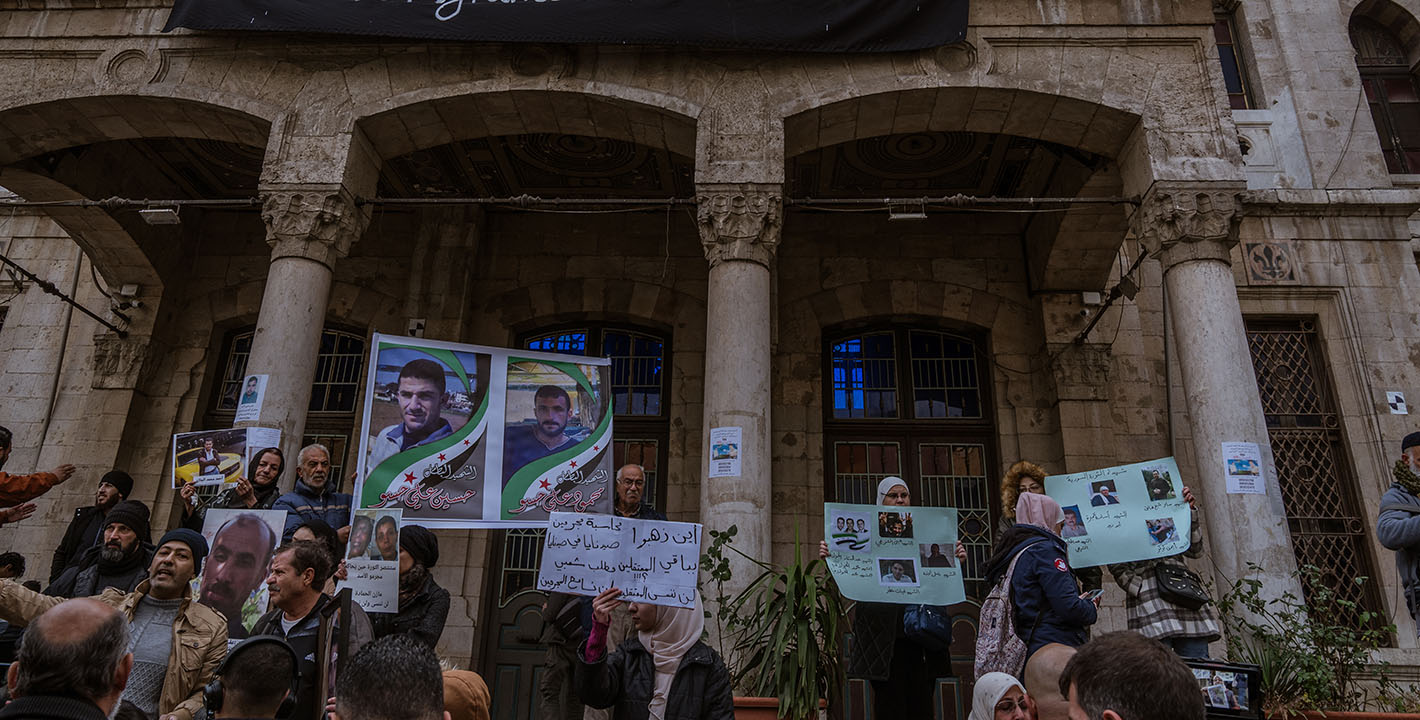
Reconciliation councils are emerging throughout the country to mediate in intracommunal disputes, many from the war years.
Natacha Danon

In an interview, Rozina Ali discusses her new book on the rise and manifestations of Islamophobia in the United States.

Michael Young
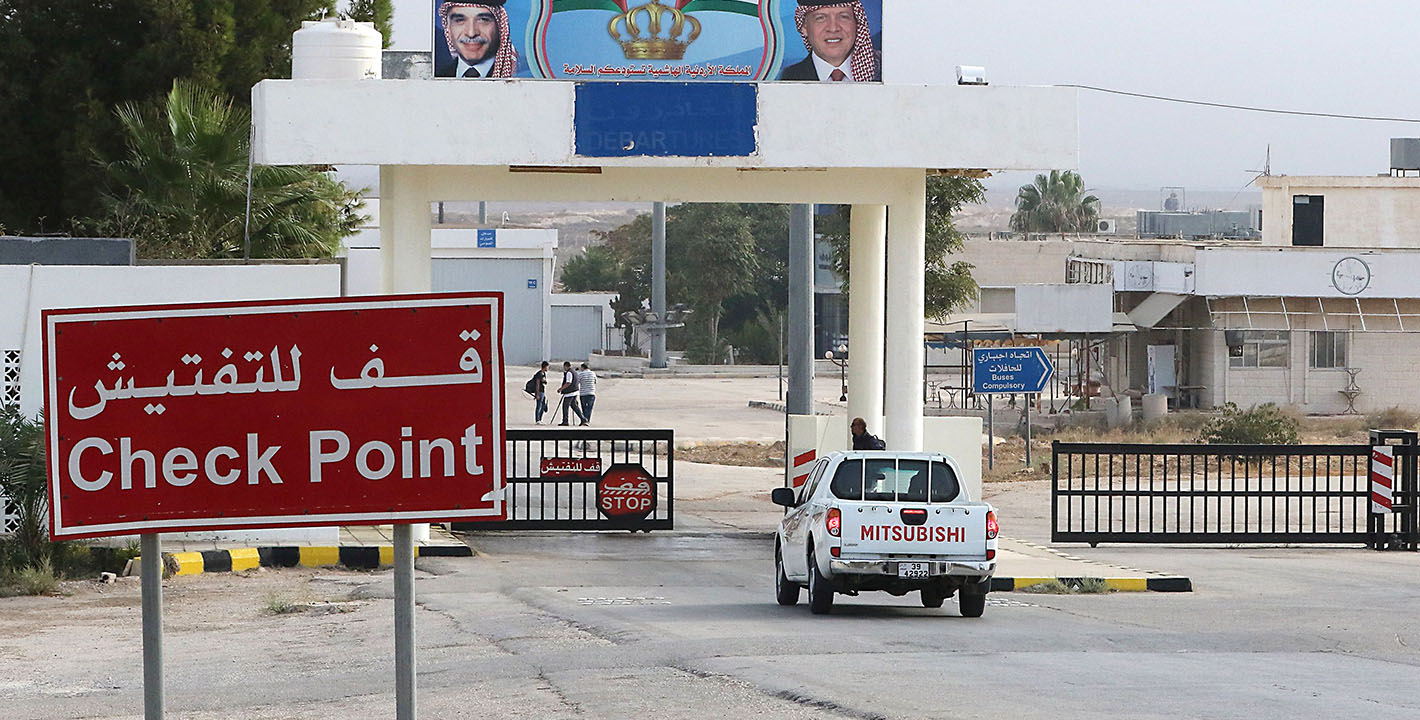
The civil war in Syria may have ended, but the country continues to serve as a source for the trafficking of illegal substances into and via Jordanian territory.

Armenak Tokmajyan, Laith Qerbaa
As the U.S.-led Coalition withdraws, the Kurds’ reliance on Baghdad, and on themselves, will only increase.
Wladimir van Wilgenburg

In an interview, Ian Lustick and Eli Clifton discuss their new book on why a prominent ally has so much influence in America.
Michael Young