

Paper
Ashley J. Tellis
{
  "authors": [
    "Ashley J. Tellis"
  ],
  "type": "other",
  "centerAffiliationAll": "dc",
  "centers": [
    "Carnegie Endowment for International Peace"
  ],
  "collections": [],
  "englishNewsletterAll": "ctw",
  "nonEnglishNewsletterAll": "",
  "primaryCenter": "Carnegie Endowment for International Peace",
  "programAffiliation": "SAP",
  "programs": [
    "South Asia"
  ],
  "projects": [],
  "regions": [
    "South Asia",
    "East Asia",
    "China",
    "Southeast Asia"
  ],
  "topics": [
    "Economy",
    "Trade",
    "Security",
    "Military",
    "Foreign Policy",
    "Global Governance"
  ]
}
Source: Getty
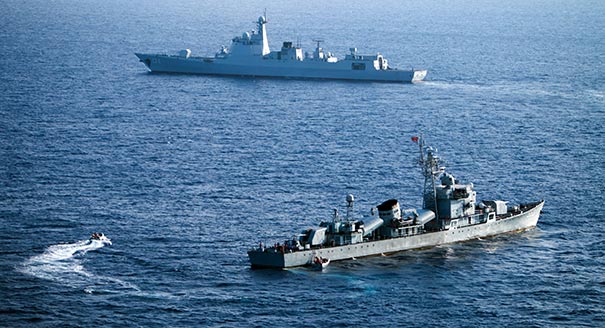
China’s actions in the South China Sea will likely have adverse consequences for the global maritime order. Such actions require a sustained and intentional response on the part of the United States.
Source: Hudson Institute
Speaking at the Hudson Institute, Carnegie’s Ashley J. Tellis addressed the strategic and diplomatic implications of Chinese actions in the South China Sea. Arguing that China’s intention to enforce its ambiguous but expansive claims poses unmistakable danger to the existing international order, Tellis sketched out some of the possible long-term consequences, as well as possible U.S. responses.
Beyond the potential risk to freedom of navigation in the region and economic disadvantages for neighboring countries with conflicting claims in the South China Sea, China’s actions strengthen the shift toward progressively greater “national enclosure” of open international waterways, Tellis warned. He added that, if left unchecked, Chinese militarization would disturb the local military balances and force the United States to commit more resources to the region in order to fulfill its obligations to its local friends and allies.
Tellis called for a coordinated campaign to increase pressure on China through multilateral institutions and other international maritime functional organizations. Sanctions could be applied to specific, Chinese state-owned enterprises engaged in illegal construction in the region, he added. He argued that a regime of routine freedom of navigation operations should be maintained, and a coalition of like-minded nations in Southeast Asia should be assisted to develop their surveillance capacities as well as their naval and air power deterrents.
Former Senior Fellow
Ashley J. Tellis was a senior fellow at the Carnegie Endowment for International Peace.
Recent Work
Ashley J. Tellis
Ashley J. Tellis
Carnegie does not take institutional positions on public policy issues; the views represented herein are those of the author(s) and do not necessarily reflect the views of Carnegie, its staff, or its trustees.

Huawei pushed hard to enter the Egyptian data centers market, until the Americans made a better offer.

Angie Omar

By failing to address Palestinian representation, the current process is bound to lead to just another temporary arrangement.

Nathan J. Brown

The armed forces champion a form of capitalism that is generating revenue, but its reliance on rent faces diminishing returns, leaving the country with massive sunk costs and deferred returns, deepening dependency on external borrowing.

Yezid Sayigh

Morocco and Algeria, each in its own way, are having to navigate the global economic fallout of the U.S.-Israeli military campaign against Iran.

Yasmine Zarhloule

Just look at Iraq in 1991.

Marwan Muasher