

Q&A
- +1
Sheena Chestnut Greitens, Oriana Skylar Mastro, Yukon Huang, …
{
  "authors": [
    "Tong Zhao"
  ],
  "type": "other",
  "centerAffiliationAll": "dc",
  "centers": [
    "Carnegie Endowment for International Peace",
    "Carnegie China"
  ],
  "collections": [
    "Future of Arms Control"
  ],
  "englishNewsletterAll": "ctw",
  "nonEnglishNewsletterAll": "",
  "primaryCenter": "Carnegie China",
  "programAffiliation": "NPP",
  "programs": [
    "Nuclear Policy"
  ],
  "projects": [],
  "regions": [
    "East Asia",
    "China"
  ],
  "topics": [
    "Nuclear Policy",
    "Arms Control",
    "Foreign Policy"
  ]
}
Source: Getty
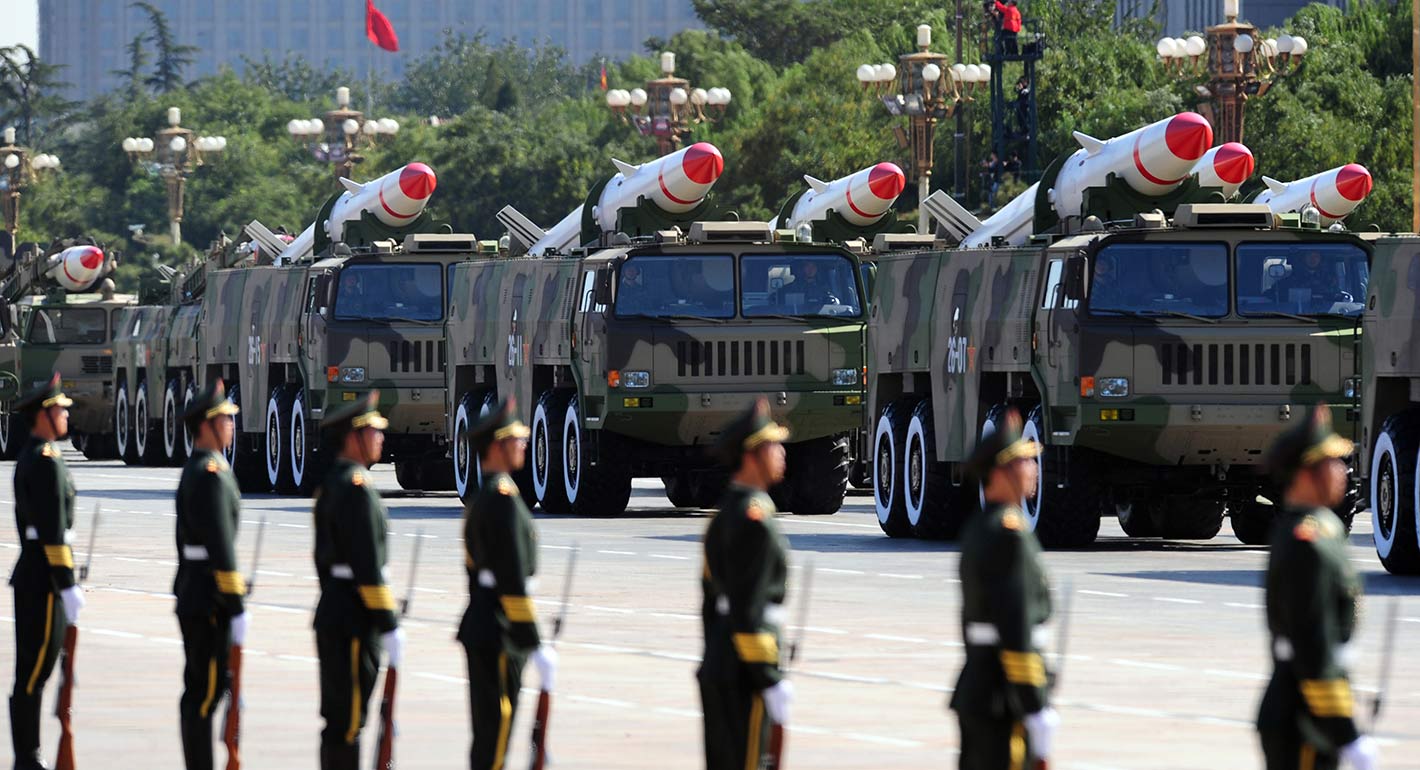
While China may not think it has an interest in participating in major-power arms control now, pressures are building for it to do so. If Washington wants to engage constructively with Beijing, it should focus on concrete proposals to manage competition.
Source: Arms Control Today
The clock is ticking on an extension of the 2010 New Strategic Arms Reduction Treaty (New START). To complicate matters, instead of extending the treaty as is, Washington seeks to broaden the existing U.S.-Russian agreement by including China in a new trilateral arms control framework. There is no chance that Beijing would change its long-held views on arms control within the next 12 months before New START expires. Nonetheless, China’s growing military power and influence are producing counterpressures for China to deepen its participation in arms control. At a time when President Xi Jinping said China should “take center stage in the world,”1 China may find itself having to seriously prepare for major-power competitions and major-power arms control.
Over time, China’s own interest will align with arms control for several reasons. At the strategic level, the major-power competition between Washington and Beijing is going to be a long-term reality. It is driven by fundamental conflicts in world views, values, and ways of governance. Nonetheless, it is in no one’s interest, including China’s, to allow this competition to become completely uncontrolled and unregulated. Just as U.S. and Soviet leaders Ronald Reagan and Mikhail Gorbachev agreed during the Cold War that “nuclear wars cannot be won and should never be fought,” Beijing and Washington should set some basic boundaries to their competition so that they do not half-wittingly destroy everything worth competing for. In particular, they need to assure each other that neither intends to threaten the survival or the most critical security interests of the other. To this end, they must commit to maintain strategic stability, avoid a repetition of a Cold War-style arms race, and agree on redlines and basic rules of major-power competition. Against an uncertain future geopolitical landscape at regional and global levels, arms control can and should serve as guardrails and a stabilizer of the major powers’ strategic relationship.
China has benefited from the U.S.-Russian arms control process without having to contribute directly to it. That situation is no longer tenable. Indeed, China’s stand-aside policies have already unwittingly contributed to the demise of one U.S.-Russian nuclear treaty, the Intermediate-Range Nuclear Forces (INF) Treaty. In the mid-2000s, Russia openly complained about restrictions on its missile programs while other nations, particularly China, were unconstrained. If China had acknowledged and addressed Russian concerns, Moscow would have had one less reason to develop and deploy the alleged treaty-violating 9M729 missile, which led the United States to withdraw from the pact. With the treaty’s demise, China is now presented with a much larger security problem. In this sense, arms control can be a preventive measure that helps China manage and mitigate future security challenges. If China’s involvement in some arms control measures today can contribute to the continuation of U.S.-Russian arms control in the future, it would be worth serious Chinese efforts.
1. “Xi Jinping: ‘Time for China to Take Centre Stage,’” BBC, October 18, 2017, https://www.bbc.com/news/world-asia-china-41647872.

Senior Fellow with the Nuclear Policy Program and Carnegie China
Tong Zhao is a senior fellow with the Nuclear Policy Program and Carnegie China, Carnegie’s East Asia-based research center on contemporary China. Formerly based in Beijing, he now conducts research in Washington on strategic security issues.
Recent Work



Sheena Chestnut Greitens, Oriana Skylar Mastro, Yukon Huang, …
Carnegie does not take institutional positions on public policy issues; the views represented herein are those of the author(s) and do not necessarily reflect the views of Carnegie, its staff, or its trustees.

In an interview, Ian Lustick and Eli Clifton discuss their new book on why a prominent ally has so much influence in America.

Michael Young

By failing to address Palestinian representation, the current process is bound to lead to just another temporary arrangement.

Nathan J. Brown
In an interview, Marc Lynch discusses his new book decrying the post-1990 U.S.-dominated order in the Middle East.
Michael Young

Just look at Iraq in 1991.

Marwan Muasher

A coalition of states is seeking to avert a U.S. attack, and Israel is in the forefront of their mind.
Michael Young