

Article
Marina Ottaway, Omar Hossino
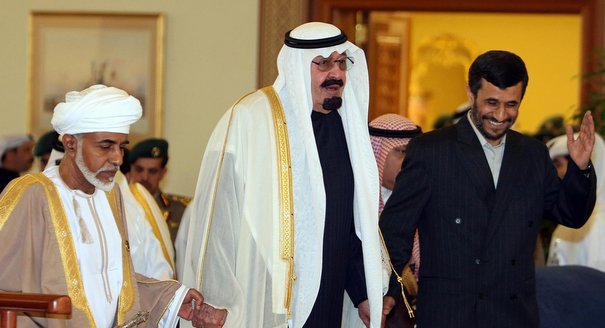
Source: Getty
Any effective U.S. diplomatic approach to Iran must involve other countries in the Gulf, but Washington will not succeed if it continues to strive for an anti-Iranian alliance. A normalization of relations between Iran and its neighbors is an important and attainable step for reintegrating Iran into the international community.
Any effective U.S. diplomatic approach to Iran must involve other countries in the Gulf, but Washington will not succeed if it continues to strive for an anti-Iranian alliance. While an overall security arrangement including all Gulf countries is not possible at this stage, a normalization of relations between Iran and its neighbors is an important and attainable step for reintegrating Iran into the international community, Marina Ottaway concludes in a new paper.
Gulf countries can help engage Iran in negotiations, but messy and often significant divisions between them complicate efforts to normalize relations. Ottaway analyzes Iran’s relationship with the Gulf Cooperation Council (GCC) countries—Saudi Arabia, Kuwait, Bahrain, Qatar, the United Arab Emirates, and Oman—as well as Jordan, Israel, Egypt, and Iraq.
Key Conclusions:
“Although during the negotiations over Iran’s nuclear program Gulf countries are essentially spectators to a process—the outcome of which will be determined by the United States, Iran, major European countries, Russia, and China—GCC countries have an important role to play in the difficult process of reintegrating Iran into the international community,” Ottaway writes. “Normalization of relations among the GCC countries, Iraq, and Iran would be a positive step in this process of reintegration. It would also help stabilize the region, decreasing tensions and the possibility of conflicts over bilateral issues that might trigger more serious problems.”

Former Senior Associate, Middle East Program
Before joining the Endowment, Ottaway carried out research in Africa and in the Middle East for many years and taught at the University of Addis Ababa, the University of Zambia, the American University in Cairo, and the University of the Witwatersrand in South Africa.
Recent Work
Marina Ottaway, Omar Hossino
Marina Ottaway
Carnegie does not take institutional positions on public policy issues; the views represented herein are those of the author(s) and do not necessarily reflect the views of Carnegie, its staff, or its trustees.

As the U.S. stumbles in its war with Iran, we are likely to see an acceleration of its disengagement from the region.

Michael Young

In Egypt’s dense cities, the disappearance of foliage has health implications and punishes daily commuters.

Angie Omar
The Zaidi government’s objective to collect weapons is constrained by regional conflict, but it can take certain measures at home.
Ali Al-Mawlawi

It is improbable that Israel’s forthcoming elections will alter much in terms of how the country thinks about security.

Nathan J. Brown

Huawei pushed hard to enter the Egyptian data centers market, until the Americans made a better offer.
Angie Omar