

Paper
Lora Saalman
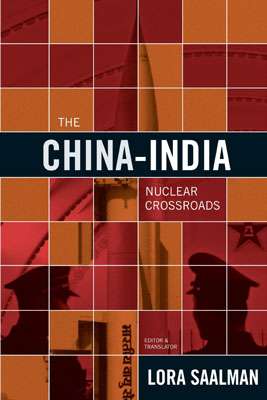
Leading Chinese and Indian experts examine the political, military, and technical factors that affect Sino-Indian nuclear relations, providing a comprehensive framework through which China and India can pursue enhanced cooperation.
Source: Washington

Despite these trends, The China-India Nuclear Crossroads is the first serious book by leading Chinese and Indian experts to examine the political, military, and technical factors that affect Sino-Indian nuclear relations. In this book, editor and translator Lora Saalman presents a comprehensive framework through which China and India can pursue enhanced cooperation and minimize the unintended consequences of their security dilemmas. | 中文
“The place to start for anyone interested in the atomic dimension of the China-India relationship and its profound impact on Asian security and the global nuclear order.”
—C. Raja Mohan, Member of India’s National Security Advisory Board and Distinguished Fellow at the Observer Research Foundation
“A first and crucial attempt to comprehensively compare Chinese and Indian nuclear perspectives.”
—Shen Dingli, Executive Dean of the Institute of International Studies and Director of the Center for American Studies at Fudan University
“Provides a better understanding of the security perceptions driving China and India’s nuclear strategies...a must read.”
—Shyam Saran, Senior Fellow at the Center for Policy Research and former counselor in the Embassy of India in Beijing, China
“Serves as a communication bridge between Chinese and Indian scholars.”
—Zheng Ruixiang, Senior Researcher at the China Institute of International Studies and China’s former consul general in Mumbai, India

Former Nonresident Associate, Nuclear Policy Program
Saalman was a nonresident associate in the Nuclear Policy Program at the Carnegie Endowment for International Peace. Her research focuses on China’s nuclear and strategic policies toward India, Russia, and arms control.
Recent Work
Lora Saalman
Lora Saalman
Carnegie does not take institutional positions on public policy issues; the views represented herein are those of the author(s) and do not necessarily reflect the views of Carnegie, its staff, or its trustees.

The armed forces champion a form of capitalism that is generating revenue, but its reliance on rent faces diminishing returns, leaving the country with massive sunk costs and deferred returns, deepening dependency on external borrowing.

Yezid Sayigh
In an interview, Marc Lynch discusses his new book decrying the post-1990 U.S.-dominated order in the Middle East.

Michael Young

Just look at Iraq in 1991.

Marwan Muasher

Baku may allow radical nationalists to publicly discuss “reunification” with Azeri Iranians, but the president and key officials prefer not to comment publicly on the protests in Iran.

Bashir Kitachaev

In addressing Hezbollah’s disarmament, the Lebanese state must start by increasing its own leverage.
Michael Young