
• Research
  • Emissary
  • About
  • Experts
Carnegie Global logoCarnegie lettermark logo
Democracy
  • Donate
{
  "authors": [],
  "type": "pressRelease",
  "centerAffiliationAll": "dc",
  "centers": [
    "Carnegie Endowment for International Peace"
  ],
  "collections": [],
  "englishNewsletterAll": "",
  "nonEnglishNewsletterAll": "",
  "primaryCenter": "Carnegie Endowment for International Peace",
  "programAffiliation": "russia",
  "programs": [
    "Russia and Eurasia"
  ],
  "projects": [],
  "regions": [],
  "topics": []
}
Source: Getty

Press Release

Russia after the Fall

Link Copied
Published on Oct 1, 2002
Program mobile hero image

Program

Russia and Eurasia

The Russia and Eurasia Program continues Carnegie’s long tradition of independent research on major political, societal, and security trends in and U.S. policy toward a region that has been upended by Russia’s war against Ukraine.  Leaders regularly turn to our work for clear-eyed, relevant analyses on the region to inform their policy decisions.

Learn More

Source: Carnegie

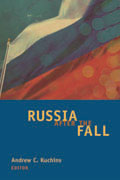
RUSSIA AFTER THE FALL

Andrew C. Kuchins, Editor
 
Price: $24.95Price: $45.00
Paperback, 324 pp.Cloth, 324 pp.
ISBN: 0-87003-198-8ISBN: 0-87003-197-X
Pub. Date: Sept. 2002 
Order the Book from Carnegie's distributor.
 

Table of Contents
Introduction
Index

Reviews and Advance Praise

About the Book
Russia's first decade after the collapse of the Soviet Union has been simultaneously tumultuous and transformative. For most of the 1990s the Russian economy was in free fall, the legal system in absentia, and the majority of citizens engaged primarily in survival efforts. Not surprisingly, the former superpower also struggled to adapt to its greatly diminished means and status.

Russia after the Fall examines Russian politics, economics, society, and foreign and security policy. Internationally renowned experts provide retrospective analyses of how Russia has fared in its reform efforts and a prospective look at the challenges ahead. This book will be of interest to scholars, students, and a general audience seeking to better understand where Russia has been and where it is going.

About the Editor
Andrew C. Kuchins is director of the Carnegie Moscow Center. He conducts research and writes widely on Russian foreign and security policy. He is a member of the governing council of the Program on Basic Research and Higher Education in Russia, the advisory committee of Washington Profile, and the editorial board of the journal, Demokratizatsiya. He is the author of Summit with Substance: Creating Payoffs in an Unequal Partnership (Carnegie Endowment policy brief no. 16).

Carnegie does not take institutional positions on public policy issues; the views represented herein are those of the author(s) and do not necessarily reflect the views of Carnegie, its staff, or its trustees.

More Work from Carnegie Endowment for International Peace

  • Commentary
    Carnegie Politika
    Does Russia Have Enough Soldiers to Keep Waging War Against Ukraine?

    The Russian army is not currently struggling to recruit new contract soldiers, though the number of people willing to go to war for money is dwindling.

      Dmitry Kuznets

  • Kushner and Putin shaking hands, with Witkoff standing next to them
    Commentary
    Emissary
    What If Trump Gets His Russia-Ukraine Deal?

    It’s dangerous to dismiss Washington’s shambolic diplomacy out of hand.

      Eric Ciaramella

  • Abstract of global AI
    Article
    South-South AI Collaboration: Advancing Practical Pathways

    The India AI Impact Summit offers a timely opportunity to experiment with and formalize new models of cooperation.

      Lakshmee Sharma, Jane Munga

  • Commentary
    Strategic Europe
    Taking the Pulse: Can the EU Attract Foreign Investment and Reduce Dependencies?

    EU member states clash over how to boost the union’s competitiveness: Some want to favor European industries in public procurement, while others worry this could deter foreign investment. So, can the EU simultaneously attract global capital and reduce dependencies?

      • Rym Momtaz

      Rym Momtaz, ed.

  • Article
    What Can the EU Do About Trump 2.0?

    Europe’s policy of subservience to the Trump administration has failed. For Washington to take the EU seriously, its leaders now need to combine engagement with robust pushback.

      Stefan Lehne

Get more news and analysis from
Carnegie Endowment for International Peace
Carnegie global logo, stacked
1779 Massachusetts Avenue NWWashington, DC, 20036-2103Phone: 202 483 7600Fax: 202 483 1840
  • Research
  • Emissary
  • About
  • Experts
  • Donate
  • Programs
  • Events
  • Blogs
  • Podcasts
  • Contact
  • Annual Reports
  • Careers
  • Privacy
  • For Media
  • Government Resources
Get more news and analysis from
Carnegie Endowment for International Peace
© 2026 Carnegie Endowment for International Peace. All rights reserved.