

Commentary
Nikolay Petrov
{
  "authors": [
    "Nikolay Petrov"
  ],
  "type": "legacyinthemedia",
  "centerAffiliationAll": "",
  "centers": [
    "Carnegie Endowment for International Peace",
    "Carnegie Russia Eurasia Center"
  ],
  "collections": [],
  "englishNewsletterAll": "",
  "nonEnglishNewsletterAll": "",
  "primaryCenter": "Carnegie Russia Eurasia Center",
  "programAffiliation": "",
  "programs": [],
  "projects": [],
  "regions": [],
  "topics": []
}
Source: Getty
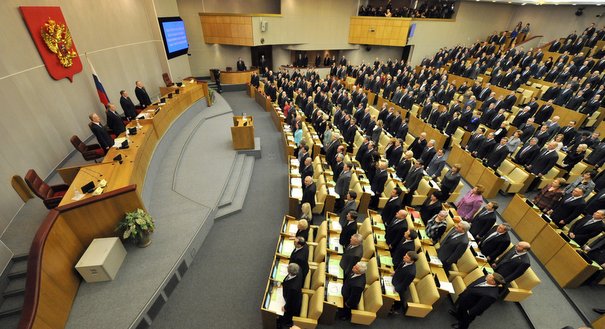
The series of United Russia interregional conferences are clearly part of a larger election campaign and will likely be used to help hasten early State Duma elections.
Source: The Moscow Times

At the conference, Putin announced development programs for the agricultural, automotive, fuel and energy sectors. He also announced a health care modernization program (460 billion rubles, or $15.1 billion, over two years), road repairs in the regional capitals (50 billion rubles) and a new federally funded housing program (424 billion rubles over the next five years).
In the past, the regional development strategy was put forward prior to gubernatorial elections. With the cancellation of direct elections for regional leaders, it was announced that each candidate for governor must submit a program. That didn’t work at all. Since last year, the government stopped discussing regional strategies at its meetings, announcing that strategies should first be adopted for the districts, with those integrated into regional plans adopted afterward.
Another important aspect is the interaction between government officials and party members at the federal level with those at the regional level. Apart from Putin, a large team of federal officials accompanies their regional counterparts. In Nizhny Novgorod, for example, the group includes three deputy prime ministers and six high-profile government ministers. This is a good school, enabling the government to familiarize itself with the situation in the regions and promoting links between Moscow and the regions.
The pendulum that swings between the capital and the regions is once again moving toward the regions. Immediately after the attacks waged against heavyweight governors and the dismantling of a number of political machines, the government has started handing out “favors.” In particular, Putin announced that it is “very necessary to decentralize business, social and cultural life.” He believes that the way to achieve that is to set ambitious objectives and to fulfill international commitments for “uplifting” the cities and regions: the 2012 Asia-Pacific Economic Cooperation Summit in Vladivostok; the annual political forum in Yaroslavl; business forums in Krasnoyarsk, Irkutsk and other cities; and the 2014 Winter Olympics in Sochi.
The series of United Russia conferences are clearly part of a larger election campaign. Will they help to hasten early State Duma elections, an idea recently put forward by Duma Speaker Boris Gryzlov? The eight conferences were originally planned to be held over a two-year period. At the same time, however, three have already been held in six months, and those currently under preparation could be held within another six months. Even if all eight are not held, it is clear that priority is given to those regions with the largest populations — Siberia and the Volga region — and those with the most pressing problems — the North Caucasus.
With the large-scale projects announced at the United Russia conference in Nizhny Novgorod clearly part of the election campaign, it would suggest that anything is possible at this point. Although the final decision regarding the possibility of early elections is likely to be made after the Oct. 10 elections, it looks like the authorities are seriously considering this option.
Former Scholar-in-Residence, Society and Regions Program, Moscow Center
Nikolay Petrov was the chair of the Carnegie Moscow Center’s Society and Regions Program. Until 2006, he also worked at the Institute of Geography at the Russian Academy of Sciences, where he started to work in 1982.
Recent Work
Nikolay Petrov
Nikolay Petrov
Carnegie does not take institutional positions on public policy issues; the views represented herein are those of the author(s) and do not necessarily reflect the views of Carnegie, its staff, or its trustees.