

Commentary
Nikolay Petrov
{
  "authors": [
    "Nikolay Petrov"
  ],
  "type": "legacyinthemedia",
  "centerAffiliationAll": "",
  "centers": [
    "Carnegie Endowment for International Peace",
    "Carnegie Russia Eurasia Center"
  ],
  "collections": [],
  "englishNewsletterAll": "",
  "nonEnglishNewsletterAll": "",
  "primaryCenter": "Carnegie Russia Eurasia Center",
  "programAffiliation": "",
  "programs": [],
  "projects": [],
  "regions": [],
  "topics": []
}
Source: Getty
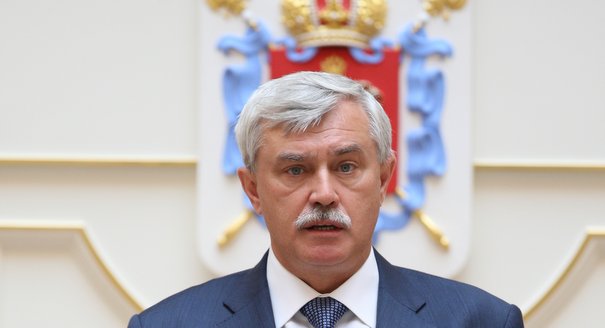
The political logic behind the decision to replace St. Petersburg Governor Valentina Matviyenko with Georgy Poltavchenko, the non-charismatic presidential envoy to the Central Federal District, remains unclear.
Source: The Moscow Times

If United Russia were suffering from low ratings in St. Petersburg and the unpopular Matviyenko was dragging the party even further down, why replace her with a gray, low-profile presidential envoy who has about as much charisma as State Duma Speaker Boris Gryzlov? For all of her shortcomings — and there were many of them — Matviyenko at least was a colorful and charismatic politician.
What’s more, the trio that United Russia has selected for its St. Petersburg ticket for the December Duma elections — Deputy Prime Minister Dmitry Kozak; Hermitage Museum director Mikhail Piotrovsky; Mariinsky Theater director Valery Gergiyev; or Sergei Bagnenko, a doctor who won the primaries — underscores how important it is for the authorities to boost United Russia’s flagging ratings in the region.
The reason behind the Poltavchenko appointment could have something to do with the elections in December and March. It would have been difficult to appoint a major political figure in the governor’s spot during the next presidential term, when it will be necessary to make painful social reforms.
There is a similarity between the Poltavchenko appointment and that of Mayor Sergei Sobyanin. Both capitals have thus been placed in the hands of individuals loyal to Prime Minister Vladimir Putin and who both come from outside the local political elite.
The shuffle may also be connected with the future fate of President Dmitry Medvedev, who could end up in St. Petersburg after the 2012 presidential election — perhaps as chairman of the Constitutional Court. His relationship with Matviyenko has been strained, to put it mildly, as it has with Kozak. But Medvedev’s relationship with Poltavchenko is more neutral and less personalized, as would be expected between a boss and one of his subordinates. And judging from his 10 years as a presidential envoy, even if he were to hold the St. Petersburg governorship post for years, Poltavchenko would never become a “master” — at least not in the sense that Matviyenko was or Anatoly Sobchak earlier.
Moreover, Poltavchenko’s appointment does not disrupt the equilibrium that has formed between the major St. Petersburg clans. What’s more, Poltavchenko apparently does not have his own team, nor does he have the resources to form one. Finally, Poltavchenko has far less experience than Sobyanin as a major political player and administrator.
Another possibility is that this is a package deal in which Poltavchenko is only a figurehead whose main function is to guarantee that the clans will reach agreement on the distribution of power. In that case, we will soon see new high-profile appointments to major posts from other political teams.
The Mironov-Matviyenko-Poltavchenko three-step has been taken directly from Putin’s 2007-08 playbook when he replaced big-name players with more obscure individuals from his reserve of loyalists. With this round of reshuffling just beginning, more high-profile changes undoubtedly lie ahead.
Former Scholar-in-Residence, Society and Regions Program, Moscow Center
Nikolay Petrov was the chair of the Carnegie Moscow Center’s Society and Regions Program. Until 2006, he also worked at the Institute of Geography at the Russian Academy of Sciences, where he started to work in 1982.
Recent Work
Nikolay Petrov
Nikolay Petrov
Carnegie does not take institutional positions on public policy issues; the views represented herein are those of the author(s) and do not necessarily reflect the views of Carnegie, its staff, or its trustees.