

{
  "authors": [
    "Akio Kawato"
  ],
  "type": "commentary",
  "centerAffiliationAll": "",
  "centers": [
    "Carnegie Endowment for International Peace",
    "Carnegie Russia Eurasia Center"
  ],
  "collections": [],
  "englishNewsletterAll": "",
  "nonEnglishNewsletterAll": "",
  "primaryCenter": "Carnegie Russia Eurasia Center",
  "programAffiliation": "",
  "programs": [],
  "projects": [],
  "regions": [],
  "topics": []
}
Source: Getty
Is Japan Back?—Yes, But What Kind of?
Japan is back as a modern post-imperialist power. True, she has many problems, but they are no larger than the problems which other nations suffer.
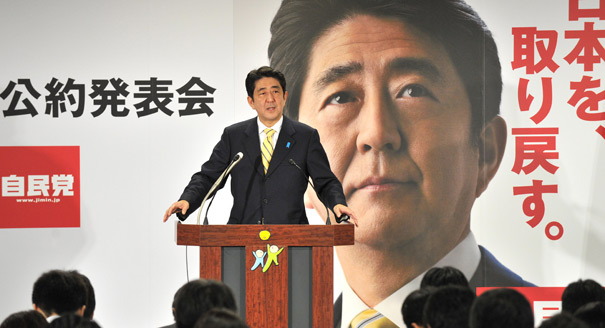
The Liberal Democratic Party (LDP), the erstwhile producer of the Japan’s post-war economic growth, has now firmly been reinstated in power, winning back in late July the majority of seats in the Upper House. It is the absence of majority in the Upper House that had caused annual replacement of the prime ministers in Japan. At last, the Japanese have garnered a “stable” government until next election, which comes only three years from now.
But remember that LDP mostly took advantage of the failure of the preceding Democratic Party’s government, and that the new economic initiatives of Prime Minister Abe have not yet brought tangible benefit for ordinary Japanese; the turn-out at the Upper House election was merely 52.61 percent, the third lowest in history.
Now assured of power for the coming three years, in-fighting within the ranks of the LDP will intensify. Whenever Abe’s rating goes down (he will have to tackle many divisive issues), opposing figures in the party will use this as a chance for him or herself to try to become prime minister (prime minister is elected from among the parliamentarians).
Abe alleges that his biggest task now is revitalizing the economy, but many know that he wants to change the Constitution, especially the overly pacifistic Article 9, which prohibits to possess armed forces for the use in settling international conflicts. Will Abe soon tackle this archi-task? It will not be easy in any case to amend the Constitution (it needs approval of two-thirds of the parliamentarians and a national referendum). And even if it be finally amended, this will not mean that pre-war militaristic Japan comes back.
Mr. Abe and the majority of the Japanese are well aware that the alliance with the United States is vital for the defense of Japan. In amending the Constitution what the majority of Japan’s political class want to achieve is merely the recognition as an army of Japan’s Self-Defense Forces (in reality, a full-fledged army), so that the latter can use arms when they take part in U.N. peace keeping operations abroad, and be subject to civilian control with the prime minister as commander-in-chief. Therefore, the only change Abe’s Japan will bring to the world political field is the stable representation of Japan by Mr. Abe; you can count on his words.
That is all about politics. Then what about the economy? That is a more important question, because the power which Japan emanates is mostly economic and cultural. Japan’s economy remains tenacious in spite of many problems. The earthquake and tsunami in 2011 have not lowered Japan’s GDP, and the overly high yen-rate has recently been corrected (it will facilitate export from Japan). So this year the World Bank predicts 1.4 percent of growth for Japan (2 percent for the United States and minus 0.6 percent for the EU). Today you may not see much of Japanese electronic goods around, but the thing is that high-value Japanese parts are hidden in most products, and that many electronic devices are built using Japanese machineries. Japanese car makers produce more than eight million cars annually, and abroad they produce twice as many. Nearly fifty percent of the Chinese export is done by foreign companies (the Japanese factories may well be contributing no less than one fourth of it), and Asian countries have formed a supply chain network of parts and semi-finished products, in which Japanese companies play a vital role.
As the economies of the BRICS are revealing systemic weakness, the role of the industrialized nations will be reevaluated. Today they still contribute 75 percent of the global foreign direct investments. And as the United States and the EU now seek to “exit” from monetary easing after the Lehman crisis, Japan’s role will be even greater; she has started a drastic easing policy and is now able to purchase governmental bonds of the United States and the EU, replacing China as the main financier; while China is now repatriating money from abroad.
Therefore, Japan as a multinational economic entity (something which exceeds the boundaries of conventional nation states) will keep growing, and Japan as a nation state in the classic sense of the word will become more noticeable with the stable representation by Mr. Abe. Yes, Japan is back as a modern post-imperialist power. True, she has many problems, but they are no larger than the problems which other nations suffer.
About the Author
Akio Kawato
Writer
Akio Kawato is a former Japanese diplomat and blogger.
Carnegie does not take institutional positions on public policy issues; the views represented herein are those of the author(s) and do not necessarily reflect the views of Carnegie, its staff, or its trustees.