

Commentary
Maria Lipman
{
  "authors": [
    "Maria Lipman"
  ],
  "type": "commentary",
  "centerAffiliationAll": "",
  "centers": [
    "Carnegie Endowment for International Peace",
    "Carnegie Russia Eurasia Center"
  ],
  "collections": [],
  "englishNewsletterAll": "",
  "nonEnglishNewsletterAll": "",
  "primaryCenter": "Carnegie Russia Eurasia Center",
  "programAffiliation": "",
  "programs": [],
  "projects": [],
  "regions": [],
  "topics": []
}
Source: Getty
It is common these days to talk about a rise of middle class revolts against their governments’ lack of respect for the citizens or their paternalistic practices. The main question remains: what makes such outbursts of civic sentiments successful and how one defines success?
Abuse of authority is a temptation that comes naturally to a successful leader. (Unsuccessful ones are not immune to this temptation either, but this is not the case of Erdogan’s Turkey.) The Turkish Prime Minister Recep Tayyip Erdogan gained power through democratic procedure and has presided over economic growth and a rise of living standards in his country. He reduced the power of the military. He made some progress toward making peace with the Kurds. And he consolidated his power and popularity in the course of three national elections. But he also suppressed media freedom and pursued increasingly undemocratic policies that have alienated the more secular, modernized urban population of Turkey. In the words of a Turkish historian, Erdogan evolved as a “control freak under the influence of too much success.” After a decade in power, he seems to have reached a limit. His citizens rose in large numbers to voice their deep dissatisfaction with Erdogan’s governance.
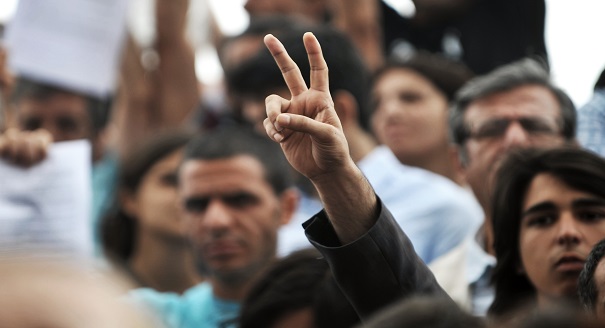
The numbers of the protesters, their endurance, fearlessness, and especially their solidarity are a message not just to Erdogan, but also to the participants of the protests themselves. Those Turks who took to the streets discovered that they are capable of a large-scale selfless commitment and generous self-help. The protesters in Istanbul also learned that their cause is eagerly shared by their compatriots in Ankara and other Turkish cities.
It is common these days to talk about a rise of middle class revolts against their governments’ lack of respect for the citizens or their paternalistic practices that alienate or exclude the urban, educated, and independent-minded. Indeed, over the past couple of years, mass protests erupted in Egypt and Tunisia, Russia, Turkey, Brazil, and Bulgaria. And now again in Egypt. This should probably be seen as a message to rulers of other nations where relative prosperity gives rise to “educated haves” whose “craving for a voice and respect” drives them to demand civil liberties, fair elections, or better governance.
The latest revolts are not an entirely new phenomenon. Some observers, like The New York Times’ Bill Keller, see earlier versions of these developments in China in 1989 or Venezuela in 2002. I would also add Serbia in 1996–1997. One can easily find similar and dissimilar features in all of these cases. The main question remains: what makes such outbursts of civic sentiments successful and how one defines success? The example of today’s Egypt shows that the yearned-for toppling of the leader and the establishment of a new regime (arguably a success of the mass uprising) rather than solving the country’s problems has led to further instability. In Russia where the protests have failed and the government is currently on the offensive against the civil society, it was common to hear from protesters that if only they would bring together hundreds of thousands or more, they would make a dramatic difference. These days scholars and political commentators in Russia talk about the society’s weakness, timidity, lack of solidarity, as well as very low demand for change. Yet it is not just about numbers or even the morale of the protesters. It is also about the regime itself—its confidence and ruthlessness, the loyalty, even if forced, of its elites, and the support it gets from the more conservative constituencies. Large numbers did not make a difference in 2009 in Iran where public protests were brutally suppressed. Nor did they make a difference in Turkey now. And this, too, is a message from Turkey. For all the solidarity and courage of the Turkish protesters’ revolt, Erdogan’s police crushed it down. Rather than responding to the protesters’ grievances, Erdogan threatens them with retributions. Yet maybe the new sense of togetherness and citizenship experienced by the modernized Turks should be seen as success in its own right—something that would eventually help them transform their country into a more wholesome democracy.

Former Scholar in Residence, Society and Regions Program, Editor in Chief, Pro et Contra, Moscow Center
Lipman was the editor in chief of the Pro et Contra journal, published by the Carnegie Moscow Center. She was also the expert of the Carnegie Moscow Center’s Society and Regions Program.
Recent Work
Maria Lipman
Maria Lipman
Carnegie does not take institutional positions on public policy issues; the views represented herein are those of the author(s) and do not necessarily reflect the views of Carnegie, its staff, or its trustees.