

Commentary
Dmitri Trenin
{
  "authors": [
    "Dmitri Trenin"
  ],
  "type": "commentary",
  "centerAffiliationAll": "",
  "centers": [
    "Carnegie Endowment for International Peace",
    "Carnegie Europe",
    "Carnegie Russia Eurasia Center"
  ],
  "collections": [],
  "englishNewsletterAll": "",
  "nonEnglishNewsletterAll": "",
  "primaryCenter": "Carnegie Russia Eurasia Center",
  "programAffiliation": "",
  "programs": [],
  "projects": [],
  "regions": [],
  "topics": []
}
Source: Getty
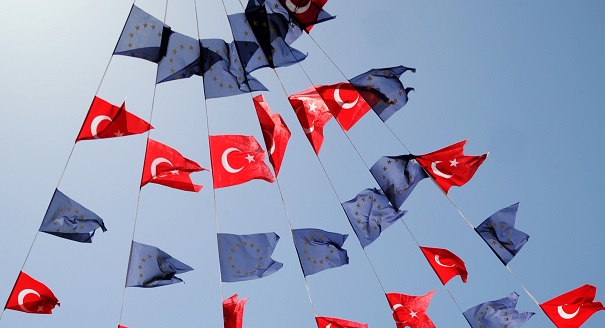
If the EU’s ambition were to be a mere trading bloc, it should be able to accommodate Turkey. If the Union, however, also aspires to be a political player, the rising power Turkey will hardly fit. The EU’s strategy must ensure that former Ottoman possessions in the Balkans eventually become part of Europe. As to Turkey, it should be turned into Europe’s close partner.
Turkey’s current instability is laden with geopolitical consequences. On the one hand, the rise of the protest movement highlights the yearning of the country’s educated urbanites—let’s call them Turkey I—for a more perfect democracy, their insistence on the secular character of the state, and a rejection of authoritarian style of governance. This activism suggests that the gap between Turkey and the European Union is narrowing, on the level of the advanced groups of society. If such reading of the Turkish developments is correct, then the Union needs to conclude that its soft power is working, and intensify its contacts with Ankara, drawing Turkey into ever tighter integration with, and eventually into the EU.
On the other hand, the protestors, while active and vocal, represent a minority of Turkey’s electorate. Prime Minister Erdogan’s Justice and Development (AK) party has won three elections in a row, plus a constitutional referendum. The current protests notwithstanding, Turkey’s silent majority—let’s say, Turkey II—is with Erdogan. This is a clear result of his policy of economic reform, which spurred the country’s economic growth, empowered private businessmen, and raised the purchasing power of the entire population. Pro-business as he is, Erdogan, however, is also an Islamist leader who dreams of Turkey as a regional power. Both Islamist identity and regional ambitions distinguish today’s Turkey.
With this in mind, should the EU pressure Erdogan on human rights in the hope of correcting his behavior and giving Turkey I a chance, or should it concede victory to Turkey II and use the recent developments as an excuse to suspend Turkey’s EU accession process, which is highly unpopular in a number of European countries, including Germany and France? Most likely, Europe will avoid a clear choice and continue to be half-hearted and ambivalent on Turkey. Erdogan will be spared serious criticism, but Turkey will not get appreciably closer to the goal it has been pursuing since 1964.
It is not that Europe does not understand geopolitics anymore. Today’s accession of Croatia to the EU, and the announced start of accession talks next January with Serbia suggest otherwise. Europe is not entirely oblivious to the geopolitical value of Ukraine either. The issue is strategy. If the EU’s ambition were to be a mere trading bloc, it should be able to accommodate Turkey. If the Union, however, also aspires to be a political player, the rising power Turkey will hardly fit. The EU’s strategy must ensure that Croatia, followed by Serbia, Bosnia and Herzegovina, Montenegro, Albania, and other former Ottoman possessions in the Balkans eventually become part of Europe. As to Turkey, it should be turned into Europe’s close partner.
Former Director, Carnegie Moscow Center
Trenin was director of the Carnegie Moscow Center from 2008 to early 2022.
Recent Work
Dmitri Trenin
Dmitri Trenin
Carnegie does not take institutional positions on public policy issues; the views represented herein are those of the author(s) and do not necessarily reflect the views of Carnegie, its staff, or its trustees.