

{
  "authors": [
    "Tedo Japaridze"
  ],
  "type": "commentary",
  "centerAffiliationAll": "",
  "centers": [
    "Carnegie Endowment for International Peace",
    "Carnegie Russia Eurasia Center"
  ],
  "collections": [],
  "englishNewsletterAll": "",
  "nonEnglishNewsletterAll": "",
  "primaryCenter": "Carnegie Russia Eurasia Center",
  "programAffiliation": "",
  "programs": [],
  "projects": [],
  "regions": [],
  "topics": []
}
Source: Getty
Change Since 2008. Everything and Nothing
“Returning to Europe” is meaningful for Georgia. The Russian option is but a threat.
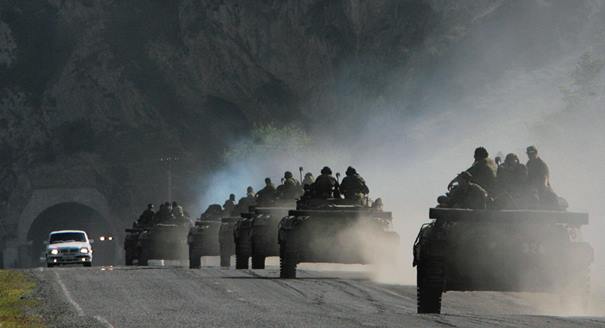
Five years have elapsed since 2008, when Georgia lost 20 percent of its sovereign territory and was shunned from NATO membership. Since then, hundreds of thousands of internally displaced persons (IDPs) have no access to their homes; the regimes of the occupied territories have added barbed wire across the areas of their de facto control. Meanwhile, Georgia is often portrayed as the “perennially aspirant” NATO member. Nonetheless, polls in Georgia indicate that the commitment to a western trajectory remains unwavering. A taboo question is “why?”
Russia will continue to neighbor Georgia—neither of us can change our geography; that is inescapable. There are one million Georgians living in Russia, sending remittances vital to the Georgian economy. The Russian language is still spoken both by the highly educated and working class people. We are two deeply religious societies, of the same faith. So, “why indeed” is there no pro-Russian force at Stalin’s and Beria’s birthplace?
Engagement as such is not in vain. As of recent, the Russian prime minister indicated that the “borderization” of secessionist entities was not Kremlin policy. Ultimately, this is a realistic approach. In 2008, President Saakashvili misguidedly tried to counterbalance strategic asymmetry with tactical maneuvering, playing into a Russian trap. However, Georgia’s loss is not straightforwardly Russia’s gain. Moscow is held hostage to vested interests in Russia and client regimes it needs to support with cash and fuel subsidies; in kick-starting nation-building projects in the region, the Kremlin has to deal with domino effects in the North Caucasus. Bottom line: Moscow, unlike Brussels, does not have a “Neighborhood Policy.”
This is in fact bad geopolitics: no war can be won without a “peace theory.” Georgia’s Euro-Atlantic trajectory is uncontested, quite decoupled from either “sticks” or “carrots.” It provides the polity with a sense of direction and intervals of achievement, the promise of higher human rights standards and opportunity for upward social mobility. “Returning to Europe” is meaningful. The Russian option is but a threat—a threat to our independence, sovereignty, and the capacity-building to become a normal, relevant, and democratic state. At least these are the perceptions on Georgian minds. While anyone with a sense of realism admits that a modus vivendi must be found, being intimidated into a choice hardly constitutes an “alternative trajectory.”
Tedo Japaridze is chairman of the Committee on Foreign Relations in the Parliament of Georgia.
About the Author
Tedo Japaridze
Member, Georgian parliament
Tedo Japaridze is a member of the Georgian parliament, former ambassador, and chairman of the Foreign Relations Committee.
Carnegie does not take institutional positions on public policy issues; the views represented herein are those of the author(s) and do not necessarily reflect the views of Carnegie, its staff, or its trustees.