

Commentary
Alexander Baunov
{
  "authors": [
    "Alexander Baunov"
  ],
  "type": "commentary",
  "centerAffiliationAll": "",
  "centers": [
    "Carnegie Endowment for International Peace",
    "Carnegie Russia Eurasia Center"
  ],
  "collections": [],
  "englishNewsletterAll": "",
  "nonEnglishNewsletterAll": "",
  "primaryCenter": "Carnegie Endowment for International Peace",
  "programAffiliation": "",
  "programs": [],
  "projects": [],
  "regions": [],
  "topics": []
}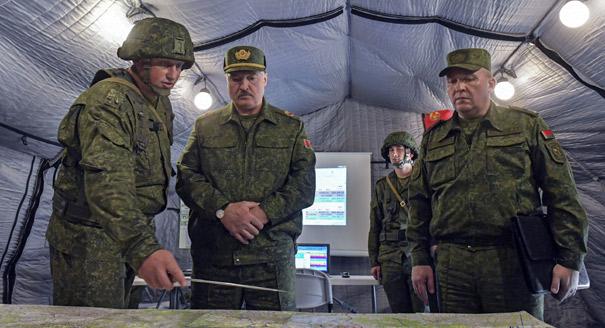
Source: Getty
Any internal political activity is becoming conclusively geopoliticized. Elections in Belarus or Russia, for example, are not an expression of feedback between the public and the government, but an act of defensive foreign policy.
Russian President Vladimir Putin has finally broken his silence of more than two weeks regarding the protests in Belarus sparked by a contested presidential election there. On the weekend, a state TV channel aired a lengthy interview with him, in which it was acknowledged that since there are protests, there must be some problems. It was made clear, however, that the solution to those problems must not change the global power balance to the detriment of the Kremlin. The relationship between Belarusian President Alexander Lukashenko and his people is an internal matter—so long as it remains within the geopolitical status quo. If it changes that status quo in a way that does not benefit Russia, it will stop being an internal matter and will warrant intervention. Crucially, the forcible removal of a dictator who is not pro-Western is in itself viewed as a disturbance of that balance, and would turn the problem from an internal affair into an external one.
What’s happening in Belarus is now being willfully reduced to the all too familiar formula of a choice between a dictator and pro-Russian stance versus the opposition and a pro-European path. By supporting Lukashenko in his interview, Putin once again confirmed that the legitimacy of any foreign regime is calculated not by the transparency of procedures or the popularity of the leader, but by whether or not the previous distance between that country and the West is preserved. If it is, then that regime is legitimate. If that distance is decreased, then the regime’s legitimacy is in doubt.
Putin’s attitude toward the Belarusian regime sheds light on how he sees his own power and its inherent potential for the use of force. Authority in Russia is legal so long as it is indomitable: i.e., so long as it retains its independence from the West. The use of force is justified if its end goal is maintaining that distance, while challengers who want to reduce the distance are dangerous idealists or traitors.
For two weeks, the Kremlin watched closely to see whether Lukashenko was determined enough to cling on to power, whether there was a split within the elite, whether the security services would betray him. Satisfied that Lukashenko was indeed determined enough, and that there was no division, the Kremlin made the decision once and for all to support him. After all, there’s no other visible candidate who would better guarantee the Union State that Russia and Belarus form, or who would keep Belarus the same distance—or further—from the West.
It should be said that even a schism within the elite or security services wouldn’t necessarily be a signal for Lukashenko to step down, in the eyes of the Kremlin. Syria’s Bashar al-Assad, Libya’s Muammar Gaddafi, and Venezuela’s Nicolas Maduro refused to step down even when faced with internal divisions, and in Putin’s book they were right to do so.
The EU, for its part, is so far unable to formulate a proposal for Belarus, having been stung by its experience in Ukraine, not least by Russia’s reaction there. Right now, the EU is weakened by Brexit and the new coronavirus pandemic, and has even fewer opportunities to punish Russia or reward protesting Belarus.
Russia’s state media has switched from its earlier, relatively honest portrayal of the protests as “Belarus is not Ukraine” to “in Belarus, just like in Ukraine…” The conundrum for Russia of a “friendly people versus a friendly regime” in Belarus has been solved using the most primitive means: of the two friends, the real one was declared to be the regime. And somewhere in Belarus, that regime is quietly supported by the “right” kind of people, the Kremlin’s logic goes. Those people who are loudly opposing the regime will reveal their enmity sooner or later. And if they don’t, it can always be ascribed to them. Any symbols used by the protesters that differ from state emblems are gradually, at Lukashenko’s instigation, being labeled as fascist.
Even Russian domestic public opinion, which is tired of Putin, still professes twice as much support for Lukashenko (over 50 percent of Russians) as for the protesters (about 25 percent). This was also significant when the decision to support Lukashenko was being taken.
Judging by this rapid simplification of events in Belarus, the Kremlin won’t complicate matters for itself when the issue of power in Russia arises. The version of events eventually selected for Belarus is the default one of a color revolution fomented by foreign powers, which corresponds most closely to the polarized perception of the world as a geopolitical standoff between its rulers and those who refuse to be ruled. Similarly, within Russia itself, after some brief consideration, the plan enacted earlier this year was the most straightforward option: restarting the clock on presidential terms, allowing Putin to stay in power beyond the end of his current term in 2024.
The ease with which this constitutional reform was enacted, together with the reinterpretation of protests in Belarus, suggest that Putin may solve any questioning of his power with the simple formula “Let’s ask the people whether or not they want me to be president.” But if people suddenly respond, as they have in Belarus, that they do not want that, their response will fall on deaf ears. As soon as they give the wrong answer, Russians will begin to be defined not as citizens, but as the willing or unwilling collaborators of an external foe.
This is the conclusive geopoliticization of any internal political activity. It simplifies any unpleasant decision: elections, for example, are not a question of power, or an expression of feedback between the public and the government, but an act of defensive foreign policy, and therefore election results should be treated accordingly. The same approach should be taken to freedom of assembly and publication, investigations into doping scandals, feature films, investments, and so on.
The internal political agency of the Belarusian people is important, but less so than the external political agency of the Belarusian state as a player in the global power balance. Demands for freedom can be accommodated—as long as they don’t conflict with the task of maintaining the geopolitical equilibrium. The same goes for the demands of the Russian people. Both Belarusians and Russians are a resource in the resistance to the global hegemony, so the most important thing is that this precious resource doesn’t fall into the wrong hands.
This external political framework changes the form and content of any internal activity. Russia’s leading foreign policy expert is Putin, and he decides everything like a geopolitical strategist, including the issue of his own power, and the power of a neighboring autocrat.

Senior Fellow, Editor-in-Chief, Carnegie Russia Eurasia Center
Baunov is a senior fellow and editor-in-chief at the Carnegie Russia Eurasia Center.
Recent Work
Alexander Baunov
Alexander Baunov
Carnegie does not take institutional positions on public policy issues; the views represented herein are those of the author(s) and do not necessarily reflect the views of Carnegie, its staff, or its trustees.