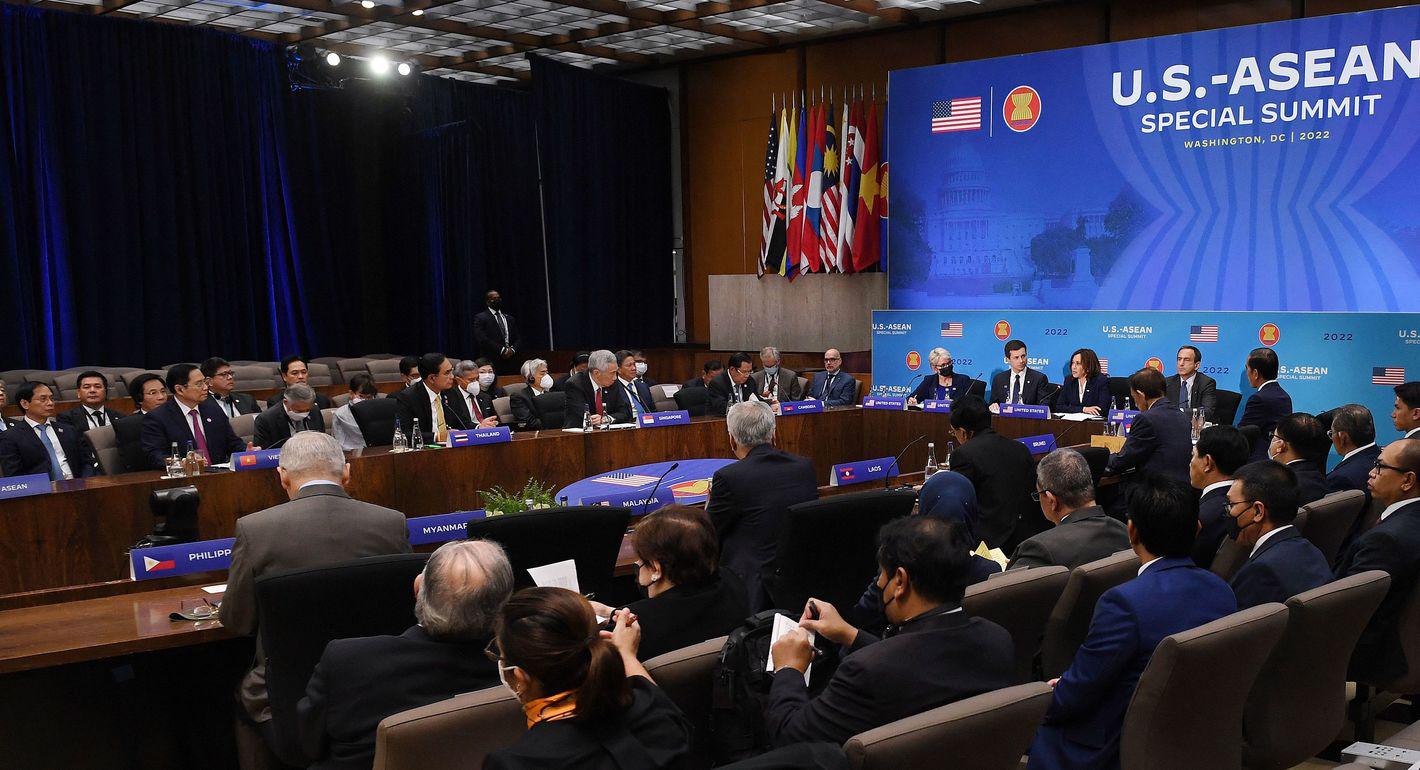
On a recent episode of the China in the World podcast, Paul Haenle spoke with Hoang Thi Ha, Senior Fellow and the Co-coordinator of the Regional Strategic and Political Studies Programme at the ISEAS-Yusof Ishak Institute, about China’s growing influence and diplomacy in Southeast Asia. A portion of their conversation, which has been edited and condensed for clarity, is below.
Paul Haenle: In a recent article for Think China, I was struck by something you wrote about how Southeast Asian countries stand to benefit from the competitive dynamic between the United States and China. This is not a view you hear often from officials in the region. Some worry that great power competition will have mostly negative externalities. So, help me understand your argument. Is it that the United States and China will compete to provide positive inducements to the region? How will this play out?
Hoang Thi Ha: There are certainly negative externalities for the region. We are all concerned about the fallout from U.S.-China strategic competition in terms of economic as well as security implications. But that should not prevent us from looking at the more positive side of the game. Great power competition is not only about prevailing over the other side in military terms but also about running faster and winning over more allies and partners. And that involves providing positive inducements. In the end, I think it boils down to this question: Between the United States and China, and their respective governance systems, which country will excel at delivering economic growth, political stability, and social mobility at home, while enabling solutions to global challenges and responding to the world’s development needs.
So positive inducements are not simply a matter of giving handouts or providing more aid; they are about being part of the success story of regional countries and enabling their development and economic growth through trade, investment, capacity building, and technology transfer. The United States did this exceptionally well during the Cold War with the Soviet Union. In this century, China stands a good chance of success as well.
We all know that Southeast Asia is economically and geopolitically attracted to both Washington and Beijing. And Southeast Asian countries have leveraged this U.S.-China competitive dynamic to their benefit. For example, Southeast Asia was a priority region for both the United States and China’s vaccine diplomacy and pandemic response in 2020. Recent statistics show that Indonesia, Vietnam, and the Philippines are among the top 10 recipients of both American and Chinese vaccine donations. China’s vaccine sales accounted for almost 70 percent of Indonesia’s vaccine portfolio in 2021. In the case of Cambodia, it was almost 90 percent. This facilitated a timely vaccination program and early opening of Cambodia’s borders in 2021. China’s vaccine diplomacy was very much a success story regardless of the reservations about the lower efficacy rates of Chinese vaccines as compared to mRNA vaccines.
Another important development to watch is that both the United States and China are seeking to dovetail their development assistance and foreign policy goals with their domestic growth agenda. This domestic development agenda increasingly focuses on green development, clean technologies, climate solutions, and the digital economy, which will open up new opportunities for growing collaboration, investment, and capacity building with ASEAN countries going forward.
The United States also is stepping up collaboration with its allies and partners through the Quad and other ad hoc arrangements such as “Quad Plus” and “Quad Minus” to scale up their capabilities in offering regional public goods in areas such as Covid-19 vaccines, energy security, critical technologies, and supply chain resilience. Although these initiatives are shrouded in geopolitics and countering Chinese influence, this positive agenda will potentially steer U.S. competition with China in a more responsible and healthy manner rather than a purely militarized approach.
For more, listen to the full episode and subscribe to the China in the World podcast.