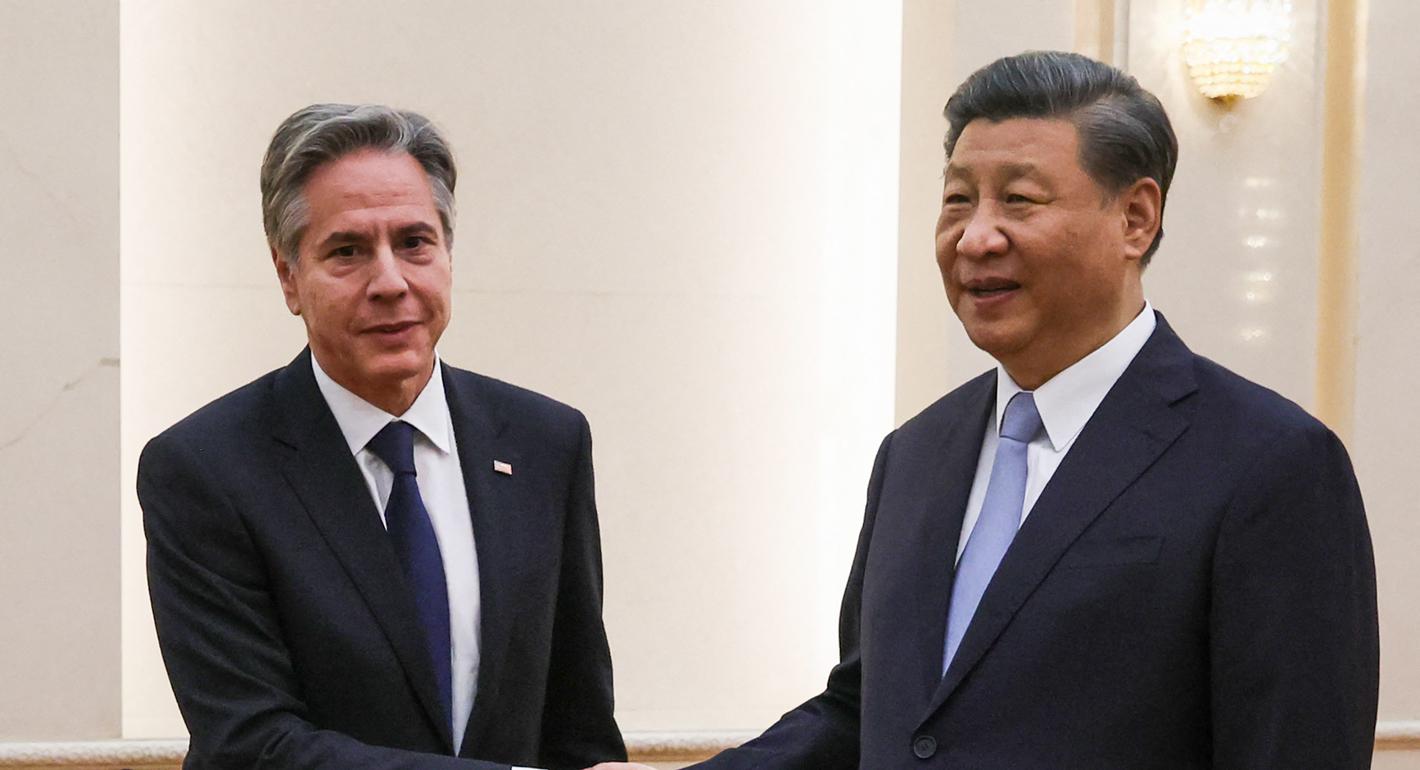
This Q&A was adapted from a Carnegie live event assessing U.S.-China relations following U.S. Secretary of State Antony Blinken’s visit to China. It has been edited for clarity.
Paul Haenle: Our friend, Bonnie Glaser, put out a Tweetshortly after Secretary of State Antony Blinken’s visit to China, focusing on thereadoutof his meeting with Chinese President Xi Jinping. She noted with concern that Xi stated “competition among major powers does not conform to the trend of the times.” The Biden administration has been trying to convince the Chinese side to accept its framework of competition as the mainstay of the relationship, while also recognizing that it is essential to work together and to prevent competition from veering into conflict. Part of the reason that China may not be willing to reopen military-to-military channels may be related to this philosophical disagreement between China and the United States. Clearly, China is competing with the United States. You and I can come up with a dozen examples of how Beijing is competing quite intensively. But why are Chinese officials so unwilling to accept the notion of competition in U.S.-China relations?
Dennis Wilder: We all know about the idea of American exceptionalism—our belief that we are a shining city on a hill; that democracy is a far better system of government than autocracy. This has been part of our narrative throughout American history. John Kennedy and other presidents referred to it. China also has a version of exceptionalism. It can be seen in what Xi Jinping calls the “Global Civilization Initiative.” Beijing views itself as the world’s first ancient civilization with a 5000-year continuous history. China is starting to say that its model can be one for the world in a way that it hasn’t said in recent history. In not only the “Civilization Initiative” but also the “Global Security Initiative,” China has put forward a notion of win-win cooperation, common humanity, and a peaceful world. So, for Xi Jinping it is very difficult to accept the notion of competition. For him, competition is an American idea, and in a competition, there can only be one winner. They see it as a race where there is going to be a loser and there’s going to be a guy that gets the medal. The Chinese don’t like that metaphor. So I think that what you saw in the recent visit between Antony Blinken and Xi Jinping was partially this philosophical position; that we need to find a way for us all to win in this competition. To some degree, this framework of competition would better serve China’s interests.
We are seeing more and more that Xi Jinping is cloaking himself in China’s history in a way that Mao Zedong and other modern Chinese leaders never did because they rejected their dynastic history. I would have you look at thevideoof the recent China-Central Asian Summit in Xi’an. If this wasn’t an imperial event, I don’t know what is. Xi Jinping is wrapping himself in China’s imperial history in ways that I think we need to start looking at. I don’t think we can understand Xi Jinping if we don’t understand that history.
Former Maurice R. Greenberg Director’s Chair, Carnegie China
Paul Haenle held the Maurice R. Greenberg Director’s Chair at the Carnegie Endowment for International Peace and is a visiting senior research fellow at the East Asian Institute, National University of Singapore. He served as the White House China director on the National Security Council staffs of former presidents George W. Bush and Barack Obama.
Dennis Wilder
Dennis Wilder is a senior fellow for the Initiative for U.S.-China Dialogue on Global Issues at Georgetown University, where he previously served as the managing director.
Carnegie does not take institutional positions on public policy issues; the views represented herein are those of the author(s) and do not necessarily reflect the views of Carnegie, its staff, or its trustees.
More Work from Carnegie Endowment for International Peace
China’s latest energy plan explicitly calls for integrating data centers into the electricity system, particularly connecting them to green energy. It appears Beijing wants to use compute as a source of domestic demand to absorb renewables excess capacity.
U.S. unpredictability has allowed China to capitalize on its positioning as the “responsible great power”. Paradoxically, the more China wins the perception game, the more likely expectations will rise for Beijing to deliver not just words but to demonstrate with its deeds.
Hanoi and Beijing have long treated each other as distant cousins rather than comrades in arms. That might be changing as both sides draw closer to hedge against uncertainty and America’s erratic behavior.
Across Asia, China is better positioned to withstand energy shocks from the fallout of the Iran war. Its abundant coal capacity can ensure stability in the near term. Yet at the same time, the country’s energy transition away from coal will make it even less vulnerable during the next shock.