On our latest Twitter Spaces discussion on July 19, 2023, Paul Haenle spoke with Evan Medeiros, professor and Penner family chair in Asia studies in the School of Foreign Service at Georgetown University; Ian Chong, nonresident scholar at Carnegie China; Dennis Wilder, senior fellow for the Initiative for U.S.-China Dialogue on Global Issues at Georgetown University; and Amanda Hsiao, senior analyst for China at Crisis Group, about the status of U.S.-China relations. A portion of their conversation, which has been edited and condensed for clarity, is below.
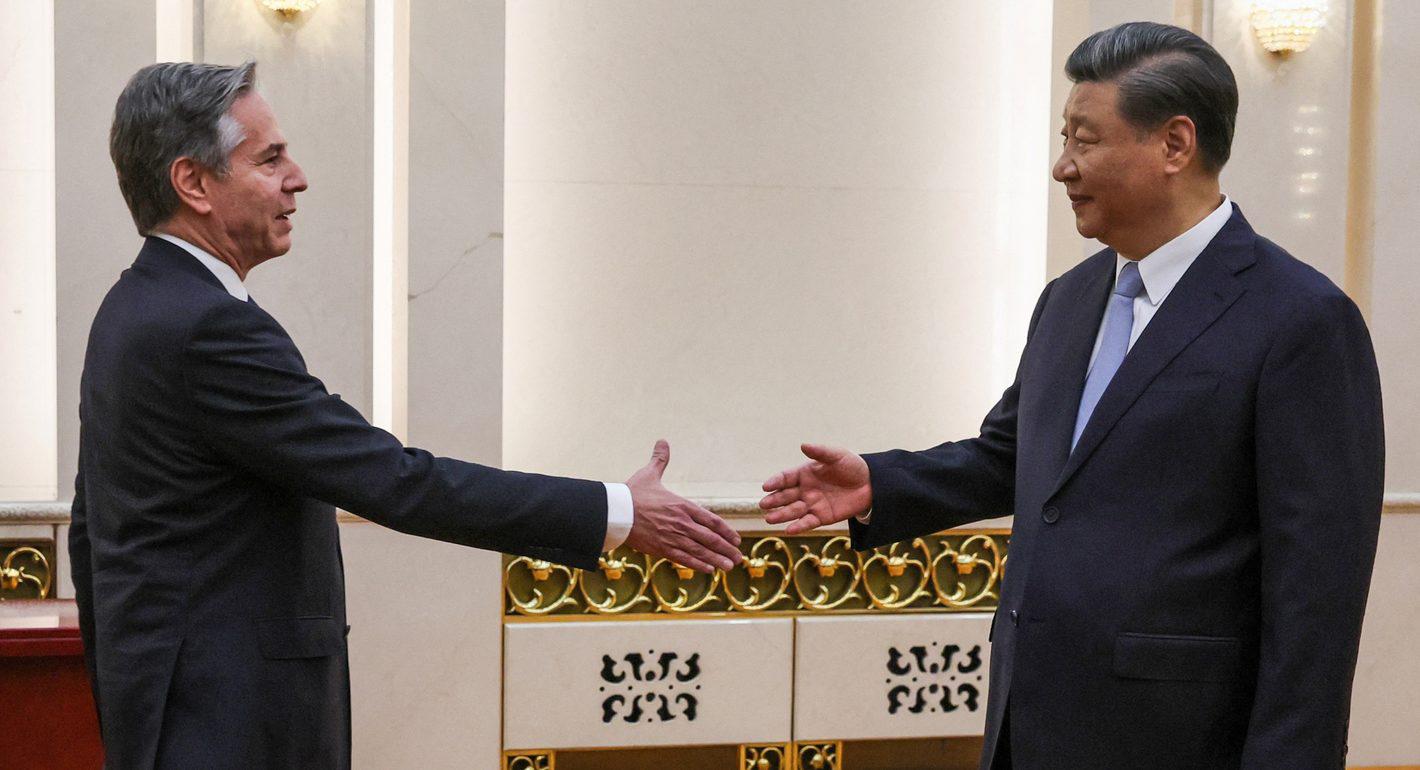
Paul Haenle: In recent months, high-level dialogue has resumed with Secretary Antony Blinken, Secretary Janet Yellen, and Climate Envoy John Kerry’s visits to Beijing. How would you describe the current state of the U.S.-China relationship, and what impact will this renewed diplomatic contact have on stabilizing the relationship? Will the impact of the visits be short-lived or will it have a longer lasting impact?
Evan Mederios: We are in a period of reconnection. Where that reconnection takes us remains an open question. The reconnection has stopped the deterioration that occurred in the first half of 2023. Whether that reconnection opens a new phase in the relationship remains to be seen.
I choose the word “reconnection” deliberately because it is a process of U.S. officials, Chinese officials, businesspeople, scholars, and students starting to interact with each other more. But of course, the core of the relationship is a series of competitive dynamics. The broader process ongoing is one that I consider to be negotiating competition: both sides are exploring the areas of competition, trying to understand the areas of relative importance, what risks and costs are important to the other side, and where the boundaries are. And I think we are going to be in this period of negotiating competition for quite a while, absent an exogenous shock, like the spy balloon incident, that could lead to rapid deterioration.
So it’s a fragile reconnection, and both sides are oriented toward negotiating the terms of competition. That’s where I think we are today.
Chong Ja Ian: In terms of the broad description of events, I would agree with Evan. But there are a variety of somewhat different views in Southeast Asia. There is a sigh of relief that there is more contact. There is a hope that U.S.-China relations will get better from here on. Whether that is the case or not, it may be too early to tell.
Renewed contacts mean that there may be a floor to U.S.-China competition. There may be ways to address potential miscalculations or the potential for unintended escalation. It’s not a hard floor, but at least there is something, a guardrail maybe. It is tentative right now, and there’s no concrete proposal for cooperation put out there. But it’s stable for now.
I suppose there are others who are a bit more anxious about if we are going to see a balloon incident or another exogenous shock as Evan put it. That could throw things into disarray again.
Smaller actors in the region feel that they have less role to play, and there is concern about getting caught in between when the major powers go at each other.
Dennis Wilder: I agree with everything that has been said. An important aspect is that with Secretary Yellen’s visit, U.S. officials began to meet Chinese officials whom they didn’t know that are now in important positions. Yellen spent time with her counterpart who is quite a mystery to Americans and many foreigners. If Gina Raimondo visits China, that will also create ties with Chinese officials who have taken up positions after the 20th Party Congress and the National People’s Congress.
Second, Taiwan’s 2024 election could be a spark for new problems in the relationship. Like the balloon incident, we could have something blow up, so I wouldn’t get too optimistic at this point.
Finally, right now, it is all American officials going to China, and no senior Chinese officials coming to the United States. That needs to change if we’re going to see bilateral ties stabilize. So far, there have been no indications or announcements that any members of Xi Jinping’s cabinet are coming to Washington. And I think that shows that this is a very fragile reset of the relationship.
Amanda Hsiao: I totally agree with what Evan said about setting or finding the terms of the U.S.-China relationship. For me, what will be interesting is that there is going to be an ongoing probing of how far the other side will go on both the competitive and the cooperative front. There will be an attempt to see the degree to which each side can influence the policy of the other side during this period. What was telling about Climate Envoy Kerry’s recent visit is that, of course, China has always been opposed to the U.S. proposal to compete and cooperate at the same time. It will be interesting to watch how far cooperation on climate change can actually go. Xi is sending signals that China will pursue climate change at its own pace. And the statement Wang Yi made today during his meeting with Kerry reiterated that cooperation on climate change can’t be separated from the broader environment of the China-U.S. relationship. I think we need to see if there is any adjustment on the Chinese side.
From Taiwan’s perspective, Taiwan is focused right now on its presidential elections. I think to some extent, having a more stable U.S.-China relationship is beneficial to Taiwan. Taiwan has not been fully in the driver’s seat of certain developments in U.S.-China relations in the last year, or in the last couple of months. So there is probably a degree of relief around that.
Of course, Taiwan will be closely watching how the U.S. discusses Taiwan in U.S.-China meetings. There were media reports about Blinken stating that the U.S. does not support Taiwan independence, which of course is a long-standing policy, but nevertheless, there will be murmurs in Taipei.