

Commentary
Alexandra Prokopenko
{
  "authors": [
    "Alexandra Prokopenko"
  ],
  "type": "commentary",
  "blog": "Carnegie Politika",
  "centerAffiliationAll": "dc",
  "centers": [
    "Carnegie Endowment for International Peace",
    "Carnegie Russia Eurasia Center"
  ],
  "collections": [],
  "englishNewsletterAll": "ctw",
  "nonEnglishNewsletterAll": "",
  "primaryCenter": "Carnegie Russia Eurasia Center",
  "programAffiliation": "russia",
  "programs": [
    "Russia and Eurasia"
  ],
  "projects": [],
  "regions": [
    "East Asia",
    "China",
    "Russia",
    "Caucasus"
  ],
  "topics": [
    "Foreign Policy",
    "Economy",
    "Political Reform",
    "Domestic Politics"
  ]
}
Source: Getty
Russia is swapping its dollar dependence for reliance on the yuan. Should relations with China deteriorate, Russia may face reserve losses and payment disruptions.
One of the biggest problems Russia is currently facing is managing its foreign trade transactions. The country’s main banks have been cut off from SWIFT; the number of transborder transaction channels has decreased drastically; and it has become much harder to conduct transactions in dollars and euros. The government is being forced to look for new ways to get paid for Russia’s exports and to pay for imports.
The authorities and businesses have tried switching to national currency transactions, barter deals, cash payments, and other schemes, but were unable to find a comprehensive solution in 2022. Efforts have now clearly shifted to cryptocurrencies and yuan payments, which means the Russian economy will grow increasingly dependent on the Chinese currency, with all the risks such a shift entails.
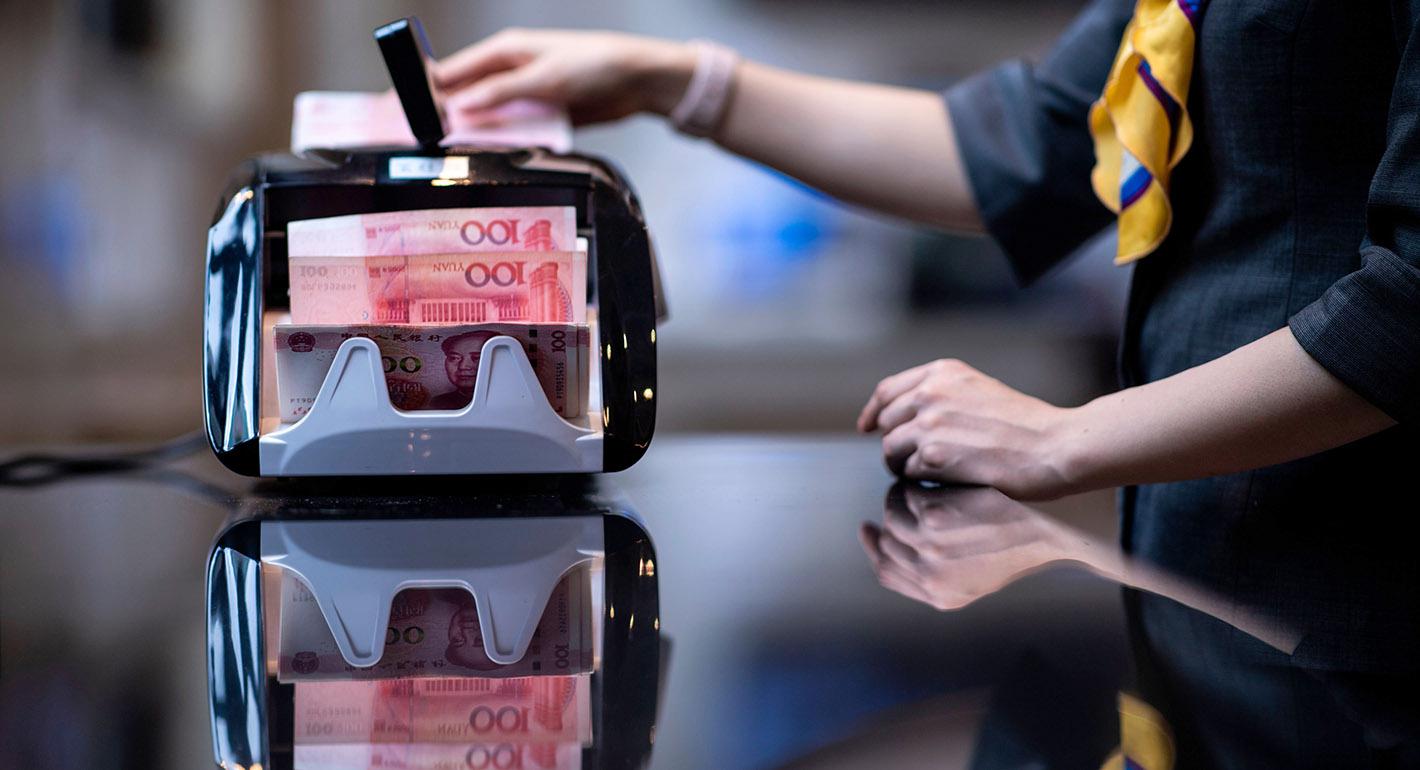
Even before the war, Russia’s central bank aimed to reduce the country’s dependence on Western currencies, particularly the U.S. dollar. The invasion and subsequent sanctions have forced Russian financial officials to accelerate those efforts: in the third quarter of 2022, the proportion of foreign currency in the Russian banking system fell to an all-time low of 15 percent. In nine months, the share of dollar and euro transactions on the Russian market declined from 52 percent to 34 percent and from 35 percent to 19 percent, respectively. They have been replaced by ruble and yuan payments, which have seen respective increases of 12.3 percent to 32.4 percent and 0.4 percent to 14 percent. The yuan’s share in stock market trading has also skyrocketed: from 3 percent to 33 percent.
From January 13 to February 6, the Finance Ministry plans to sell foreign currency worth 54.5 billion rubles by tapping into its 3.1-trillion-ruble reserves of yuan liquid assets, which make up over 40 percent of distributable liquid assets in the National Wealth Fund. It’s still an insignificant sum, which amounts to less than 3 percent in Russia’s yuan circulation in the last three months. Nevertheless, it will mean reduced volatility for the ruble.
The Finance Ministry also revised the structure of the National Wealth Fund currency component at the end of 2022, doubling its yuan share to 60 percent. Any surplus oil and gas revenues in 2023 will be accumulated in yuan. The de-dollarization of the economy, which the Russian authorities are so proud of, essentially translates into “yuanization.” Russia is drifting toward a yuan currency zone, swapping its dollar dependence for reliance on the yuan.
This is hardly a reliable substitution: now Russian reserves and payments will be influenced by the policies of the Chinese Communist Party and the People’s Bank of China. Should relations between the two countries deteriorate, Russia may face reserve losses and payment disruptions.
It’s believed that the yuan can’t become a full-fledged reserve currency because of the current restrictions on capital transactions in China. It constitutes just 3 percent of global currency reserves, overshadowed by the dollar (60 percent) and the euro (20 percent). But Russia’s growing dependence on the yuan is helping the Chinese authorities to make it into an international reserve currency. Last October, Russia became the fourth largest offshore trading center for yuan, though back in April it wasn’t even in the top fifteen for offshore yuan users.
Russian politicians often mistakenly claim that the yuan’s international expansion foreshadows the dollar’s collapse. In fact, higher yuan internationalization means that the Chinese government needs more dollar reserves. The Chinese authorities need the U.S. currency to support the yuan’s stability on offshore markets, primarily in Hong Kong. Accordingly, the yuan’s strength as a reserve currency doesn’t weaken the dollar; rather, the two currencies complement each other. This means that Beijing can’t really help Moscow in its crusade against the dollar.
Russian-Chinese cooperation on cryptocurrencies will also intensify. Right now, Russia is just testing cryptocurrency payments for foreign trade transactions, but the central bank plans to develop a model for transborder payments using the digital ruble (a central bank digital currency, or CBDC) this year. There are two options on the table: bilateral agreements on integrating CBDC platforms, or connecting the country to a unified integrated platform.
The first option has a more specific focus, on using the digital ruble to make transborder payments. In this case, international agreements could impose limitations on the payments’ purpose and amount. Under the second option, the platform would have common standards and communications protocols, and that’s what less CBDC-advanced states will adhere to. This second option is quite risky, as foreign fiat-currency-pegged CBDC may attract countries with unstable inflation and currency exchange rates.
Whichever option Russia chooses, China is the only possible partner. The country’s digital transactions through the Alipay and WeChat Pay platforms reached 166.1 trillion yuan in 2019 ($23.8 trillion). In addition, China has been testing the CBDC E-CNY prototype as the third form of money to be used inside the country. As of the fall of 2022, about 140 million Chinese people had E-CNY digital wallets, and their transactions exceeded 62 billion yuan ($9 billion). As the more technologically advanced party, Beijing is likely to establish its own rules for the platform, relegating Moscow to a less important position.
Russian leaders like to emphasize the unprecedented strategic cooperation between the two countries. Yet in reality, this cooperation makes Moscow increasingly dependent on Beijing.
Russia offers a fairly liquid market for Chinese goods, and Western sanctions have made Beijing Russia’s main trade partner. Chinese companies are joining parallel import programs, trying to replace the Western companies that have left the Russian market. Eleven out of fourteen brands on the Russian automobile market are Chinese, for example. Chinese products accounted for 40 percent of Russian imports of goods at the end of 2022, and only North Korea is more dependent on Chinese imports now than Russia. In addition, the Chinese UnionPay system is the only way Russians can use bank cards overseas.
Contrary to Moscow’s expectations, China has failed to help Russia circumvent sanctions. While not joining the sanctions, Beijing has complied with them. In the future, Russia’s economic dependence on China will only grow, meaning the Kremlin will be forced to reckon with China’s geoeconomic interests, often to its own detriment.

Senior Fellow, Carnegie Russia Eurasia Center
Alexandra Prokopenko is a senior fellow at the Carnegie Russia Eurasia Center.
Recent Work
Alexandra Prokopenko
Alexandra Prokopenko
Carnegie does not take institutional positions on public policy issues; the views represented herein are those of the author(s) and do not necessarily reflect the views of Carnegie, its staff, or its trustees.

Without a ceasefire with Ukraine on attacking each other’s energy infrastructure—to which the Kremlin is unlikely to agree—the diesel agreement between Putin and Trump is largely for show, rather than representing a genuine increase in the volumes of Russian diesel on the global market.

Sergey Vakulenko

Russian strikes are weakening the economy sustaining Ukraine’s war effort. Closing the growing funding gap will require more European support and politically contentious reforms in Kyiv.

Balázs Jarábik

Ex-president Gurbanguly Berdimuhamedov remains interested in politics, but his son Serdar, Turkmenistan’s current president, is becoming increasingly independent and willing to break with his father’s legacy. If their covert rivalry goes too far, both risk losing power.

Galiya Ibragimova

Despite a new textbook, an influx of Russian teachers and managers, and an end to the teaching of Ukrainian, the Kremlin is unlikely to have “reprogrammed” locals.

Konstantin Skorkin

For every ruble allocated to social policy, health, and education in 2027, double that amount is earmarked for the army, the police, and the security services.
Alexandra Prokopenko