

Commentary
Artyom Shraibman
{
  "authors": [
    "Artyom Shraibman"
  ],
  "type": "commentary",
  "blog": "Carnegie Politika",
  "centerAffiliationAll": "dc",
  "centers": [
    "Carnegie Endowment for International Peace",
    "Carnegie Russia Eurasia Center"
  ],
  "collections": [],
  "englishNewsletterAll": "ctw",
  "nonEnglishNewsletterAll": "",
  "primaryCenter": "Carnegie Russia Eurasia Center",
  "programAffiliation": "russia",
  "programs": [
    "Russia and Eurasia"
  ],
  "projects": [],
  "regions": [
    "Russia",
    "Eastern Europe",
    "Belarus"
  ],
  "topics": [
    "Security",
    "Military",
    "Foreign Policy",
    "Nuclear Policy",
    "Economy"
  ]
}
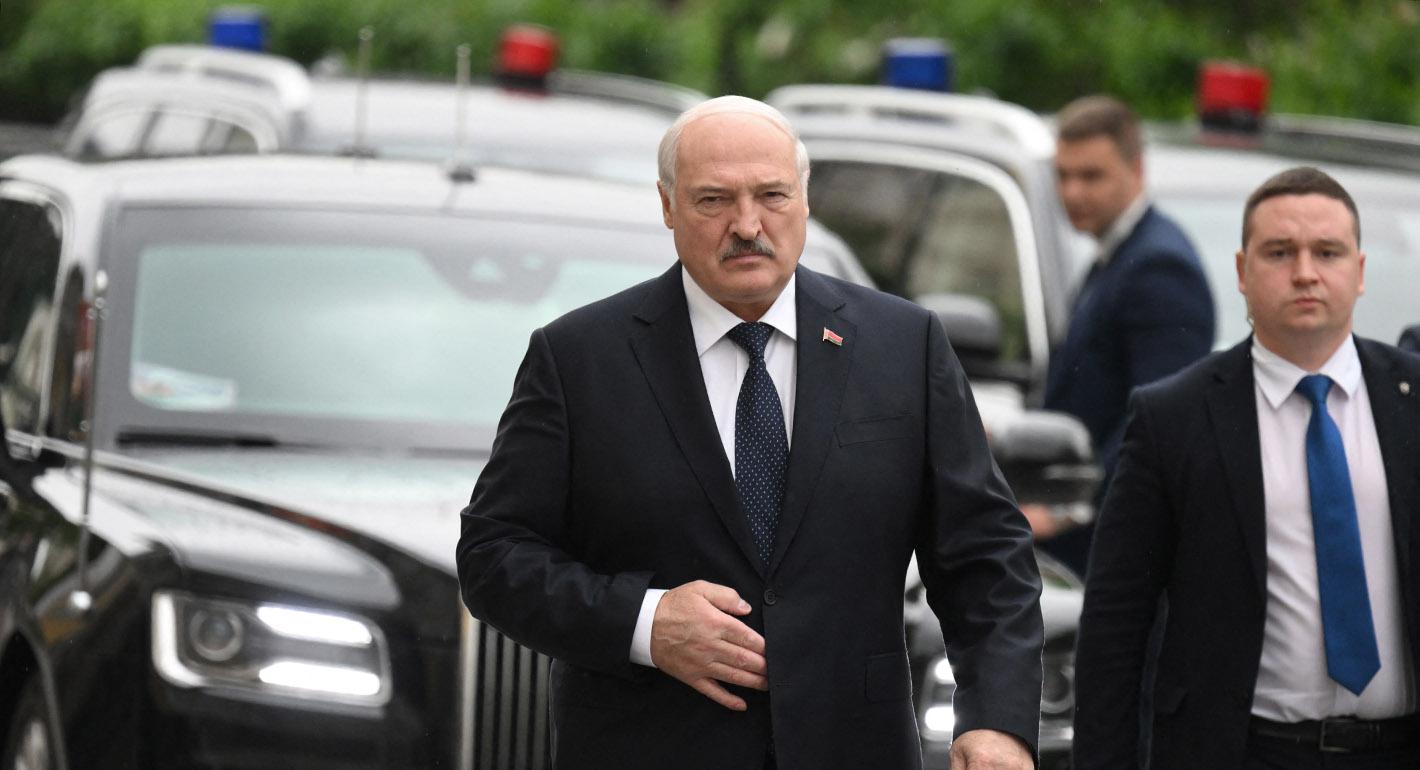
Source: Getty
By imagining an attack or even an invasion, Lukashenko is increasing the risks of war coming to Belarus.
For several months now, Minsk’s actions have demonstrated a new perception of external threats. What were once propaganda tales of “opposition militants” and a “NATO invasion” have transformed into genuine fears within the Belarusian regime. The reality is not, of course, that NATO is actually preparing to invade, but rather that the contested Belarusian leader Alexander Lukashenko believes that an invasion is in the works. To forestall it, he is ready to resort to all kinds of desperate measures, from hosting Russian nukes to welcoming Russia’s infamous Wagner mercenary army to the country.
This transformation did not occur overnight or in a vacuum. It began on February 26, when a drone attacked a grounded Russian radar surveillance aircraft at an airfield near Minsk. A Pentagon data leak pointed to Ukrainian “SBU [security service] agents” as the perpetrators of the attack.
In response, the Belarusian authorities detained over 600 people in March alone. Minsk has also strengthened control on its western border. Individuals who have previously come under scrutiny for participating in protests, holders of European humanitarian visas and residence permits, Ukrainian nationals, and those who have recently visited Ukraine are now subject to additional scrutiny and even detention. There have been reports of dozens of cases of Belarusian nationals being barred from entering their own country.
Fears in Minsk intensified when the war in Ukraine finally began to spread to Russian soil in the form of drone attacks in the capital, assassination attempts (both successful and unsuccessful) on Russian propagandists, and the bombing of Russian border regions. Concerned that such attacks could be repeated in Belarus through its unmanned border with Russia, the Belarusian authorities reintroduced border checks. Minsk has actually tightened control more than Moscow itself, and not only as a result of Lukashenko’s more totalitarian instincts.
For Lukashenko, unlike for Putin, the risks of armed sabotage on his territory carry the distinct threat of regime change. Lukashenko fears that the West is preparing to use the war in Ukraine as a pretext to overthrow him. He arrived at this paranoid conclusion partly due to the militarization of the Belarusian opposition and Ukrainian subversive activities in Russia. The trauma of the 2020 protests, when Lukashenko came dangerously close to being ousted, also plays a role.
The brutal crackdown on the 2020 electoral protests prompted an exodus from the country, with the exiled opposition joining the already robust Belarusian political diaspora, mostly in neighboring Poland and Lithuania. Even though the Belarusian protesters largely abstained from violence in 2020, hundreds of exiled Belarusians are now fighting on behalf of Ukraine.
The largest Belarusian unit there—the Kalinoŭski regiment—has been saying for some time that its ultimate goal is to liberate Belarus. Meanwhile, Poland-based exile groups provide military training and advocate for partisan resistance against Lukashenko’s regime.
Still, it’s one thing to want something, and quite another to act on it. The combined military strength of all the opposition structures and Belarusian volunteers is no more than 800–1,000 people. The majority of them are contracted with the Ukrainian Armed Forces, and cannot engage in independent raids into Belarus.
Another important guarantee against escalation from either NATO or Ukraine is Belarus’s role in the war: complicit in the aggression, but mainly watching from the sidelines. Kyiv will certainly try to avoid giving Lukashenko any reason to commit his own army to the war, and for this reason will not allow its Belarusian units to march onto their homeland.
As for NATO, the idea of a military invasion of Belarus is unthinkable, as it would inevitably lead to a direct war with Russia. Even in a hypothetical situation in which Lukashenko is left without military support from the Kremlin, it is unlikely that the West would be willing to gamble its soldiers’ lives on such a risky undertaking.
Lukashenko, however, has a different perception of the motives and intentions of the West. He sees the 2020 protests as a Western attempt to topple him, and believes the West is poised to strike again. He doesn’t believe that statements about the armed liberation of Belarus are merely the dreams of militant members of the diaspora and is convinced that such radical rhetoric must have been ordered by the West.
As early as 2022, Lukashenko began preparing for a hybrid invasion. New units to combat extremists were established. Training drills rehearse the liberation of border towns from militant groups. The military budget for 2023 has increased by about 55 percent, while spending on the other security forces has grown by a third.
The numerous attacks on Russian soil have only intensified Lukashenko’s paranoia, on the basis that if the West allows Kyiv to do such things to Russia, then there will surely be no restraint toward Belarus. The problem is that in his attempts to protect himself from imaginary threats, Lukashenko is creating real ones.
The Belarusian leader believes his country may be attacked in one form or another if the fear of a possible response from the country’s main ally, Russia, weakens in the West. He is therefore seriously concerned by the Kremlin’s lackluster reaction to cross-border attacks on the Belgorod region and the drone strikes in Moscow. This is why his speeches are littered with defiant promises to fight off any invasion with the help of Russia.
The less successful the Russian army appears on the front lines, the less credible Belarus’s deterrent. For this reason, Lukashenko is only too pleased to start hosting Russian tactical nuclear weapons. Control over the weapons and the initiative to deploy them there clearly belong to the Kremlin: Putin would not have entertained Lukashenko’s requests on such an important matter if he himself did not want to test the West with an escalation. But for the Belarusian leader, the placement of nuclear weapons in Belarus is still another security guarantee.
In a similar vein, Lukashenko has framed the redeployment of Wagner to Belarus as another deterrent for the West, even though it is still unclear how many mercenaries will take advantage of his offer. Soon after the abortive mutiny, the Belarusian leader stated that Wagner troops would rise to protect “Minsk’s interests,” should Belarus come under attack. Lukashenko is apparently eager to use any opportunity to scare away his opponents, even if he is not actually in control of the military capabilities he invokes in his threats.
The problem is that by getting so closely involved with Russia, Lukashenko is blurring the line between the two countries, and that line had previously guaranteed a more restrained Ukrainian attitude toward Belarus. If Russia uses nuclear weapons or threatens to do so in a way that makes NATO consider preventative or retaliatory strikes, then the list of priority targets may well include facilities in Belarus. Hitting those sites would in theory demonstrate the Western alliance’s might while avoiding a direct attack on Russia, providing Moscow with an off ramp. In fact, this is exactly what U.S. officials did in a 2020 war game.
By scaring himself with imaginary threats of liberation campaigns by exile groups, Lukashenko is increasing the risks of an actual war reaching his country—and on a scale that will need far more than border controls to stop it.

Nonresident Scholar, Carnegie Russia Eurasia Center
Artyom Shraibman is a nonresident scholar at the Carnegie Russia Eurasia Center.
Recent Work
Artyom Shraibman
Artyom Shraibman
Carnegie does not take institutional positions on public policy issues; the views represented herein are those of the author(s) and do not necessarily reflect the views of Carnegie, its staff, or its trustees.
A leak of Russian gas price data helps establish that China is paying Russia far less than Central Asian countries and Gazprom’s former European customers.

Sergey Vakulenko

Japan’s long-term security policy is driven by concerns about China, and there is little appetite for (or interest in) pursuing a confrontation with Moscow.

James D.J. Brown

The truth of the strategic situation is that Europe and Russia are extremely unlikely to be able to “turn the page” on their confrontation within the next two decades.

Arkady Moshes
Russia spent years building a “sovereign internet,” concentrating web infrastructure exclusively within Russian territory. Ukrainian drone attacks have shown how vulnerable that approach has left the Russian internet.

Maria Kolomychenko

Putin’s conservative staffing policies and search for ever greater control have cemented parliament’s transformation into a bureaucratic appendage of the executive branch.

Andrey Pertsev