

Commentary
Artyom Shraibman
{
  "authors": [
    "Artyom Shraibman"
  ],
  "type": "commentary",
  "blog": "Carnegie Politika",
  "centerAffiliationAll": "",
  "centers": [
    "Carnegie Endowment for International Peace",
    "Carnegie Russia Eurasia Center"
  ],
  "englishNewsletterAll": "",
  "nonEnglishNewsletterAll": "",
  "primaryCenter": "Carnegie Russia Eurasia Center",
  "programAffiliation": "",
  "programs": [],
  "projects": [],
  "regions": [
    "Belarus"
  ],
  "topics": [
    "Domestic Politics",
    "Civil Society"
  ]
}
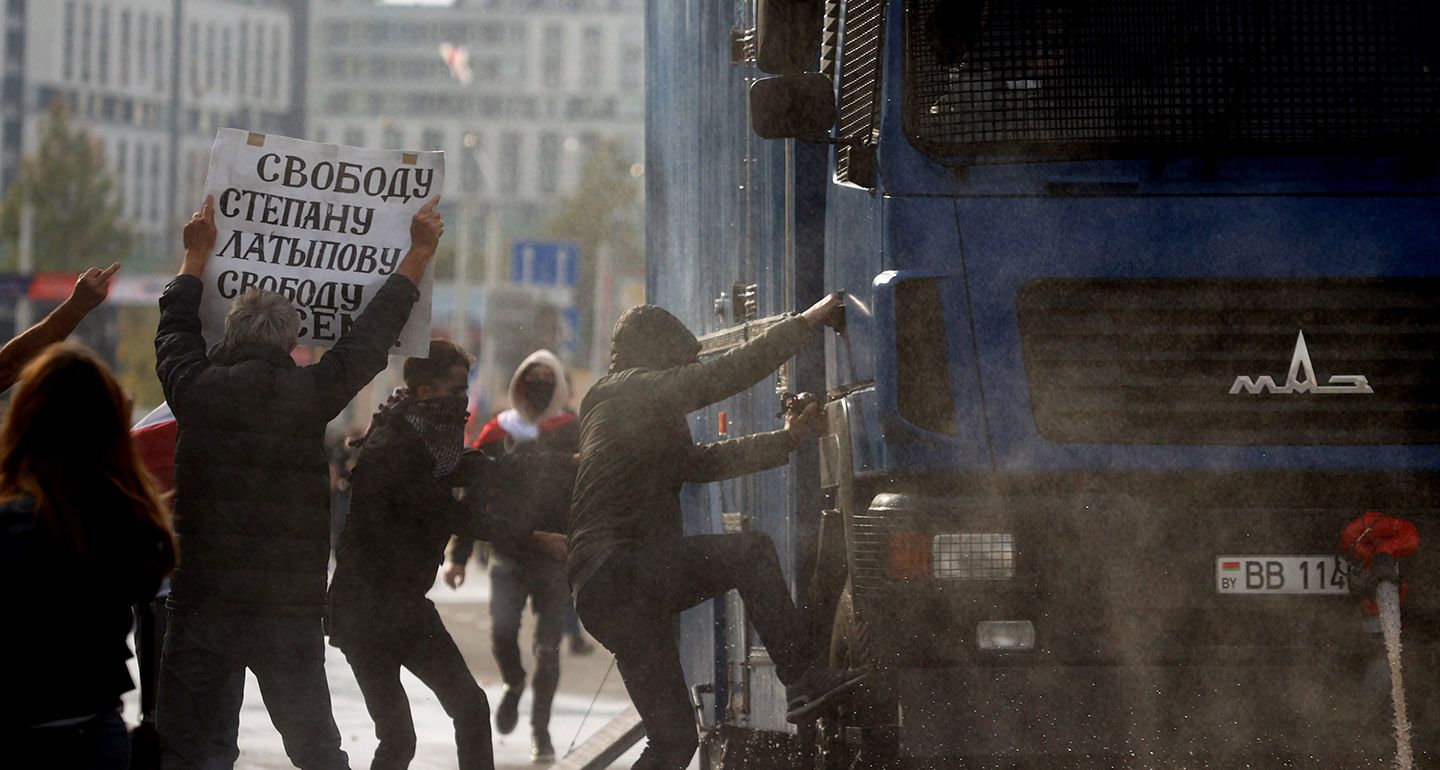
Source: Getty
The unusual move is likely a signal to the West that Minsk is uncomfortable about the prospect of permanent dependence on Moscow.
Belarus has freed about 110 political prisoners in four waves in the last three months. The most recent release was on September 16, when thirty-seven people walked free. Of course, this is a drop in the ocean of political repression in Belarus. Over 1,300 political prisoners remain behind bars, including opposition leaders, journalists, and activists—and new arrests continue.
Nevertheless, this is Belarus’s way of sending a signal, and there can only be one possible addressee: the West. Alexander Lukashenko’s regime may be benefiting from the ongoing war in Ukraine, but he still wants to prepare for a less rosy future.
At home, the Belarusian authorities claimed the prisoner releases were motivated by compassion. Lukashenko said those being freed were the seriously ill, the elderly, and women with children. Yet the regime is rarely motivated by compassion (at least six political prisoners have died in jail since 2021), and most of those released were actually healthy young men. What they did have in common was that many of them had sought a pardon from Lukashenko and were serving relatively short jail terms for online crimes. Some only had a few months or weeks left of their sentences. In other words, this was obviously a political gesture.
After all, it’s unlikely Lukashenko believes he can regain the trust of opposition-minded Belarusians in this way. The authorities launched a huge crackdown following the 2020 street protests sparked by massive electoral fraud in presidential elections, and arrests for crimes including social media “likes” are still a regular occurrence. Freeing a few dozen political prisoners will hardly change the atmosphere of fear and suspicion.
Instead, Lukashenko’s target audience is likely the West. Political prisoners have long been a yardstick for the state of relations between the West and Belarus. In the past, Lukashenko has released political prisoners when he was seeking to improve relations with the United States or the European Union. This paid off twice, in 2008 and 2015.
Today, however, the situation is completely different, not least because the current crisis between Belarus and the West isn’t just about the situation inside Belarus. The majority of current Western sanctions against the Belarusian regime were imposed not because of the regime’s decision to crush opposition demonstrations, but for supporting Russia’s war against Ukraine, creating a migrant crisis on the EU’s eastern border, and forcing a Ryanair flight carrying an opposition activist to land in Minsk in 2021.
Lukashenko’s image in the eyes of the West is so bad that it couldn’t possibly be rectified by a handful of symbolic pardons. When Belarus allowed its territory to be used for the full-scale invasion of Ukraine in 2022, many Western diplomats and officials wrote off the country. They decided Belarus was a Russian vassal state unworthy of any attention.
As a consequence, it will be an uphill battle to get the West to take Lukashenko’s signals seriously. The release of a hundred political prisoners will be noticed, but it’s clearly not enough to start a conversation about treating Minsk differently.
It’s therefore unclear what exactly Lukashenko might be hoping to gain. There are several possible answers. Perhaps Minsk simply overestimates the West’s appetite for reconciliation and mistakenly believes the gesture will generate a flurry of interest.
At the same time, the waves of prisoner releases could be the first in a series of signals prepared by Lukashenko. From a primitive negotiating point of view, of course, it’s better to start small to see if you can get what you want for less. The end goal may not be the normalization of relations with the West and the lifting of sanctions: even Minsk understands that would be an absurd aspiration. But Lukashenko may, for example, be looking to end Belarus’s diplomatic isolation and resume top-level contact with the West.
In this respect, Lukashenko may see 2025 as a good time to try to reset his legitimacy abroad. Belarus will hold presidential elections next year, and the stain of the previous elections is gradually being forgotten. Perhaps he believes it might be possible to suggest a fresh start to the West.
There are also some signs that Minsk expects an imminent conclusion to the war in Ukraine—or at least a freezing of hostilities. Earlier this year, Lukashenko publicly ordered state propaganda outlets to dial down anti-Ukraine hysteria to pave the way for the possibility of normalizing Belarus-Ukraine relations.
Belarusian Foreign Minister Maxim Ryzhenkov said recently that the West’s approach toward Belarus will not change until the shooting stops in Ukraine. This logic suggests that Minsk believes a round of mutual concessions with the West could follow a ceasefire, yielding political rewards for Lukashenko.
Finally, Minsk’s overtures to the West could also be the result of economic worries. For the moment, the Belarusian economy is booming because of massive Russian military spending. But that will not last forever, and there are signs of economic overheating, as well as labor shortages. An end to the fighting in Ukraine would mean reductions in Russian military spending—and less demand for Belarusian industrial goods.
Whatever Lukashenko was seeking by freeing political prisoners, the very fact of this move suggests that Minsk is uncomfortable about total dependence on Moscow over the long term. An alliance with Russia guarantees Lukashenko’s authority, but the Belarusian leader is clearly concerned it might be difficult for him to continue to rule—and then hand power to a successor—if he’s completely isolated from the West. The current honeymoon period with Moscow is not seen as permanent by Minsk.
It’s entirely possible that Lukashenko will not even be able to start a dialogue with the West, because of the huge gulf between the two sides. Even if such a dialogue did get under way, it would be easy for officials in Moscow, or hawks in Minsk, to derail any budding rapprochement.
Still, the overture itself is telling. Minsk has revealed that it does not consider its current status as an isolated Russian vassal a return to historical normality, but a temporary deviation.

Nonresident Scholar, Carnegie Russia Eurasia Center
Artyom Shraibman is a nonresident scholar at the Carnegie Russia Eurasia Center.
Recent Work
Artyom Shraibman
Artyom Shraibman
Carnegie does not take institutional positions on public policy issues; the views represented herein are those of the author(s) and do not necessarily reflect the views of Carnegie, its staff, or its trustees.

Ex-president Gurbanguly Berdimuhamedov remains interested in politics, but his son Serdar, Turkmenistan’s current president, is becoming increasingly independent and willing to break with his father’s legacy. If their covert rivalry goes too far, both risk losing power.

Galiya Ibragimova

For every ruble allocated to social policy, health, and education in 2027, double that amount is earmarked for the army, the police, and the security services.

Alexandra Prokopenko
An analysis of traffic accident data suggests that Ukrainian drone attacks caused a material but not disastrous fall in Russian gasoline consumption over the summer.

Sergey Vakulenko

Sergei Kiriyenko used Russia’s parliamentary vote to further hone his strategy of corporate mobilization that is designed to maximize votes for United Russia.

Andrey Pertsev

Trump has promised Belarus a massive potash deal. But Minsk is seeking something greater: restored Western transit and greater room for maneuver from Russia.

Balázs Jarábik