

Commentary
Sergey Vakulenko
{
  "authors": [
    "Sergey Vakulenko"
  ],
  "type": "commentary",
  "blog": "Carnegie Politika",
  "centerAffiliationAll": "",
  "centers": [
    "Carnegie Endowment for International Peace",
    "Carnegie Russia Eurasia Center"
  ],
  "englishNewsletterAll": "",
  "nonEnglishNewsletterAll": "",
  "primaryCenter": "Carnegie Russia Eurasia Center",
  "programAffiliation": "",
  "programs": [],
  "projects": [],
  "regions": [
    "Ukraine",
    "Russia",
    "Kazakhstan"
  ],
  "topics": [
    "Trade",
    "Energy",
    "Security",
    "Climate Change"
  ]
}
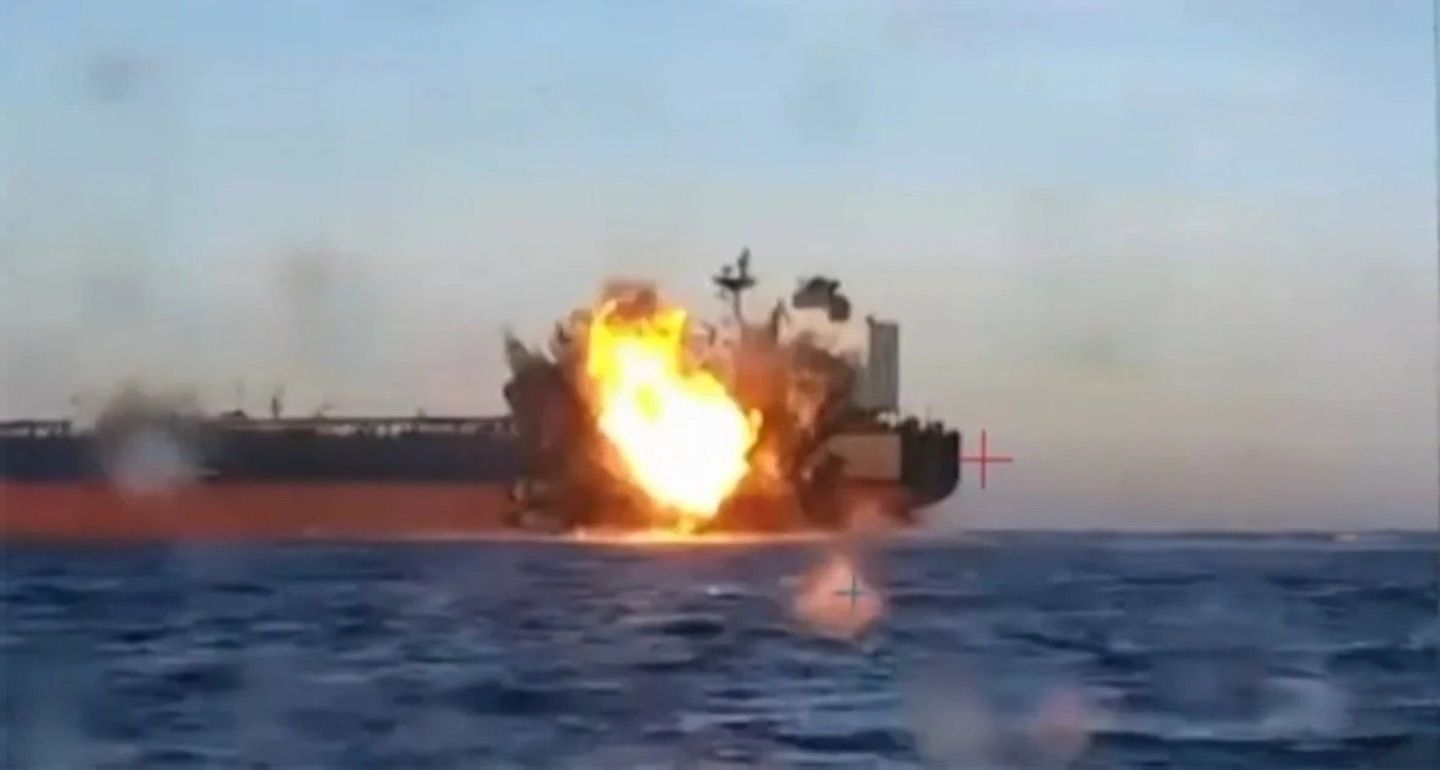
Фото: Security service of Ukraine
Inflicting damage on oil infrastructure in Russia that is used by Kazakhstan and a whole series of Western oil majors risks backfiring on Kyiv.
Amid a broader escalation of the Russia-Ukraine war in the Black Sea, Ukraine attacked the offshore loading terminal of the Caspian Pipeline Consortium (CPC) near the Russian port of Novorossiysk on November 29. The damage inflicted turned out to be a far more significant problem for the CPC than previous attacks, including Ukrainian strikes on a CPC pumping station in the North Caucasus in February, and on CPC offices in Novorossiysk in September.
For Ukrainian commanders tasked with reducing Russia’s oil export revenue, the CPC might appear to be just another part of Russia’s oil infrastructure. However, damaging the CPC will cause more problems for some of Ukraine’s allies than it will ever do for Russia.
The CPC exports both Russian and Kazakh oil. In 2024, Russian oil (produced in the North Caucasus) accounted for just 15 percent of the pipeline’s daily throughput of 1.2 million barrels. The rest is Kazakh oil pumped from the Central Asian state’s largest oilfields: Tengiz, Kashagan, and Karachaganak. These fields are complex, expensive to develop, and operated by consortiums including the world’s biggest energy companies (ExxonMobil, Chevron, Eni, TotalEnergies, Shell, and others). In total, Tengiz, Kashagan, and Karachaganak provide about 80 percent of Kazakhstan’s oil exports (and about 40 percent of the country’s export revenue). Almost all of this oil reaches world markets through the CPC.
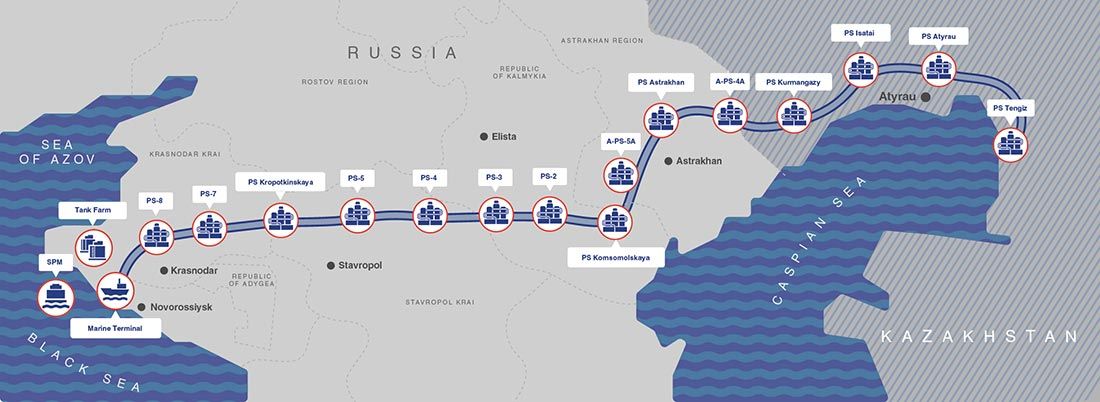
The Kazakh and Russian segments of CPC are owned by two companies: CPC-K and CPC-R, respectively. Their shareholders are mostly Western energy companies involved in oil production in Kazakhstan. However, Kazakhstan also owns 30 percent of the shares, Russian state-owned pipeline operator Transneft holds 24 percent, and small stakes are owned by Russian energy companies via joint ventures with Western firms. This complicated arrangement is explained by the fact that the point of the CPC is not to profit from transporting oil, but simply to ensure its owners can export crude from Kazakhstan and sell it on world markets.
If the CPC were to stop working entirely, Russia would lose out on dividends and taxes from the consortium, and would need to pay to ship 200,000 barrels of oil a day from the North Caucasus to Novorossiysk by rail. In total, that would cost Russia an additional $600–$650 million a year. That is not insignificant, but it is far less than the approximately $27 billion a year that Astana and the Western firms operating in Kazakhstan would lose.
Following the November 29 strike, Kazakhstan’s Foreign Ministry released an irate statement calling on Ukraine to stop such attacks. In response, Ukraine’s Foreign Ministry accused Kazakhstan of taking an insufficiently principled stance toward Russia, implied collateral damage was acceptable. Others have argued that Kazakhstan has had ample time by this point in the war to have found alternative routes for its oil exports.
In fact, it’s not quite that straightforward. Firstly, decisions about Kazakhstan’s oil exports are not only taken by Astana; they also involve the international energy companies working in the country. Secondly, landlocked Kazakhstan is a hostage to its geography. To all intents and purposes, the country is unable to export oil southward: Uzbekistan, Turkmenistan, and Iran produce their own oil, while the Afghan market is small. It’s also difficult to access the Indian Ocean via these countries—not just because of the high mountains, but also the political risks (particularly when Western companies are involved).
Kazakhstan exports some of its oil to China via a pipeline with a capacity of 400,000 barrels of oil a day (mostly produced from small fields in central and eastern Kazakhstan, and sent to western parts of China, where demand is limited). It also has the option of sending oil to the Mediterranean via Azerbaijan and the Baku–Tbilisi–Ceyhan (BTC) pipeline. Production of offshore Azerbaijani oil (which the BTC was built to transport) is currently falling, so the BTC has spare capacity—though not nearly enough to absorb all the oil currently pumped through the CPC.
The main problem with this westward route is that Kazakhstan can only ship oil to Azerbaijan via Russia (and Moscow is unlikely to agree to such an arrangement), or via tanker across the Caspian Sea. At the moment, there are only about twenty tankers in the Caspian Sea, each with a capacity of 8,000 tons or less, and Kazakhstan’s main oil port, Kuryk, can only handle 200,000 barrels a day. Theoretically, Kazakhstan could build a pipeline under the Caspian, but that would be technically challenging (given the lack of heavy equipment in the region) and very time-consuming (there is no way it could have been completed since Russia’s full-scale invasion of Ukraine).
Kazakhstan and its Western partners previously dealt with four stoppages to the CPC in 2022. These were caused by Russia, which was fearful that Western sanctions imposed following the full-scale invasion of Ukraine might mean a significant fall in its oil exports—and wanted to spook the world by showing it could also deprive international markets of a million barrels of Kazakh oil per day.
Another stoppage to the CPC would play into the Kremlin’s hands. It would make India, China, and Türkiye more willing to buy Russian oil (at less of a discount), and would send global oil prices higher, increasing the incentives for countries to evade Western sanctions. And Russia could insist that this was all the result of Ukraine’s actions.
It’s already clear that Western energy firms from countries allied with Ukraine are not happy about what is unfolding. The lobbying power of international oil companies is significant, and is already being directed toward convincing Kyiv to stop its attacks on the CPC. There was almost certainly a similar lobbying effort following the damage done to the CPC by drones earlier this year—so these energy companies likely believe Kyiv is now knowingly damaging their interests. Nor will these Ukrainian attacks increase sympathy for Ukraine’s cause in Kazakhstan.
It’s possible that Kyiv has calculated that hitting the CPC will demonstrate its resolve and readiness to take unpopular action to protect its interests. Perhaps Kyiv is trying to make other countries feel the consequences of the war, and, by doing so, push them into making more of an effort to help achieve peace. However, there’s no guarantee that the affected countries will push for a just peace, rather than simply a rapid end to the fighting.

Senior Fellow, Carnegie Russia Eurasia Center
Sergey Vakulenko is a senior fellow at the Carnegie Russia Eurasia Center.
Recent Work
Sergey Vakulenko
Sergey Vakulenko
Carnegie does not take institutional positions on public policy issues; the views represented herein are those of the author(s) and do not necessarily reflect the views of Carnegie, its staff, or its trustees.
The issue is not that the president only has selective information at his disposal, but that the decision-making process consists of one person with an unshakeable vision of how the world works.

Tatiana Stanovaya

A much-discussed disagreement over internet restrictions in Russia was never an existential threat for Putin: It was about elite groups protecting their interests.

Alexandra Prokopenko
By reminding the world that Lukashenko is a threat to NATO and Ukraine, Kyiv is trying to return the focus to why the Belarusian regime needs to be contained rather than rewarded.

Artyom Shraibman

The demands of the Kremlin’s war in Ukraine, demographic problems, and public hostility toward Central Asians mean Russia does not have enough workers.

Salavat Abylkalikov

Minsk’s faith in the future of its larger neighbor’s economy is fading as Belarusian firms in Russia see record losses.

Olga Loiko