

Commentary
Alexey Malashenko
{
  "authors": [
    "Alexey Malashenko"
  ],
  "type": "commentary",
  "centerAffiliationAll": "",
  "centers": [
    "Carnegie Endowment for International Peace",
    "Carnegie Russia Eurasia Center"
  ],
  "collections": [],
  "englishNewsletterAll": "",
  "nonEnglishNewsletterAll": "",
  "primaryCenter": "Carnegie Russia Eurasia Center",
  "programAffiliation": "",
  "programs": [],
  "projects": [
    "Eurasia in Transition"
  ],
  "regions": [
    "Central Asia",
    "Kazakhstan",
    "Russia",
    "Eastern Europe",
    "Ukraine",
    "Belarus"
  ],
  "topics": [
    "Economy",
    "Trade",
    "Foreign Policy"
  ]
}
Source: Getty
The Ukraine crisis has had an increasingly negative effect on Russia’s relations with Belarus and Kazakhstan, its closest allies and partners in the Customs Union and Eurasian Union.
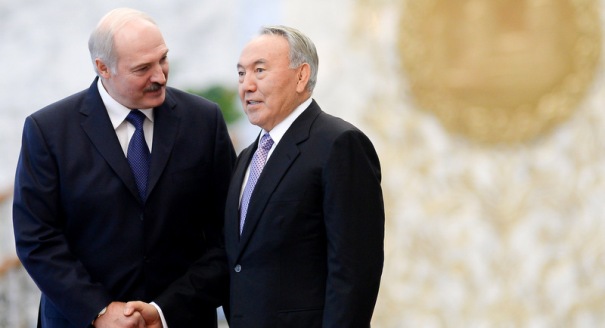
The Ukraine crisis has had an increasingly negative effect on Russia’s relations with Belarus and Kazakhstan, its closest allies and partners in the Customs Union and Eurasian Union. Minsk and Astana have never recognized Crimea as part of Russia and are not about to do so now. Both heads of state are demonstrative about their neutrality in matters concerning Russia and Ukraine. Kazakh President Nursultan Nazarbayev conceives of himself as “an honest manager, who supports neither side.” Belarusian President Alexander Lukashenko said on December 21, during a meeting with his Ukrainian counterpart Petro Poroshenko, that Belarus is prepared to do anything Poroshenko asks “in a day.” Additionally, Lukashenko has also essentially returned customs checkpoints to the Russian border, which defeats the purpose of the Customs Union.
Both Minsk and Astana realize that now is the best time for a multi-vector (or even an independent) approach to foreign policy. By acting as mediators between Kiev and Moscow, they hope to score political points with the European Union and the United States, which are trying to extract concessions from Russia.
It seems that Russia itself is looking for ways out of the conundrum in which it now finds itself. To this end, Moscow may need to rely on friendly states and acceptable politicians, whose mediation will allow it to save face.
In addition, playing the role of mediator could shield Kazakhstan and Belarus from unpredictable turns in Russian policy, like those of 2014. These concerns are especially relevant in light of recent statements circulating in Russia about the “artificiality” of the Kazakh state and Kazakh Russophobia. As for Belarus, Moscow’s irritation with Minsk is now at its peak. In quite a transparent (albeit rude) reminder of this, Alexei Pushkov, the head of the Duma’s Foreign Affairs Committee, warned Lukashenko against the mistakes made by Slobodan Milosevic, Muammar Gaddafi, and Saddam Hussein.
The Kremlin can’t help but be concerned by the newfound skepticism toward its policies coming from its Russia’s closest partners toward its policies. Moscow’s key integration project—the creation of the Eurasian Economic Union—is reeling against the backdrop of the sharp decline in oil prices and the ruble’s collapse. Perhaps Russia’s closest partners’ new attitudes will prompt Russia to revise its policies on Ukraine.
Former Scholar in Residence, Religion, Society, and Security Program
Malashenko is a former chair of the Carnegie Moscow Center’s Religion, Society, and Security Program.
Recent Work
Alexey Malashenko
Alexey Malashenko
Carnegie does not take institutional positions on public policy issues; the views represented herein are those of the author(s) and do not necessarily reflect the views of Carnegie, its staff, or its trustees.

Despite a new textbook, an influx of Russian teachers and managers, and an end to the teaching of Ukrainian, the Kremlin is unlikely to have “reprogrammed” locals.

Konstantin Skorkin

For every ruble allocated to social policy, health, and education in 2027, double that amount is earmarked for the army, the police, and the security services.

Alexandra Prokopenko

Cargo traffic through Russia’s Northern Sea Route has increased because of the disruption caused by the conflict in the Middle East, the Ukraine war, and U.S.-China tensions.

Mikhail Korostikov
An analysis of traffic accident data suggests that Ukrainian drone attacks caused a material but not disastrous fall in Russian gasoline consumption over the summer.

Sergey Vakulenko

Sergei Kiriyenko used Russia’s parliamentary vote to further hone his strategy of corporate mobilization that is designed to maximize votes for United Russia.

Andrey Pertsev