

Paper
Yezid Sayigh
{
  "authors": [
    "Yezid Sayigh"
  ],
  "type": "legacyinthemedia",
  "centerAffiliationAll": "dc",
  "centers": [
    "Carnegie Endowment for International Peace",
    "Malcolm H. Kerr Carnegie Middle East Center"
  ],
  "collections": [],
  "englishNewsletterAll": "menaTransitions",
  "nonEnglishNewsletterAll": "",
  "primaryCenter": "Malcolm H. Kerr Carnegie Middle East Center",
  "programAffiliation": "MEP",
  "programs": [
    "Middle East"
  ],
  "projects": [],
  "regions": [
    "Türkiye",
    "Gulf",
    "Levant",
    "Saudi Arabia",
    "Syria",
    "Iraq",
    "Middle East"
  ],
  "topics": [
    "Political Reform",
    "Security",
    "Foreign Policy"
  ]
}
Source: Getty
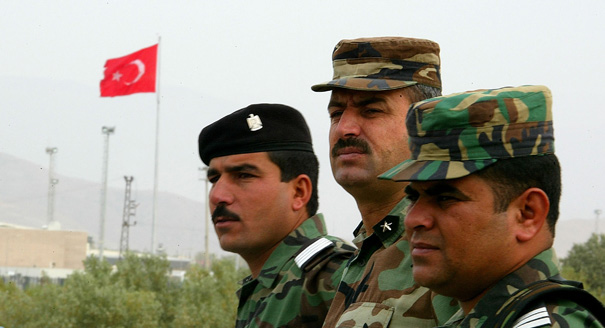
U.S. and Turkish relations continue to be tested by both the fight against the self-proclaimed Islamic State and the Kurdish question.
Source: Center for International Relations
The U.S. faces a difficult set of choices. On one hand it continues to regard the PKK as a terrorist organization, but has indirectly assisted its sister organization in Syria, the PYD, in its fight against the Islamic State. The U.S. also assists the Kurdish Regional Government (KRG) in Iraqi Kurdistan, which has bad relations with the PKK but good ones with Turkey. On the other hand, the U.S. has been careful not to endorse calls by the KRG for full independence of Iraqi Kurdistan, and not to commit itself to Kurdish autonomy in Syria. So U.S.-Kurdish relations are complex. But the U.S.-German decision to withdraw the Patriot air defence missiles currently deployed in Turkey under a NATO mandate, which was done in consultation with Turkey, suggests that Turkey's NATO partners are uncomfortable at seeming to stand by the resumption of armed hostilities by the Turkish armed forces against the PKK, whether inside Turkey or across the border in northern Iraq. So this may be an initial attempt to limit how far Turkey escalates its new conflict with the Kurds.
I am not clear what is meant by this question. The only real agreement between the U.S. and Turkey at the moment focuses on U.S. use of the Turkish Incirlik air base to launch attacks on ISIS. This has limited scope and impact and does not represent a dramatic or strategic transformation of U.S. ability to act in the region, which is already considerable thanks to its use of fleets in the Mediterranean and the Gulf and to the use of bases in GCC countries. Conversely, it is evident that the agreement over Incirlik has not given the U.S. any extra influence with the Turkish government, which is not as seriously committed to the fight against ISIS as it is to fighting the PKK and has resumed its pressure for a safe zone or no-fly zone in Syria.
This Q&A was originally published by the Center for International Relations.

Senior Fellow, Malcolm H. Kerr Carnegie Middle East Center
Yezid Sayigh is a senior fellow at the Malcolm H. Kerr Carnegie Middle East Center in Beirut, where he leads the program on Civil-Military Relations in Arab States (CMRAS). His work focuses on the comparative political and economic roles of Arab armed forces, the impact of war on states and societies, the politics of postconflict reconstruction and security sector transformation in Arab transitions, and authoritarian resurgence.
Recent Work
Yezid Sayigh
Yezid Sayigh
Carnegie does not take institutional positions on public policy issues; the views represented herein are those of the author(s) and do not necessarily reflect the views of Carnegie, its staff, or its trustees.

Cargo traffic through Russia’s Northern Sea Route has increased because of the disruption caused by the conflict in the Middle East, the Ukraine war, and U.S.-China tensions.

Mikhail Korostikov

Sergei Kiriyenko used Russia’s parliamentary vote to further hone his strategy of corporate mobilization that is designed to maximize votes for United Russia.

Andrey Pertsev

The European far right might fail to steer EU policy in the direction Russia wants, but they will create enough chaos inside Europe to benefit the Kremlin.

Dimitar Bechev

Minsk clearly expected the dialogue with Washington to yield more results, in particular the lifting of EU sanctions and permission to export potash.

Artyom Shraibman

If the Russian-speaking community in Latvia cannot articulate their interests without being seen as disloyal, they could end up embracing a pro-Kremlin agenda.

Sergejs Potapkins