

Commentary
Russian strikes are weakening the economy sustaining Ukraine’s war effort. Closing the growing funding gap will require more European support and politically contentious reforms in Kyiv.
Balázs Jarábik
{
  "authors": [
    "Paul Haenle",
    "Li Bin",
    "Douglas H. Paal",
    "Jung H. Pak",
    "Michael D. Swaine",
    "Tong Zhao"
  ],
  "type": "other",
  "centerAffiliationAll": "",
  "centers": [
    "Carnegie Endowment for International Peace",
    "Carnegie China"
  ],
  "collections": [
    "Carnegie China Commentaries"
  ],
  "englishNewsletterAll": "",
  "nonEnglishNewsletterAll": "",
  "primaryCenter": "Carnegie China",
  "programAffiliation": "",
  "programs": [],
  "projects": [],
  "regions": [
    "North America",
    "United States",
    "East Asia",
    "China",
    "North Korea"
  ],
  "topics": [
    "Arms Control",
    "Security",
    "Military",
    "Foreign Policy",
    "Nuclear Policy"
  ]
}
Source: Getty
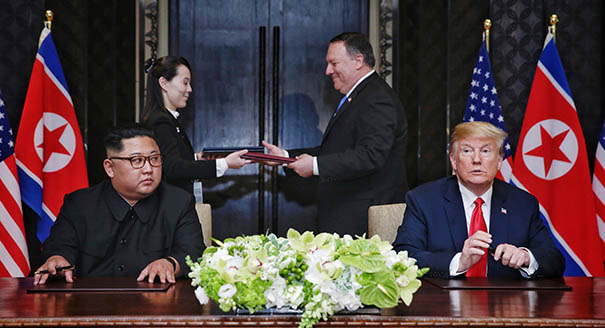
Despite the pageantry of the Singapore summit, the outcomes remain uncertain.
While some laud U.S. President Donald Trump for his diplomacy, others claim that he gave up too much while North Korean leader Kim Jong-un conceded little. Foreign policy experts provide their perspectives on this historic event and predict what’s next.
“Kim Jong-un got what he wanted at the Singapore summit: the international prestige and respect of a one-on-one meeting with the U.S. president, the legitimacy of North Korean flags hanging next to U.S. flags in the background, and the press stalking him like a movie star as he spent an evening sightseeing in Singapore.
For the United States, the high bar for success initially set by Trump—a clear commitment by Kim Jong-un on comprehensive, verifiable, irreversible denuclearization in a rapid manner—was significantly lowered, and there were very few achievements for the Trump administration to point to and little substantive progress made.
Trump’s statements during his press conference on suspending U.S. joint military exercises and wanting to bring U.S. troops home will greatly concern allies like South Korea and Japan, two countries for which these concessions will have dramatic consequences. They will also question what other verbal commitments he made in his one-on-one meeting with Kim without consulting them first. These were bonus victories for Kim, and the North Korean press has wasted no time in publishing these concessions. The only clear outcome Trump walked away with was Kim’s verbal agreement to destroy a missile testing site; however, this was not included in the signed summit statement, and it’s unclear if the site has any actual value for North Korea’s weapons program anymore.
Trump has criticized past administrations for kicking the can down the road when it comes to North Korea. However, the outcomes of this summit appear to have done the same, and the administration now faces daunting and strenuous negotiations in the months to come over the nuances that entail actual denuclearization and the verification process that must come with it.
Kim will now look to build on the momentum of the summit, possibly holding meetings with Russian President Vladimir Putin and Japanese Prime Minister Shinzo Abe to further bolster his international stature, as well as continuing the negotiating process with the United States in the hopes of hosting Trump or visiting the White House. Kim’s arrival on a Chinese airplane also made clear Beijing’s deep interests in maintaining influence and leverage in North Korea and future developments on the Korean Peninsula, and we should not be surprised if another Kim-Xi meeting occurs in the near future. Moreover, we should watch China’s next moves closely, including whether or not they provide unilateral economic relief that undermines Trump’s commitment to sustain the maximum pressure campaign until actual steps toward denuclearization begin.”
—Paul Haenle, director, Carnegie–Tsinghua Center for Global Policy
“The Kim-Trump Summit on June 12 was a good start. The two leaders should have reached more agreements than the four points in their joint statement. Some significant work is still needed to carefully design a road map for the peace and denuclearization process on the Korean Peninsula. The road map should be technically feasible, politically acceptable, and resilient over time. Experts from the six parties should work together for the road map and its implementation.
China can play two roles going forward. First, it can help stabilize the denuclearization and peace processes on the Korean Peninsula, protecting against disturbances therein. Second, China can make concrete contributions to dismantling North Korea’s nuclear facilities.”
—Li Bin, senior fellow, Carnegie Endowment for International Peace
“Clearly Trump wanted this meeting to be a success more than Kim did. If this summit were conducted by the head of a corporation, its board should order a medical intervention to investigate the mental health of the leader. Yes, it’s better than last year’s threats of fire and fury, but it is far short of what the situation requires in terms of concrete denuclearization. Taken together with Trump’s bizarre performance at the G7 meeting and afterward, and the post–Singapore summit press conference, there should be questions raised about Trump’s stability.
Beijing should be all smiles, with its proposal of military-freeze-for-military-freeze at the core of the agreement and with Japanese and South Korean doubts about the value of the alliance reinforced. China is recovering the influence it lost over the past few years on the Korean Peninsula.
The next steps after Singapore are urgent, challenging, and not promising. The best shot at getting Kim committed to real changes in behavior has passed. Sanctions will melt away in the bath of Trump’s rhetoric. China will gain a louder voice, as it will be the major police force maintaining the sanctions, and Pompeo will increasingly have to rely on Beijing to get the results Trump has promised yet undermined at the same time.”
—Douglas H. Paal, vice president for studies, Carnegie Endowment for International Peace
“Following the unprecedented meeting between the leaders of the United States and North Korea, Trump has been claiming success. He tweeted, ‘Everybody can now feel much safer than the day I took office. There is no longer a Nuclear Threat from North Korea.’ Yet, while the summit started a diplomatic process, no concrete progress on North Korean denuclearization has been made.
In fact, North Korea scored a victory as the Singapore declaration did not include timetables or plans for inspections of North Korean facilities. In effect, Trump created a shaky and loose foundation for his diplomats to build upon, canceling U.S.–South Korean military exercises, casting doubt on the future of the U.S. presence in East Asia, and gratuitously complimenting Kim. Secretary of State Mike Pompeo now has the unenviable task of reassuring allies (especially Japan), maintaining support for maximum pressure, and trying to wrest concessions from an apparently intransigent North Korea on its nuclear program.
The Moon Jae-in administration in South Korea has embraced the outcome of the meeting and is likely to press the accelerator on its plans to advance inter-Korean engagement. These developments are probably reinforcing for Kim Jong-un that he can keep his nuclear weapons program and enjoy the pageantry of future summits. In its bland, watered-down language, the Singapore declaration signaled one step forward and two steps backward on the U.S. policy of complete, verifiable, irreversible denuclearization of North Korea.”
—Jung H. Pak, senior fellow and SK-Korea Foundation Chair in Korea Studies, Center for East Asia Policy Studies, Brookings Institution
“If Kim continues his de facto moratorium on testing, and Trump continues to avoid his bluster about bloody noses and needing to act rapidly to remove Pyongyang’s nuclear weapons, this development could lead to the kind of outcome that many predicted would constitute a best-case scenario: a North Korean missile test freeze with a vague commitment to denuclearize, a cessation of mutual threats, and a protracted negotiation process.
Such an outcome is certainly not what Trump had promised for years in the face of the growing North Korean nuclear threat. But his supporters will no doubt look past that, as they do with all of his bluster, and see this as some kind of win. It is certainly not that. At this point, North Korea has gained far more than has the United States: a meeting with the U.S. president, movement toward a peace treaty and normalization, and a moratorium on U.S.–South Korean military exercises. Pyongyang has given up nothing on the nuclear front, other than an apparent cessation of testing. Aside from the unprecedented handshake, if you substitute Madeleine Albright for Trump, we have been here before.
The next step for the U.S. is presumably to follow up the vague statements produced at the Singapore summit with substantive denuclearization talks with North Korea. Beijing will seek to keep the two countries talking and show support for continued North-South Korea talks as well. The danger is that Pyongyang will offer little and Trump will continue to give much, with the latter committed to the idea that good feelings can substitute for tangible progress. His primary aim will be to produce signs of progress as we get closer to the midterm elections in the U.S., and of course just prior to the next presidential election. Kim will likely cooperate, as long as he can keep his nuclear weapons. And he almost certainly will get to keep them.”
—Michael D. Swaine, senior fellow, Carnegie Endowment for International Peace
“As expected, there were no major breakthroughs on North Korea’s denuclearization. Given the reality of a deeply paranoid North Korea that does not trust the United States, any expectation of a more radical deal with Kim Jong-un that would achieve greater nuclear concessions is unrealistic. Although Trump’s negotiation strategy was driven by no coherent goal or methodology, he stumbled into making some right decisions. He is willing to explore the possibility of gradually transforming U.S.–North Korean political engagement from hostile to friendly. Furthermore, Trump is making efforts to help North Korea transform from an isolated pariah state to a more normal and open country, despite North Korean hesitation over immediate denuclearization. Such efforts can help address the root causes of the nuclear crisis and many other security problems on the peninsula: North Korea’s deep paranoia and distrust of the Western countries.
Trump probably did not realize that he made a decision that can help tackle this underlying problem. To transform North Korea into a more normal and open country in the long run is an important strategic goal that Kim Jong-un seems willing to cautiously pursue and that would fundamentally make everyone safer. For this reason, I expect China to step up efforts in helping Kim’s pivot to the economy and embrace of the outside world. Countries like Russia and South Korea may take a similar approach. Whether this will be successful is the real test of diplomacy. It has just started.”
—Tong Zhao, fellow, Carnegie–Tsinghua Center for Global Policy

Former Maurice R. Greenberg Director’s Chair, Carnegie China
Paul Haenle held the Maurice R. Greenberg Director’s Chair at the Carnegie Endowment for International Peace and is a visiting senior research fellow at the East Asian Institute, National University of Singapore. He served as the White House China director on the National Security Council staffs of former presidents George W. Bush and Barack Obama.
Former Senior Fellow, Nuclear Policy Program and Asia Program
Li was a senior fellow working jointly in the Nuclear Policy Program and Asia Program at the Carnegie Endowment for International Peace.

Distinguished Fellow, Asia Program
Paal previously served as vice chairman of JPMorgan Chase International and as unofficial U.S. representative to Taiwan as director of the American Institute in Taiwan.
Jung H. Pak
Jung Pak is the U.S. senior official for the Democratic People’s Republic of Korea. She also serves as deputy assistant secretary of state for Australia, New Zealand, and the Pacific Islands in the Bureau of East Asian and Pacific Affairs at the U.S Department of State.

Former Senior Fellow, Asia Program
Swaine was a senior fellow at the Carnegie Endowment for International Peace and one of the most prominent American analysts in Chinese security studies.

Senior Fellow with the Nuclear Policy Program and Carnegie China
Tong Zhao is a senior fellow with the Nuclear Policy Program and Carnegie China, Carnegie’s East Asia-based research center on contemporary China. Formerly based in Beijing, he now conducts research in Washington on strategic security issues.
Carnegie does not take institutional positions on public policy issues; the views represented herein are those of the author(s) and do not necessarily reflect the views of Carnegie, its staff, or its trustees.

Russian strikes are weakening the economy sustaining Ukraine’s war effort. Closing the growing funding gap will require more European support and politically contentious reforms in Kyiv.

Balázs Jarábik

Despite a new textbook, an influx of Russian teachers and managers, and an end to the teaching of Ukrainian, the Kremlin is unlikely to have “reprogrammed” locals.

Konstantin Skorkin

Cargo traffic through Russia’s Northern Sea Route has increased because of the disruption caused by the conflict in the Middle East, the Ukraine war, and U.S.-China tensions.

Mikhail Korostikov

Trump has promised Belarus a massive potash deal. But Minsk is seeking something greater: restored Western transit and greater room for maneuver from Russia.
Balázs Jarábik

The European far right might fail to steer EU policy in the direction Russia wants, but they will create enough chaos inside Europe to benefit the Kremlin.

Dimitar Bechev