

{
  "authors": [
    "Issandr Amrani"
  ],
  "type": "commentary",
  "blog": "Sada",
  "centerAffiliationAll": "",
  "centers": [
    "Carnegie Endowment for International Peace"
  ],
  "collections": [],
  "englishNewsletterAll": "",
  "nonEnglishNewsletterAll": "",
  "primaryCenter": "Carnegie Endowment for International Peace",
  "programAffiliation": "",
  "programs": [],
  "projects": [],
  "regions": [],
  "topics": []
}
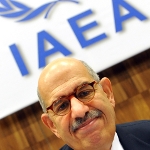
Source: Getty
The ElBaradei Effect on Egyptian Politics
Former IAEA Chief ElBaradei's criticism of Egypt's electoral process has awakened hopes for ending the country's political stagnation.
The advent of Mohammed ElBaradei as a potential presidential candidate has introduced an unpredictable new element into Egypt's slow-moving succession crisis. For the first time in recent memory, a prominent member of Egypt's establishment has spoken out against the Mubarak regime. Even if ElBaradei never attacked President Hosni Mubarak personally, his indictment of Egypt's current predicament is all the more devastating because it comes from a man who appears eminently more qualified for the presidency than the heir apparent, Gamal Mubarak.
For several months, ElBaradei—who recently stepped down as head of the International Atomic Energy Agency (IAEA) and resides in Vienna pending a return to Egypt in February—had figured on wish lists of grandees who might be able to thwart an inheritance of power scenario. His unexpected statement, issued on December 6, 2009, listing conditions for his candidacy, not only upset some factions of the Egyptian regime, but also spoke to the perennial difficulty the opposition has had in having real political impact.
Since December 2004, when the Kifaya movement first gathered outside Cairo's Court of Cassation to protest Hosni Mubarak's expected re-election (tagdid, renewal) and the prospect that his son Gamal was being groomed to inherit his position (tawrith, inheritance), Egypt's opposition has made little progress in mounting a serious challenge to the Mubarak regime. The Kifaya movement was crucial in giving expression to dissatisfaction with the status quo, but largely failed to appeal beyond a core of activists or much of the country's establishment. The major legal opposition parties—the Wafd, Tagammu’, Arab Nasserist, and even the newer Ghad Party—have continued their slow slide into irrelevancy, securing fewer seats in parliament and a narrowing share of public awareness, just as their media organs have been overshadowed by a vibrant new commercial press. Other parties have either been denied legal recognition (al-Wasat, al-Karama), are virtually non-existent (the majority of legal parties), or remain intellectual movements rather than political machines (Democratic Front).
The Muslim Brotherhood, long presented as the most potent challenger to the regime, has explicitly stated it has no interest in contesting the presidency. More generally, the re-assertion of the Islamist movement's conservative and politically quietist current—in part because of a bruising face-off with the regime in recent years—suggests that it has no desire or even capability to mount a challenge to either tagdid or tawrith.
It should no be surprise, then, that in recent years alternatives to formal political organizations, often centering on the idea of providential savior(s) as the last best hope against tawrith, have dominated media debates. Journalists and activists have speculated about whether a prominent personality—ElBaradei, Secretary-General of the Arab League Amr Moussa, Nobel Prize-winning chemist Ahmed Zuwail, Director of General Intelligence Omar Suleiman, prominent jurist and writer Tareq al-Bishri—could head off a Gamal Mubarak presidency. Muhammad Hassanein Heikal, the former minister of information and Nasser confidante who has turned into a leading critic of the Mubarak regime in its twilight years, proposed a variant of this personality-driven opposition in his latest television program. A council of elders would steer the country through a transition period, during which a new constitution would be drafted before a presidential election would be held. All of these scenarios took into account the inability of existing political organizations to achieve these changes; instead they focused on the moral suasion that the right person could exercise to convince the regime of the necessity of genuine reform.
This imperative of constitutional change lies at the core of ElBaradei's conditions for running for president. He has shone a spotlight on the political illegitimacy of the 2007 constitutional amendments, which notably restricted eligibility requirements in presidential elections, making an independent presidential candidate virtually impossible. But beyond electoral rules, ElBaradei has undermined the present constitution with numerous moral and legal arguments, articulated in a long interview with the prominent journalist Gamil Mattar in al-Shorouk newspaper. Many of these arguments have been made before, but ElBaradei's stature has given them new moral force.
The response to ElBaradei's advent on the political scene spoke volumes about tensions within the elite. Pro-regime newspapers immediately went on an offensive of insinuations (ElBaradei was accused of being a tool of both Washington and Tehran, out of touch, and secretly Swedish), only to be pushed back by a chorus of indignation by establishment voices left and right. One might not like ElBaradei, this consensus held, but his achievements and stature must be respected; not for him the smear campaigns used against the likes of politician Ayman Nour or civil rights activist Saad Eddin Ibrahim (as unfair as those might have been).
Considering that ElBaradei knows that the constitution is unlikely to be amended again, it is fair to view his position as a call for radical change outside of the present constitutional and legal framework. Indeed, it is hard to see alternatives to such a deus ex machina considering the legal and political advantages enjoyed by the regime. But even within the current system, his views might have repercussions. ElBaradei's call for internationally-monitored elections (a first for any major opposition figure) might bring greater scrutiny to 2010's parliamentary polls (in spring and fall, respectively, for the Shura Council and the People's Assembly). Moreover, he has amplified public attention to the presidential election scheduled for the following year. Some believe that Gamal Mubarak will find it much more difficult to run in 2011 (or before that should his father pass away) if ElBaradei is the face of the opposition, and suggest that President Mubarak is now almost certain to run for a sixth term.
ElBaradei faces an uphill struggle when he returns to Egypt in February, and he has yet to commit to the fight. Should he do so, however, the Mubarak regime might have to face its strongest challenge to date: a man with impeccable credentials and the potential to become the face of Egypt's long-leaderless opposition.
Issandr Amrani is a writer and political analyst based in Cairo. He blogs at www.arabist.net.
About the Author
Issandr Amrani
Carnegie does not take institutional positions on public policy issues; the views represented herein are those of the author(s) and do not necessarily reflect the views of Carnegie, its staff, or its trustees.