

{
  "authors": [
    "Nabeel Nowairah"
  ],
  "type": "commentary",
  "blog": "Sada",
  "centerAffiliationAll": "dc",
  "centers": [
    "Carnegie Endowment for International Peace"
  ],
  "collections": [],
  "englishNewsletterAll": "menaTransitions",
  "nonEnglishNewsletterAll": "",
  "primaryCenter": "Carnegie Endowment for International Peace",
  "programAffiliation": "MEP",
  "programs": [
    "Middle East"
  ],
  "projects": [],
  "regions": [],
  "topics": []
}
Source: Getty
Saudi Repression Strengthens Opposition Abroad
Mohammed bin Salman’s growing repression emboldens opposition abroad and creates more challenges for the rising leader.
As the Saudi leadership takes increasingly aggressive actions against opposition inside and outside the country, dissidents overseas are increasing their engagement with international organizations and institutions. Despite their diverse backgrounds, these opposition figures have found common ground in uniting against Crown Prince Mohammed bin Salman’s authoritarianism. Their growing momentum abroad presents another challenge to MBS as they provide a counter rhetoric of the government on the international level.
As King Salman ascended the throne in January 2015, his son Mohammed bin Salman (MBS) began consolidating power in an unprecedented manner—marginalizing powerful royal figures and monopolizing decision-making, silencing opposition voices including prominent activists, religious scholars, senior members of the royal family, and even opposition figures overseas.
Before 2015, domestic Saudi activists were muted in their criticism of the government and their suggested reforms. With room for freedoms limited, some were still were still allowed to publish their criticisms in local newspapers. Dr. Abdullah Alaoudh, a visiting adjunct professor at George Washington University, explained that “before 2015, sometimes we would escalate and sometimes de-escalate. It was a tug-of-war with the government.”1 An example of previous efforts was the 1993 Committee for the Defense of Legitimate Rights (CDLR), which was met with the arrest of eighteen founding members. However, the late king, Fahd bin Abdulaziz, ordered the release of most of them within a month of their arrest.
However, since coming to power, MBS closed all remaining meager avenues for dissent. MBS’ new highly aggressive approach is resulting in a notable increase in regime opponents abroad. Saudi asylum seekers tripled in 2017 compared to 2012, according to the United Nations High Commissioner for Refugees, largely motivated by increasingly oppressive domestic silence. This does not include those who are in self-exile and have not officially applied for asylum. This new Saudi diaspora escaped the new environment of zero tolerance for any criticism. Reflecting this new reality Dr. Alaoudh notes there were hundreds of Saudis at an international Saudi opposition conference in 2018, while previous years drew only dozens of attendees.2
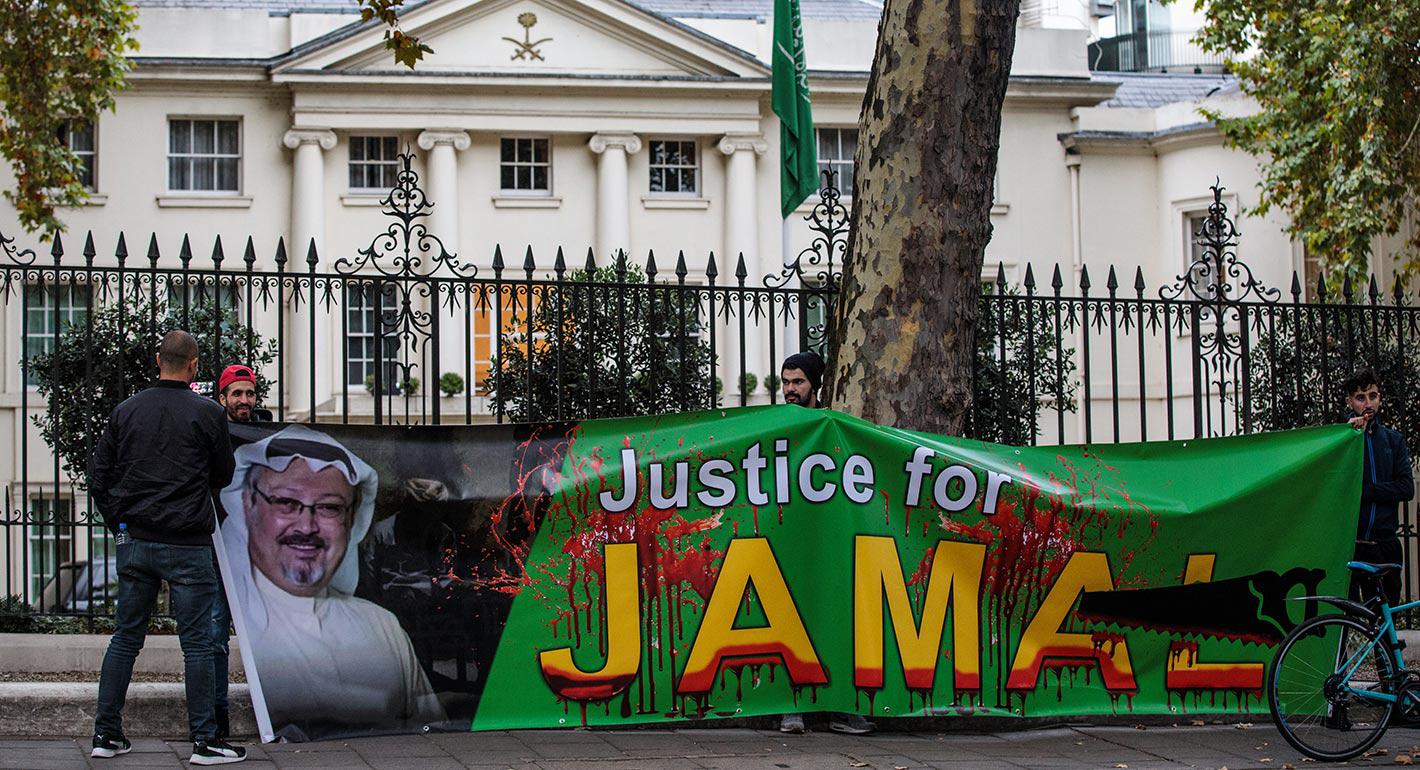
Even as Saudi opposition fled the kingdom at record levels, the government attempted to pursue them beyond its borders. The most infamous example is the brutal murder of Saudi dissident, Jamal Khashoggi. Others have been subjected to intimidation and bullying, in an effort to silence them. But despite the increased attempts to silence criticism and opposition, oppositions figures abroad are becoming more active and more adept at making their voices heard—reaching audiences inside the kingdom. “MBS’ actions turned those who were in the grey area to the opposition, and increased the opposition’s strength,” asserts Dr. Saad Al-Faqih, a prominent London-based Saudi opponent.3 Many of the expatriate Saudi opponents can relate to the kingdom’s youthful population by harnessing their high visibility on social media. Videos discussions of Saudi politics by some Saudi dissidents on social media channels are seen by hundreds of thousands, with reportedly nearly 75 percent of views coming from inside the kingdom.4 Saudis in exile understand the importance of keeping strong channels of communication with domestic audiences.
The recent establishment of the National Assembly Party (NAAS) on September 23, 2020, showcased efforts to unite exiled opposition. NAAS is actively lobbying against the Saudi government with Western states, voicing concerns over the status of human rights within the Kingdom. Saudi opposition activists overseas have also established good communication channels with reputable international organizations, academic institutions, and major media outlets to voice their concerns and challenge the narrative promoted by the Saudi government. Regime opponents believe international organizations can help them increase pressure on the Saudi government and expose its actions. Saudi dissidents understand MBS’s obsession of polishing his image abroad as the leader who can induce positive change in the kingdom, and therefore, they attempt to uncover many of the violations committed by his government in the international arena.
However, despite their individual abilities to maintain communication channels to domestic audiences on social media, the serious challenge for opposition figures and for NAAS is to garner support inside the kingdom, influencing Saudis at home to mobilize around its mission. Thought Saudis in the kingdom can now easily access the NAAS narrative, promoted by a number of Saudi dissidents abroad available on various social media outlets, it is difficult to gauge the level of the popular support for this rhetoric. Gauging the domestic validity of NAAS is especially challenging in the era of MBS, when Saudis cannot show any approval of opposition narratives. Also, the fact that these dissidents are not inside the country, and in some respects do not experience the people’s daily grievances, make their narrative less appealing for many.
While Saudi opponents abroad might not directly bring about the desired changes inside MBS’ kingdom, their increasing ability to lobby internationally for their cause and the establishment of a unified platform such as NAAS creates an opportunity to establish formal channels with international organizations, and possibly governments. These elite Saudi dissidents have a clear opportunity to voice the concerns of the people within the kingdom on the international stage. And while the role of the incoming Biden administration in this regard should not be exaggerated, Saudi dissidents, some of whom reside in the United States, are likely to seize this opportunity to pressure the new U.S. administration to draw clear red lines for the Saudi government. However, at the time being, these dissidents face significant challenges to rally Saudi people inside the kingdom around their cause.
Nabeel Nowairah is an independent analyst focusing on politics and geopolitics of the Gulf Cooperation Council (GCC) states and Yemen. Follow him on Twitter @NabeelNowairah.
1 Interview conducted by the author on September 26, 2020.
2 Ibid.
3 Interview conducted by the author on September 12, 2020.
4 Interview with Omar Abdulaziz on September 15, 2020.
About the Author
Nabeel Nowairah
Nabeel Nowairah is an independent analyst focusing on politics and geopolitics of the Gulf Cooperation Council (GCC) states and Yemen. Follow him on Twitter @NabeelNowairah.
Carnegie does not take institutional positions on public policy issues; the views represented herein are those of the author(s) and do not necessarily reflect the views of Carnegie, its staff, or its trustees.