

{
  "authors": [
    "Ali Dogan"
  ],
  "type": "commentary",
  "blog": "Sada",
  "centerAffiliationAll": "",
  "centers": [
    "Carnegie Endowment for International Peace"
  ],
  "collections": [],
  "englishNewsletterAll": "",
  "nonEnglishNewsletterAll": "",
  "primaryCenter": "Carnegie Endowment for International Peace",
  "programAffiliation": "",
  "programs": [],
  "projects": [],
  "regions": [],
  "topics": []
}
Source: Getty
Saudi Arabia’s Neom Diplomacy
Saudi Arabia is building a new megacity to woo international partners. But the plans may pit Saudi against its long-time partner, the UAE.
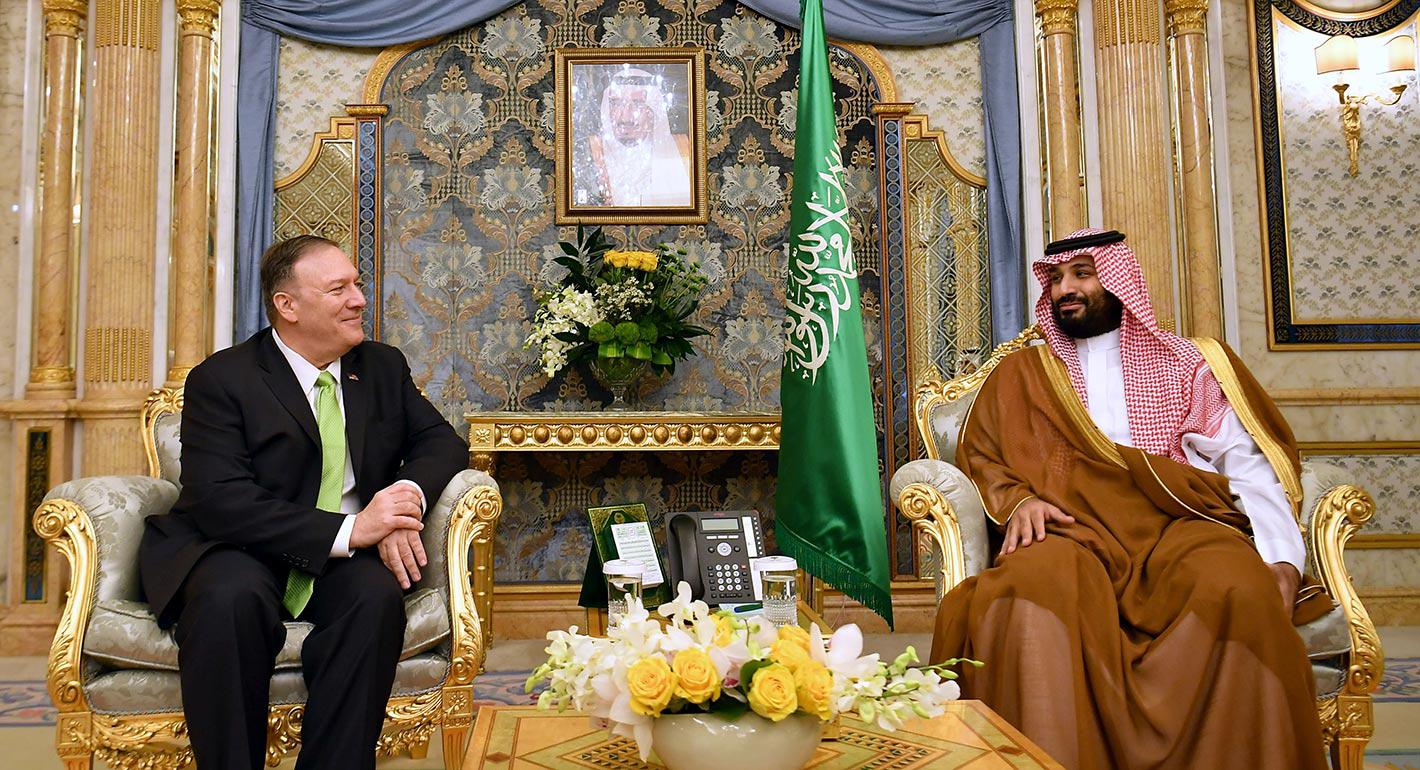
On November 23, 2020, a meeting between former U.S. Secretary of State Pompeo and Mohammed bin Salman took place in Neom, the futuristic planned city in Saudi Arabia’s Tabuk province. Neom, an acronym for “New Future,” is a planned $500 billion futuristic megacity expected to cover 10,230 square miles in northwestern Saudi Arabia abutting the Gulf of Aqaba. The place of the meeting indicates Neom’s strategic importance for Mohammed bin Salman’s foreign policy. The meeting is part of a new Saudi Neom diplomacy and is only one of many similar meetings likely to follow in the future.
Mohammed bin Salman announced the plans for the megacity Neom in October 2017, just four months after his controversial appointment as crown prince. This did not only create opposition within the royal family but also forced Mohammed bin Salman to convince the very young and highly unemployed Saudi population of his rightful claim to the throne. Neom, as MBS’ own megaproject, serves as key tool for him to consolidate his power in Saudi Arabia and foster the regime’s security. In recent years, Mohammed bin Salman has increasingly used of Neom as a lynchpin in his diplomatic efforts. The city is planned to have an independent economic zone with its own legal and tax system. The government aims for it to diversify the economy by promoting new economic high-tech areas. The city’s geographical location is close to international markets and it will be run by 100 percent renewable wind and solar energy. Furthermore, the release of Neom’s “The Line”, a 170-kilometer transportation line, shows that Neom will have an AI regulated underground train and car traffic.
What makes Neom unique compared to other megaprojects is its role in Saudi foreign policy as a soft power tool. Neom expands Saudi Arabia’s foreign policy opportunities. In the first official three-day visit of a Saudi monarch to Russia in October 2017, the Russian Investment fund (RFPI) declared that it would invest several billion dollars into Neom and take part in the facilitation of Neom with Russian high-tech companies. Due to the futuristic and neoliberal ideas at Neom’s core, Saudi Arabia also emphasizes it as a place for U.S.-Saudi cooperation and investment. For Mohammed bin Salman, the Neom project serves as a showcase to woo Saudi Arabia’s diplomatic partners.
For instance, Saudi Arabia planned to showcase its megaproject to leading economic nations at the G20 summit in 2020 by organizing visits for state leaders to Neom. During the G20 conference, British Prime Minister Boris Johnson stated that he would like to have visited Neom and that Neom represents a greener future for all. The Neom site offers a climatically and geographically better location for international companies than Dubai’s highly humid summers. Saudi Arabia is trying to promote the futuristic and touristic image of Neom as a potential competitor to Dubai. Neom advertisements in the Wall Street Journal, on social media, on European TV channels, as well as for an ESport league show the importance of Neom for Saudi Arabia’s public relations strategy. Pompeo’s recent visit exemplifies Neom’s unique status as a megaproject.
Relations with Israel are necessary for Saudi Arabia to complete Neom. The normalization agreements between the UAE, Bahrain, Sudan, and Israel therefore serve the interest of Saudi Arabia. In June 2017, Egypt handed the islands Sanafir and Tiran over to Saudi Arabia, located off the coast of Saudi Arabia and the Sinai Peninsula. Egypt gave islands to Saudi Arabia on the assumption that Egypt’s economy would benefit from Neom. Indeed, Saudi Arabia has plans for a bridge crossing the Strait of Tiran and connecting Egypt to Neom. However, expanding Saudi Highway 392 and building a Saudi-Egypt bridge requires negotiations with Israel. The 1979 peace treaty between Egypt and Israel includes the guarantee of free Israeli shipping through the straits of Tiran and, therefore, the project relies on Israel’s approval.
Neom cannot flourish if a deal with Israel does not take place. Though according to an opinion poll of the Doha institute, up to 90 percent of the Arab population still opposes the diplomatic recognition of Israel. Saudi Arabia does not only need to continue its international public relations strategy, but it also needs other allies from the Arab World to provide a ground of Arab Israeli mutual recognition. The question of whether we will witness a boost in Arab recognitions of Israel remains outstanding.
Neom might negatively impact relations between Saudi Arabia and the United Arab Emirates. The two countries’ relationship is not always so cordial. In 2003, Saudi Arabia and the UAE butted heads over a border dispute on the Shaybah oilfields. Furthermore, the War in Yemen showed divisions in both countries’ interests in Yemen. In the future, Neom and Mohammad bin Salman could lead both Gulf countries to future competition over the market. Pursuing similar projects with the aim of diversifying the economy, both countries could confront each other on the share of different markets for the region.
Major projects such as the King Abdullah Financial District (KAFD) and the King Abdullah Economic City (KAEC) already suffer from competition with neighboring UAE. International companies can promise their expats a western lifestyle in Dubai, which is not yet the case in Saudi Arabia. This is an important factor for international companies looking for regional representation in the MENA region. The multi-billion-dollar projects KAFD and KAEC struggled with getting companies into their facilities. The Saudi government even plans to transform KAFD into a special economic zone to attract international companies. Minister of investment, Khalid al-Falih said in October 2020 that special economic zones are going to be launched in 2021.
Saudi Arabia cannot let Neom fall to the same fate given the kingdom’s high population growth and high unemployment. The Saudi government will try to attract the companies away from Dubai by offering special tax agreements and other sweeteners to relocate to Neom. As the UAE and Saudi Arabia both work to reduce their economies’ dependence on oil they risk competition with each other for international companies and investment.
Whether the Emiratis will be willing to share their hegemony on the business hub remains open. It remains to be seen how the two richest Gulf countries will settle a future dispute. Saudi Arabia will need to negotiate with Israel and the UAE for Neom’s future.
Mohammed bin Salman’s foreign policy is strongly tied to his economic and social vision. Neom serves as the showcase of Saudi Arabia’s different megaprojects and a boon for its diplomatic efforts. The government aims to improve Saudi Arabia’s public image and promote the business opportunities in the kingdom through Neom. Mohammed bin Salman’s position as the heir-designate to the kingdom’s throne, will likely lead to increasing uses of Neom diplomacy.
Ali Dogan is a Research Fellow at the Leibniz-Zentrum Moderner Orient and a Doctoral Candidate at the Otto-Suhr-Institute of Political Science in Berlin. Follow him on Twitter @LearnIntelZMO.
About the Author
Ali Dogan
Carnegie does not take institutional positions on public policy issues; the views represented herein are those of the author(s) and do not necessarily reflect the views of Carnegie, its staff, or its trustees.