

{
  "authors": [
    "Tamer Badawi"
  ],
  "type": "commentary",
  "blog": "Sada",
  "centerAffiliationAll": "",
  "centers": [
    "Carnegie Endowment for International Peace"
  ],
  "collections": [],
  "englishNewsletterAll": "",
  "nonEnglishNewsletterAll": "",
  "primaryCenter": "Carnegie Endowment for International Peace",
  "programAffiliation": "",
  "programs": [],
  "projects": [],
  "regions": [],
  "topics": []
}
Source: Getty
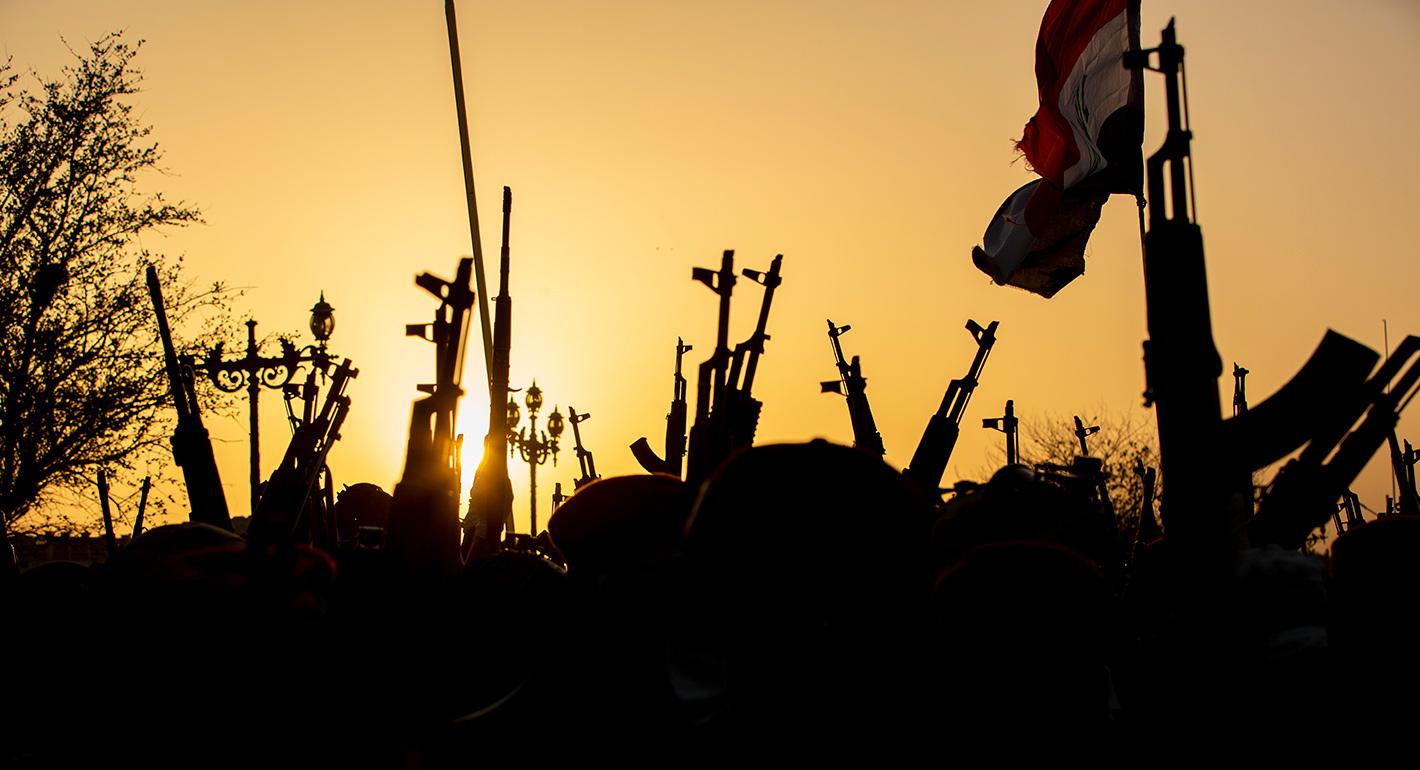
Iraq’s Resurgent Paramilitaries
Paramilitary surrogates are popping up in Iraq with strong links to existing militant networks. The application Telegram has been crucial in fostering new paramilitary identities.
Iraqi paramilitary groups opposing U.S.-led coalition forces, including Iran-backed Kata’ib Hezbollah (KH) and Asa’ib Ahl al-Haq (AAH), use Telegram to create new groups that publicize their attacks. For prominent groups, this cultivation of new militant identities taking credit for attacks on U.S.-led troops deflects attention from their responsibility, complicating U.S.-reprisals and deflecting domestic political pressures. With nearly two dozen new Telegram channels that have materialized over the past year alone and claim to represent previously unknown paramilitary groups, roughly 75 percent of the emergent organizations are paramilitary, and 25 percent are armed vigilantes.1
This apparent rise in new actors within Iraq’s highly fragmented paramilitary landscape has occurred since March 2020.2 Between March 2020 and March 2021, at least twenty-six new groups have appeared (figure 1).3 Concurrently, some of the Telegram channels belonging to surrogate groups attracted more new followers than Telegram channels openly affiliated with long-standing paramilitary groups. For example, as of mid-April 2021, Ashab al-Kahf (AaK), a prominent surrogate, had over 8,000 followers while KH had around 7,400. The new channels share flashy announcements, including self-described vigilante groups threatening to attack embassies and Iraqi political parties. Though actors on these new Telegram channels are credited with anti-United States operations and attacks against domestic rivals–occasionally sharing footage of attacks–there is no proof of their physical presence or formal structure. The lack of concrete information indicates that they are either surrogates given a margin of autonomy from major paramilitaries or merely the major groups attributing their attacks to fictitious surrogates on Telegram.
| Figure 1: A chronological list of Iraq’s new surrogate groups (2020–2021) | ||||
| Name | Estimated appearance date | Group type | Logo | |
| 1 | Usbat al-Tha'ireen (The League of Revolutionaries) | March 2020 | Paramilitary |  |
| 28 | Fariq Fatemiyoun al-Maidani (The Field-based Fatemiyoun Team) | March 2020 | Vigilante/ Cyber Operations |  |
| 3 | Ashab al-Kahf (The People of the Cave) | March 2020 | Paramilitary |  |
| 4 | Qabdat al-Huda (The Grip of Guidance) | April 2020 | Paramilitary |  |
| 5 | Saraya al-Thawra Al-Eshreen al-Tahniya (The Second 1920 Revolution Companies) | May 2020 | Paramilitary |  |
| 6 | Tha'ar al-Muhandis (The Revenge of Muhandis) | May 2020 | Paramilitary |  |
| 7 | Jund Soleimani (The Soldiers of Soleimani) | June 2020 | Paramilitary |  |
| 8 | Kata’ib al-Shabaniya (The Shabaniya brigades) | July 2020 | Paramilitary |  |
| 9 | Liwa Muntaqimon (The Avengers brigades) | July 2020 | Paramilitary |  |
| 10 | Ahl al-Maroof (The People of Favors) | August 2020 | Vigilante group |  |
| 11 | Saraya Awliya al-Dam (The Blood Guardians’ Companies) | August 2020 | Paramilitary |  |
| 12 | Rab’ Allah (God’s People) | September 2020 | Vigilante/ Propaganda Group |  |
| 13 | Abu Jadaha (The People of the Lighter) | September 2020 | Vigilante/ Propaganda Group |  |
| 149 | Al-Majame'e al-Khasa (The Special Groups) | September 2020 | Vigilante-Propaganda Group |  |
| 15 | Quwat Thu al-Faqar (The Forces of Thu al-Faqar) | September 2020 | Paramilitary |  |
| 16 | Saraya al-Muntaqim (The Avengers Companies) | September 2020 | Paramilitary |  |
| 17 | Qasim al-Jabarin (The Breaker of Titans Companies) | September 2020 | Paramilitary |  |
| 18 | Liwa al-Shahid Ahmed Dar'am (The Brigades of Martyr Ahmed Dar’am) | September 2020 | Paramilitary |  |
| 19 | Firqat al-Ghashia (The Division of the Overwhelming) | September 2020 | Paramilitary |  |
| 20 | Ulu al-Azam (Those of the Perseverance and Strong Will) | September 2020 | Paramilitary |  |
| 21 | Ahbab Allah (God’s Beloved People) | October 2020 | Vigilante Group |  |
| 22 | Saraya Tha'ar al-Shuhada (The Companies of Martyrs’ Revenge) | October 2020 | Paramilitary |  |
| 23 | Kata’ib Abul-Fadl al-Abbas (Abul-Fadl al-Abbas Brigades) | November 2020 | Paramilitary |  |
| 24 | Al-Muqawama al-Dawliya (The International Resistance) | January 2021 | Paramilitary |  |
| 25 | Alwiyat al-Wa'ad al-Haq (The Brigades of the Truthful Promise) | January 2021 | Paramilitary |  |
| 26 | Liwa Khaybar (The Khaybar Brigade) | March 2021 | Paramilitary |  |
| Source: The author’s data collection is from open-source resources | ||||
The Telegram channel, “Sabereen News,” (the Patient People’s News) has become central to the emergence of these new groups. Though Sabereen News hasnot associated itself with a specific group, the channel is used to publicize militant operations claimed by various groups.4 As such, social media has proven effective in diverting attention from Iraq’s main paramilitary organizations—Sabereen’s monthly subscribers skyrocketed by 150 percent in June 2020 when Iraqi paramilitary attacks against coalition forces increased and the government clashed with KH militants.5 This growth has since slowed (figure 2), likely due to the saturation of Telegram with competing channels that cover attacks against the coalition forces.
Figure 2: Sabereen News’ monthly subscribers and their growth rate from May 2020 to March 2021

While some look to these new organizations as improvised in 2020, Iraqi paramilitary strategy since late 2019 has trended toward fracturing militant identities to divert attention from major actors. Across this emergent militant class, marketing strategies have emerged as pivotal to the legitimacy of these new identities. Surrogates promoted by Sabereen and other channels share branding similarities with other militant networks, further underscoring possible linkages. Notably, the emblems of many of these new groups resemble that of Iran’s IRGC, and several of these groups replicate the names and symbols of pre-existing Shia and Sunni armed groups (figure 3). Illustrating this, AaK, derives its name from a proto-paramilitary group active in early 2004.6 The group evolved into AAH, becoming a full-fledged group in 2006, when it splintered from Jaysh al-Mahdi. Meanwhile, this new class of paramilitaries employs highly variable visual and linguistic communication techniques. This variability could suggest either the multiplicity of paramilitary actors directing these groups, or indicate a few groups intentionally creating variations to convince their audience of the new groups’ independent evolution. In either case, the intention is to prevent the audience from accurately attributing attacks to a specific known group.
| Figure 3: Example for branding similarity between new groups and other groups | ||
| New group | Influencing model | |
| 1 |  The Second 1920 Revolution Companies (an Iraqi surrogate that emerged in May 2020) |  The 1920 Revolution Brigades (a Sunni group founded in 2003) |
| 210 |  The International Resistance Faction group (an old logo for a surrogate that emerged in January 2021 |  The Fatemiyoun Brigade (an Afghan Shia group operating in Syria) |
Announcements of new groups peaked in September 2020, with the announcement of nine new armed groups, followed by a dramatic decrease in October. In October 2020, Iraq’s paramilitaries offered a “conditioned opportunity” (armistice), to the United States to prevent further escalation and minimize domestic pressure in exchange for an urgently scheduled withdrawal of U.S. troops. This armistice was issued through the so-called Iraqi Resistance Coordination Commission (IRCC), an entity claiming to speak on behalf of an axis of paramilitaries in the country. Spearheaded by four prominent paramilitaries, the IRCC is influential in Iraq’s paramilitary arena primarily due to the leadership of KH and AAH. However, cooperation between KH and AAH is strengthened by the participation of Harakat al-Nujaba (HaN)—a group positioning itself as a facilitator between different Iran-backed Iraqi paramilitaries—and Kata’ib Sayyid al-Shuhada (KSS)— a group visible in Syria—in the IRCC.
The threat posed against those groups after the U.S. assassination of the two leading figures, the IRGC Quds Force’s Qassem Soleimani and the Popular Mobilization Units’ Deputy Commander Abu Mahdi al-Muhandis in January 2020 necessitated uneasy collaboration in Iraq’s highly competitive paramilitary environment. Through this cooperation, Iran has been able to consolidate a semblance of control over Iraq’s groups through the IRCC framework, persuading them to act in conjunction to perpetuate the idea of generating new militant identities.
Under the IRCC conditioned opportunity, rocket attacks by paramilitary groups against the U.S. Embassy and Iraqi bases hosting U.S. troops declined between October 2020 and late January 2021. Conversely, during that period, attacks on logistical convoys allegedly supplying the coalition forces increased, as they presented a lower profile form of anti-U.S. action (figure 4).7 Furthermore, most of these attacks occurred in central and southern Iraq, the strongholds of the paramilitary groups (figure 5). Additionally, coordinated attacks by vigilante groups against Iraqi parties and media perceived to be close to the United States became relatively more visible. The ability of these obscure actors to increase their operations under the IRCC armistice indicates Iraq’s prominent paramilitary actors, either unilaterally or in a coordinated effort, pursued a high-risk strategy against the United States that could have invited a strong reprisal.
Figure 4: Paramilitary attacks purportedly targeting U.S.-led coalition forces since Mustafa al-Kadhimi took office in May 2020

Figure 5: The governorates in which attacks against logistical convoys purportedly supplying U.S.-led Coalition forces taken place between July 2020 and March 2021

Trilateral relations between Iraq, Iran, and the United States continue to impact the strategy and operations of Iraq’s paramilitaries. During president Trump’s exit from the White House, Iraq’s paramilitary network resumed operations with the announcement of two groups and the completion of over twenty operations against logistical convoys. Furthermore, since January 2021, operations targeting coalition forces’ bases with rocket attacks have been on the rise. On March 4, 2021, the IRCC implicitly revoked its October armistice by blessing new anti-United States attacks in 2021—including rocket attacks that those groups had previously avoided endorsing last year. Later, the IRCC openly revoked the armistice in a statement released on April 7, the same day Iraq and the United States held their third strategic dialogue. The Biden administration’s relative de-escalation against Iran’s regional axis contributed to cohesion between major Iraqi paramilitary groups such as KH and AAH. This created smoother modus operandi for those groups to stage anti-U.S. attacks through surrogates.
The concession to allow surrogate groups is a calculated trade-off for major Iraqi paramilitary groups. Surrogate groups provide them an avenue for plausible deniability in regard to attacks against U.S.-led troops. With the surrogate groups claiming responsibility for attacks, major groups have not been able to publicly show-off their individual capabilities to attack U.S.-led forces. The current mushrooming of surrogates puts into question the future of those groupings and constructed identities. This current wave of surrogates can become the cornerstone of a new class of “special groups,” similar to the class of paramilitaries Iraq witnessed after the U.S. invasion of 2003.
Notes
1 Among twenty-six groups appeared between March 2020 to March 2021, twenty groups identify as paramilitary, whilst six groups are vigilantes.
2 After their first appearance on Telegram, some of these groups claimed operations retroactively.
3 The vast majority of those groups do not publicize an establishment date. Ashab al-Kahf (AaK) is a notable exception where some Iraqi Telegram channels from the Iran-led ‘axis-of-resistance’ suggest it was established in 2019, despite only starting to be visible since March 2020.
4 Sabereen News and some new groups have been increasingly utilizing several foreign languages to reach a wider audience and gain wider international attention, especially English. In addition, Russian and Persian have been used by Sabereen.
5 Data collected and analyzed by author from https://tgstat.com/.
6 This group name and date is provided by a manifesto booklet published by AAH and reviewed by the author.
7 While paramilitary groups claim the attacked convoys are destined for the coalition forces, the spokesperson of the coalition forces made a counterclaim in a tweet on April 17 that the attacked convoys did not belong to the coalition.
8 This surrogate started as a cyber-operations grouping and has a twin group named ‘Fariq Fatemiyoun al-Electroni’ (The Fatemiyoun Electronic Team) that is more dedicated to cyber-operations. Another two prominent cyber-operations groups are 'Fariq Kawthariyoun al-Electroni' and ‘Neo Cyber.’ The emergence of those groups indicates the development of an axis of cyber-focused militant-vigilantes against domestic and foreign nemeses.
9 Al-Majame'e al-Khasa was established in September 2020 but it started operating a month after. It has often operated in conjunction with Rab’ Allah, the most proactive vigilante group among the six groups.
10 The logo similarity between the two groups, IRF and Fatemiyoun, was first noticed by conflict analyst Amir Toumaj.
Tamer Badawi is an associate with Bonn-based CARPO and Istanbul-based Al Sharq Forum, focusing on Iraq, Iran, and security in their neighborhood. Follow on Twitter @Tamerbadawi1.
About the Author
Tamer Badawi
Consultant and a PhD Candidate at Kent University.
Tamer Badawi is an associate with the Middle East Directions Programme at the European University Institute, focusing on Iran’s foreign policy toward its neighbors. His research focuses on the political economy of Iran’s relations with Arab countries and with Islamist movements. He was previously a research fellow at Al Sharq Forum in Istanbul. Tamer received an M.A. in International Relations from Central European University, and a B.A. in Oriental Studies from Alexandria University.
Carnegie does not take institutional positions on public policy issues; the views represented herein are those of the author(s) and do not necessarily reflect the views of Carnegie, its staff, or its trustees.