

{
  "authors": [
    "Adnan Abu Amer"
  ],
  "type": "commentary",
  "blog": "Sada",
  "centerAffiliationAll": "dc",
  "centers": [
    "Carnegie Endowment for International Peace"
  ],
  "collections": [],
  "englishNewsletterAll": "menaTransitions",
  "nonEnglishNewsletterAll": "",
  "primaryCenter": "Carnegie Endowment for International Peace",
  "programAffiliation": "MEP",
  "programs": [
    "Middle East"
  ],
  "projects": [],
  "regions": [],
  "topics": []
}
Source: Getty
Postponed Palestinian Elections: Causes and Repercussions
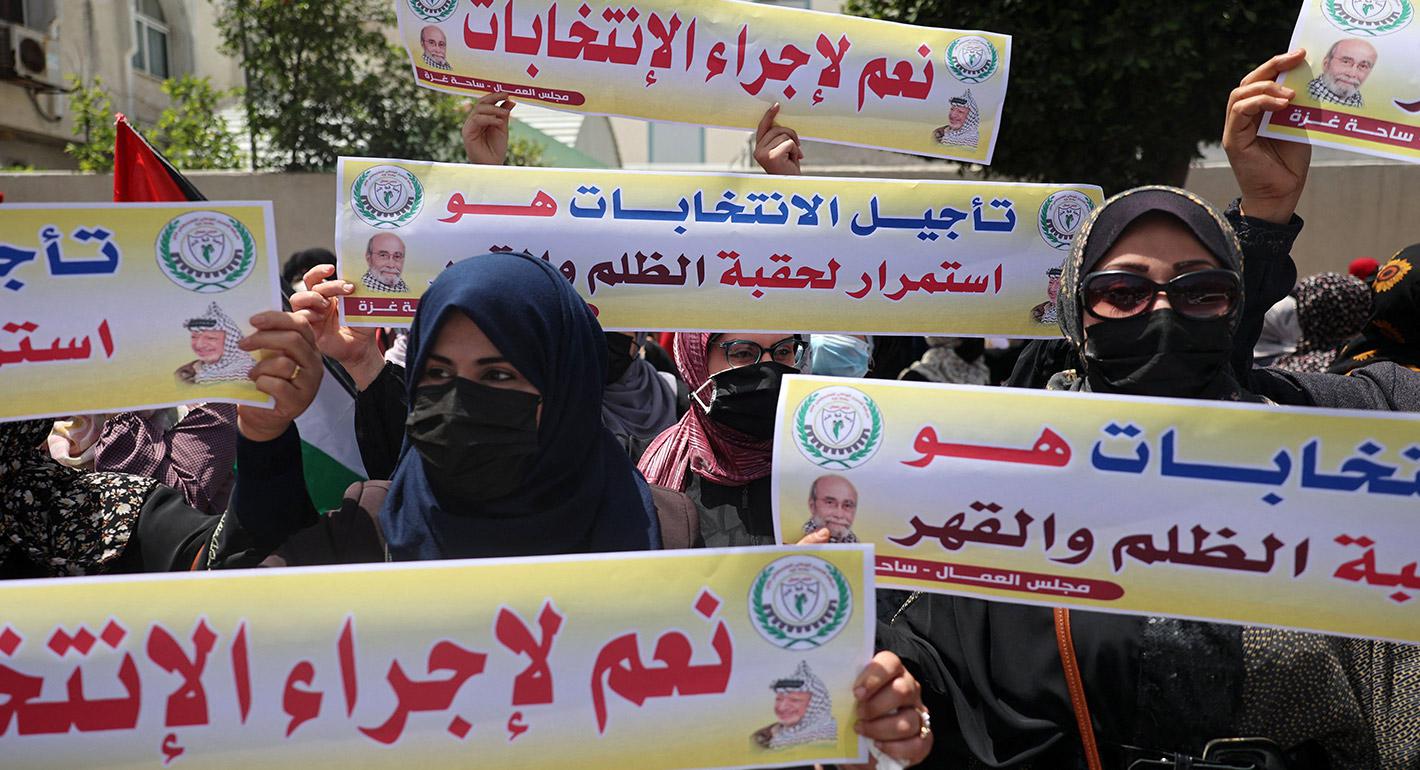
President Mahmoud Abbas’ decision to postpone the May 22 legislative elections has been denounced by some Palestinians as a “usurpation of power” and a “constitutional crime.”
Over the past few weeks, President Mahmoud Abbas’ political team has signaled that the legislative elections scheduled for May 22 might be postponed. The official announcement came on April 29, after internal reports indicated that the Fatah movement, led by Abbas, would face certain defeat due to fragmentation. The movement remains divided among three factions: Mahmoud Abbas’ "Storm,” Marwan Al Barghouti’s “Liberty,” and Mohammed Dahlan’s “Future.” Both Al Barghouti and Dahlan are formidable opponents of Abbas and are eager to challenge the incumbent in the long-anticipated electoral cycle.
Palestinian Politics
The Abbas team has consistently sought to convince Barghouti, a longtime Fatah activist currently imprisoned by Israel, to end his presidential campaign.1 In Abbas’ inner circle, there is a strong belief that Barghouti could receive a significant share of votes at the expense of Abbas. Fatah Central Committee members Hussein al-Sheikh and Mahmoud al-Alouli visited Barghouti in prison but failed to dissuade him from his bid for office. Barghouti’s refusal to end his campaign increased the potential for election delays, given his popularity among Fatah factions.
In light of the Fatah movement’s fragmentation, Hamas holds a clear advantage in potential legislative elections, as shown by public opinion polls indicating a likely landslide victory. Abbas’ postponement of the May 2021 elections originates from fears of repeating the 2006 elections debacle, when Hamas won 76 of the 132 seats in the Legislative Council. Ahead of this election cycle, Hamas prepared by unifying its factions, supporting candidates with proven scientific and academic backgrounds, and hinting at the possibility of electoral alliances with other parties.
Hamas reportedly “undertook strenuous efforts to dissuade Abbas from postponing elections, after learning of his intentions a few weeks ago.”2 With failed repeated attempts to influence the Abbas team, Hamas’ organizational ranks and electoral bases have been “highly disappointed” by the decision.3 Though postponing elections does not necessarily equal the end of Palestinian democracy, Hamas leadership is “completely convinced that Abbas isn’t serious in his intentions to hold elections in the future, which poses several challenges in the coming period.”4
Regional Interventionism
In addition to internal divisions, regional Arab neighbors have intervened in Palestinian political affairs and contributed to the elections’ postponement. The heads of the Egyptian and Jordanian intelligence services, Abbas Kamel and Ahmad Hosni, visited the headquarters of the Palestinian Authority to meet with Abbas in mid-January. The two officials hoped to dissuade Abbas from proceeding to elections, fearing a certain victory for Hamas, which would have repercussions for internal politics in their countries. Egypt is wary of a Hamas victory, given its potential to lend legitimizing moral support to the Muslim Brotherhood. Meanwhile, as Jordan emerges from an internal security crisis related to a reported coup attempt against the king, any victory for Hamas in Palestine—especially in the West Bank—could increase instability given the King’s tenuous relations with Hamas.
Egypt and Jordan have intervened in internal Fatah politics before, hoping to promote reconciliation between Abbas and Mohammad Dahlan, former leader of Fatah in Gaza. Dahlan has long received regional support, especially from Cairo and Abu Dhabi, but their attempts to cement his leadership in the Palestinian political arena since 2011 have been largely unsuccessful. Abbas not only expelled Dahlan from the Fatah movement in 2011, but following the unsuccessful efforts of Cairo and Amman to facilitate a reconciliation, Abbas has vetoed on any efforts to return Dahlan to the movement.
Meanwhile, Israel strongly opposes any potential Hamas victory in Palestinian elections. In March, the Israeli government dispatched Nadav Argaman, head of the Shin Bet security service, to meet Abbas in his headquarters in Ramallah. Seeing data predicting a huge victory for Hamas and resounding loss for Fatah, Israel made a final effort to persuade Abbas to backtrack on the election move. For Israel, a Hamas victory would be a “nightmare,” especially in the West Bank. Should the Hamas movement return, Israel fears a resurgence of armed operations against the army and the settlers in the occupied Palestinian territories. With cooperation from the Palestinian Authority (PA), Israel has vigorously sought to eliminate Hamas infrastructure in the West Bank through continuous arrest campaigns.
Moreover, Israel has threatened the PA on more than one occasion that any victory for Hamas in the coming elections would result in a complete Israeli boycott of the PA, halting funds transfers, and freezing security coordination. The PA’s deep security and financial ties to Israel rendered this threat a jarring warning to the organization’s leadership.
The Jerusalem Excuse
Distracting from regional interventions and domestic ruptures, Abbas declared he would postpone elections on the basis of Israel’s refusal to allow them to be held in East Jerusalem. Palestinians overwhelmingly denounced Abbas’ decision. Voters argue other options for timely elections—without a full postponement—exist, and the postponement is merely an excuse to extend Abbas’ hold on power. Furthermore, Israel declared that it never notified the Palestinian Authority of its refusal to hold elections in Jerusalem. The European Union, the mediator for this election dispute, also rejected Abbas’ postponement rationale on the same basis. On the procedural level, representatives of the Palestinian Central Elections Committee were reportedly aware of alternative election sites in East Jerusalem.5 The options are said to have included polling stations in United Nations facilities or European embassies in Jerusalem or facilitating electronic voting for Jerusalemite voters.6 But despite the array of options to encourage timely elections, the Palestinian Authority—under Abbas’ leadership—rejected all offers.7
Meanwhile, Hamas and other Palestinian factions repeatedly expressed their willingness to consult with the Palestinian Authority to ensure Jerusalemites could exercise their constitutional right in elections. Prior to the postponement decision, Hamas and other Palestinian factions had called on the PA to turn the issue of elections in Jerusalem into a political battle with Israel—to garner the attention of the international community—while remaining united in their commitment to ensuring successful elections.
Following Abbas’ unilateral postponement of elections, it remains unclear how to resume the electoral process. Immediately after the announcement, the Palestinian political arena erupted into fresh clashes and tensions. Many Palestinians rejected the decision outright, accusing Abbas of excluding other factions. Meanwhile, several regional capitals, especially Cairo and Amman, welcomed the postponement, although Abu Dhabi was left frustrated with the postponement decision given Emirati interests in creating a political foothold for Dahlan . Israel too welcomed the delayed elections, despite fears it may cause security concerns problems should Hamas react by escalating its armed attacks in the West Bank or firing rockets from Gaza.
The decision to postpone the legislative elections is an earthquake in the Palestinian arena that will surely precipitate aftershocks. Already, Fatah and Hamas have exchanged accusations of intentionally causing divisions. And the postponement increases the possibility of the PA resorting to unilateral steps—such as forming a new government without the participation of Hamas—and thereby ending any prospect of reconciliation between them.
Adnan Abu Amer is the head of the political science department at the University of Ummah in Gaza, and a writer and researcher at Arab research centers. He holds a doctorate in political history from Damascus University. Follow him on Twitter at @AdnanAbuAmer2.
Notes
1 Author interview with member of Abbas’ team,
2 Author interview with Hamas, Jerusalem is our date party member, May 1, 2021.
3 Ibid.
4 Ibid.
5 Author interview with CEC official, May 1, 2021.
6 Ibid.
7 Ibid.
About the Author
Adnan Abu Amer
Carnegie does not take institutional positions on public policy issues; the views represented herein are those of the author(s) and do not necessarily reflect the views of Carnegie, its staff, or its trustees.