

{
  "authors": [
    "Adel Marzooq"
  ],
  "type": "commentary",
  "blog": "Sada",
  "centerAffiliationAll": "",
  "centers": [
    "Carnegie Endowment for International Peace"
  ],
  "collections": [],
  "englishNewsletterAll": "",
  "nonEnglishNewsletterAll": "",
  "primaryCenter": "Carnegie Endowment for International Peace",
  "programAffiliation": "",
  "programs": [],
  "projects": [],
  "regions": [],
  "topics": []
}
Source: Getty
Qatar’s Legislative Elections: A Debate for Citizenship Rights Against Tribal Dominance
Dividing electoral districts along tribal lines will be a key test for Qatar and the rest of the Gulf states.
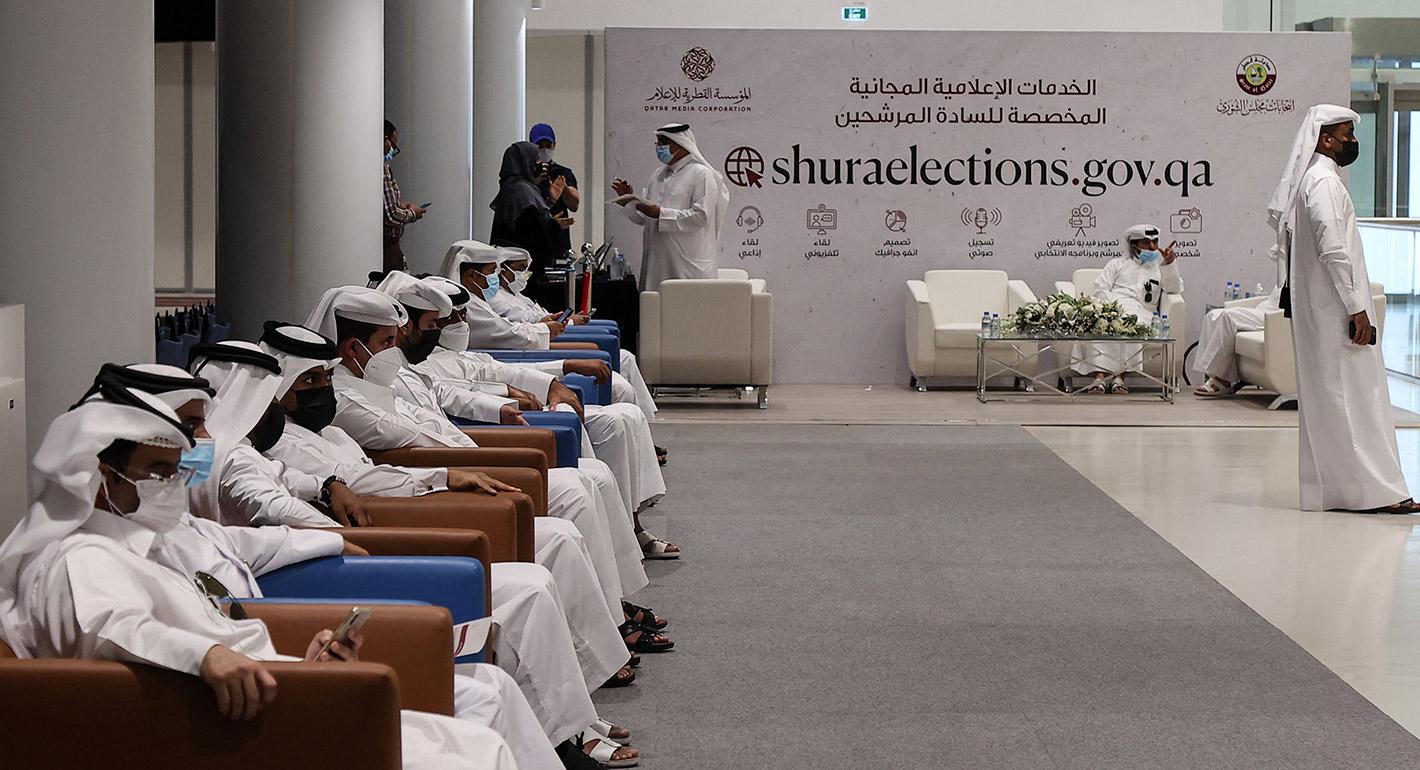
Qatar’s upcoming legislative elections to elect two-thirds of the advisory Shura Council – the first in 17 years – will be held on October 2, 2021. As per the 2004 constitution, Qataris will elect 30 members of the 45-seat body, after which the Emir will appoint the remaining 15 members.
The Shura Council has the legislative authority to suggest, approve, reject, and ultimately issue general state policies as well as control the budget. It has the power to hold the cabinet accountable for its administrative policies and can pass no confidence motions when deemed necessary. These powers, however, broad as they may be, cannot come into action without a quorum of at least two-thirds of the total members of the Council, including those appointed by the Emir. The Emir also retains a constitutional authority to dissolve the Council and take over executive and legislative powers throughout the period of dissolution.
Political Participation: A Test of Stamina
During the early 1960s, several attempts were made by Qatari thought leaders to implement political and legislative reform, the most famous of which was the 1963 petition that was harshly rejected by the government. It wasn’t until 1972 that the Amended Provisional Basic Law of Rule in the State of Qatar was passed, mentioning within it the advisory Shura Council for the first time.
Following the Gulf crisis of June 2017, the Emir of Qatar Sheikh Tamim bin Hamad al-Thani announced the commencement of preparations for the long-delayed Shura Council elections. At the time, the Emir’s decision, which was exhibited in official and civil circles, was interpreted as a tactful act of gratitude for national unity in the face of the crisis.
Although only time can tell what the country’s political landscape will look like once the Shura Council is elected, the elections themselves are expected to boost political participation of Qatari citizens and make Qatar more capable of a gradual transition towards becoming a constitutional emirate.
As preparations continue, fundamental questions arise about how the government will deal with the upcoming Shura Council, how effective the election experience will prove, and whether or not it will yield significant results. Qatar, on more than one level, is undergoing a stress test to determine whether a Shura Council will give Qataris a unique parliamentary experience that will either place their country ahead of other Gulf states or merely be another frustrating attempt at democracy.
Qatar was placed fourth in the Gulf Cooperation Council (GCC) Political Participation Index, issued by the Gulf House of Studies and Publishing. Indeed, Qatar faces several internal challenges to this end. Some of these relate to the nature of governance in the country; tribal balances and deep-rooted dependency on the concept of the rentier state; and societal reluctance to embrace liberal trends that promote individual freedoms. In parallel with the challenges at home, external challenges related to existing regional conflicts force certain limitations and obstacles on the political landscape in both Qatar and the rest of the Gulf states, which cannot be overlooked. The calm that characterizes Doha's relationship with Riyadh and Abu Dhabi does not at all mean that the pages of the Gulf crisis have been finally turned.
Dealing with Tribal Issues: Confrontation or Conciliation?
The Qatari electoral regulations seem to indicate that the government has decided to mend its relationship with the country’s tribes and come to terms with the fact that they are a strong community component that needs to be taken into serious consideration. A gesture of goodwill was made when the government created electoral districts and based their respective regions and names on the locations and names of large, prominent tribes.
Although it is almost impossible to include all components of Qatar’s community in all 30 constituencies – from Sunni urbans to Huwalas to Arab and Ajam Shiites – the state has chosen this formation secure in the knowledge that when the Emir exercises his constitutional right to appoint his chosen 15, he will, in all likelihood, appease the tribes that this division of constituencies prevents from attaining council seats.
Unfortunately, however, this electoral formula and district distribution puts tribal loyalty over nation-state and goes directly against the official state position that warns voters against allowing tribal affiliation to impede authentic representation. The flaw in this formula is that it allows larger tribes to have more votes, and moreover forces Qataris to vote in areas they don’t even live in. Nevertheless, the state, after suffering the bitter consequences of tribal conflicts during the 2019 municipal elections, insists that this system will shield the country from similar tensions.
It is worth noting that organizing tribes into semi-closed electoral districts is a new strategy in GCC elections’ protocol, and Qatar will be the first to see if this can provide fair representation for all social groups in the country.
Which Qataris Can Vote?
The Qatari population is estimated at 260,000 citizens (an estimated 11 percent of the total population of 2.5 million). While the official authorities do not provide a definitive census of Qataris eligible to vote in the elections, Article 80 of the Constitution stipulates that the candidate for the Shura Council must be ‘originally Qatari’ and not a naturalized citizen.
The Qatari government describes those who settled in the country before 1930 and held Qatari residence and nationality until the introduction of the Nationality Act No. 2 of 1961 as “original Qataris”.
The new electoral laws spurred wide-reaching national discourse and particularly alarmed members of Al-Murrah tribe, who were prevented from running. They staged protests demanding a review of these laws which they considered to be discriminatory and politically biased against them because of their suspected involvement in the failed 1996 coup.
Indeed, Al-Murrah’s protests for electoral inclusion had the effect of exposing the country’s prejudiced citizenship and nationality rules. Just like Kuwait and United Arab Emirates, Qatar adopts policies that discriminates against naturalized or non-original citizens and allows them only a fragile and marginal status in the country.
Gulf countries justify these biases by claiming that expats and naturalized citizens greatly outnumber the natives, and if both were given similar rights the natives will eventually become a minority, and this will pose an existential threat to the system of governance and the national identity of these countries. Many international human rights organizations criticize these laws especially as they perpetuate the lack of full citizenship rights through generations.
And while Qatari authorities have managed to quell the protests of Al-Murrah by reaching out to its elders to address their concerns, as well as by allowing some tribal candidates to run in the 16th electoral district, the matter of establishing who counts as an original Qatari and deserves to vote remains a serious challenge that the upcoming Shura Council will have to overcome. The council will have to reform the 2005 Law of Nationality in order to make it more aligned with the Qatari constitution, which states that all Qataris are equal citizens and are entitled to equal rights.
A Shura Council Without Women
In a conservative, religious, and tribal society, it does not seem very likely that any of the 29 women candidates running in this election will come to see the inside of the Shura Council. The Liberals, whose principles and doctrines challenge conservative Qatari society, seem doomed to the same fate.
The larger tribes are expected to have the final say in the formation of the Shura Council. They will ensure that the successful candidates will be in complete alignment with the policies of the state and are homogeneous with its principles. And as excluded hopefuls will be admitted through the Emiri appointment, the results of the election are not expected to yield a rebellious council that could pose any real opposition to the government’s policies or decisions. This, ultimately, means that the issue of the citizenship law will also remain subject to the state’s preferences.
In summation, Qatar holding Shura elections this year is a mark of its keenness to enhance its international image as a progressive Gulf country. The elections are expected to be a major step forward in terms of democratizing the country poised to host the 2022 FIFA World Cup, but nonetheless, serious doubts cloud the horizon of this experience – especially when it comes to citizens’ rights to political participation and decision-making.
Ultimately, a difficult conundrum that, unfortunately, has not yet been solved by any of the Gulf countries.
Adel Marzooq is the Editor in Chief of Gulf Observer Initiative at Gulf House for Studies and Publishing based in London. Follow him on Twitter @adelmarzooq.
About the Author
Adel Marzooq
Carnegie does not take institutional positions on public policy issues; the views represented herein are those of the author(s) and do not necessarily reflect the views of Carnegie, its staff, or its trustees.