

{
  "authors": [
    "Maged Mandour"
  ],
  "type": "commentary",
  "blog": "Sada",
  "centerAffiliationAll": "dc",
  "centers": [
    "Carnegie Endowment for International Peace"
  ],
  "collections": [],
  "englishNewsletterAll": "menaTransitions",
  "nonEnglishNewsletterAll": "",
  "primaryCenter": "Carnegie Endowment for International Peace",
  "programAffiliation": "MEP",
  "programs": [
    "Middle East"
  ],
  "projects": [],
  "regions": [],
  "topics": []
}
Source: Getty
The Cairo-Paris Axis
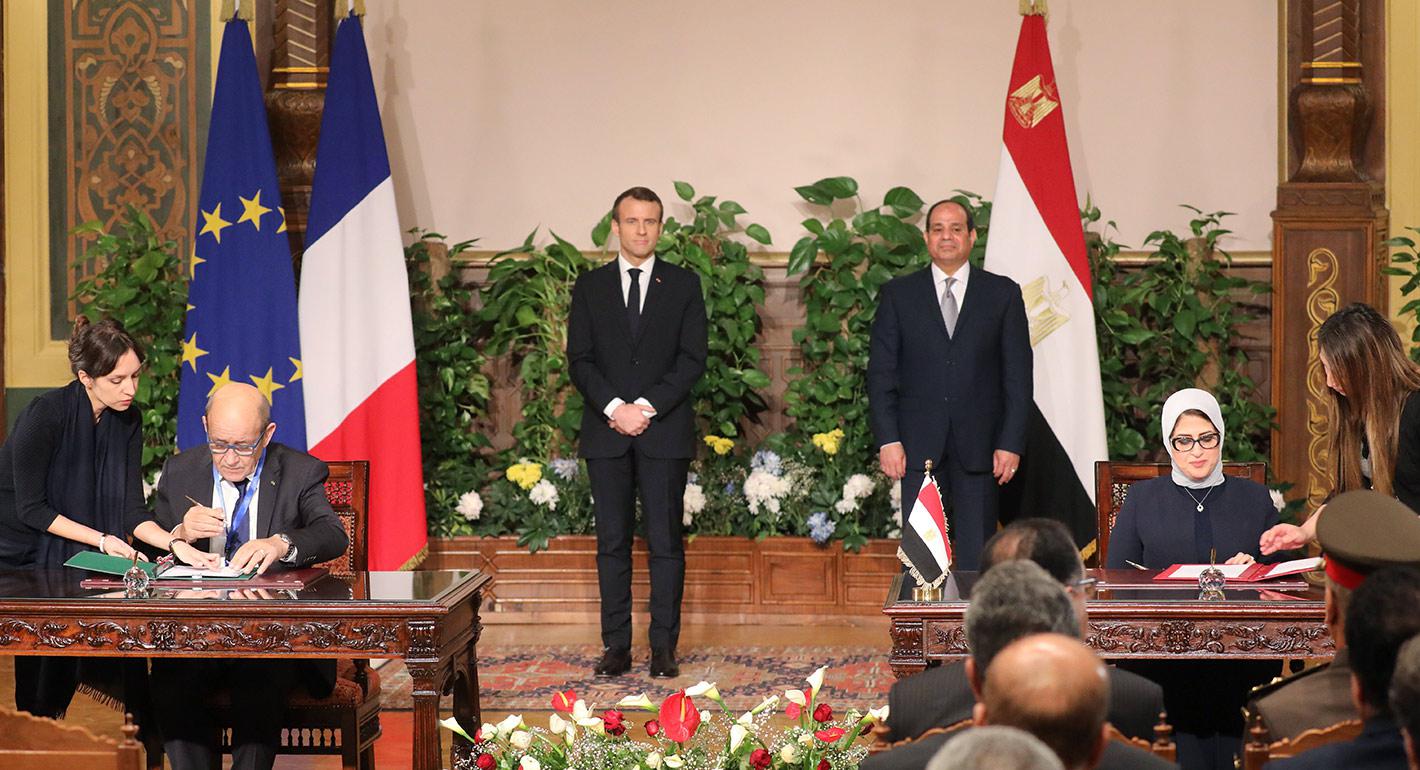
A growing alliance between Cairo and Paris is resulting in significant foreign policy coordination and in political and economic repercussions in both Egypt and France.
On the 21st of November, the French NGO Disclose leaked a set of classified French intelligence and military documents, which revealed an extensive alliance between the French state and the Egyptian government. The leak, dubbed the “Egypt Paper,” had two major revelations: the first was regarding Operation Sirli, which began on the 13th of February, 2016, in the Western Desert close to the Libyan border. According to the documents, French intelligence officers, pilots, and technicians embedded themselves within the Egyptian Armed Forces with the declared purpose of combating suspected militants infiltrating the 1200 km border with Libya.
According to the leaked French documents, the operation also led to human rights violations, which were also corroborated by local media reports that documented a case where three civilians were killed in airstrike in the Western Desert in July 2017 as well as the killing of 21 Mexican tourists in 2015, also in an airstrike in the Western Desert. The second revelation revolves around the deployment of the highly advanced electronic surveillances systems Nexa Technologies, Ercom and Suneris, and Dassault Systèmes – all of which are French companies. The sale was approved, in 2014, by the French Ministry of the Economy, headed at the time by now-President Emmanuel Macron.
The alliance between the French state and the Egyptian government is based on a complex set of financial interests, parallel foreign policy objectives, and ideological affinities. Most notably, these shared financial interests include massive arms deals between Cairo and Paris. Between 2016-2020, French arms exports increased by 44 percent compared to 2011-2015, with Egypt receiving 20 percent of French arms exports – making it the second largest customer for French arms after India. The costliest purchases so far have been French Rafale jets, purchased in two major arms deals in 2015 and 2021, worth 5.2 billion EUR and 4.5 billion EUR respectively. The structure of these arms deals is also worth noting: some of the largest arms transfers are financed through French loans, including a 3.2 billion EUR loan in 2015 as well as an undisclosed loan to finance the latest 4.5 billion EUR deal in 2021. The regressive nature of the Egyptian tax system, where the tax burden is shouldered by the lower and middle classes, means that this arrangement is effectively transferring wealth from the lower and middle classes to the French arms industry.
It also means that besides profits from the arms deals, interest payments provide another avenue for profit for French creditors, including the French state. The importance of these arms deals to the French state was reflected in the dominance of the French military, and not the French Foreign Ministry, in managing the state’s relationship with the Egyptian government.
This pattern of financing is not limited to the arms deals, with France investing 4.6 billion EUR in the Egyptian government’s infrastructure projects. The deal was signed on the 14th of June, and it includes 800 million EUR in government loans, 1 billion from AFD, the French Development Agency, and 2 billion EUR in bank loans guaranteed by the French state. The projects are to be executed by French companies.
In addition to facilitating capital flows and wealth transfer to France, France and Egypt have similar foreign policy objectives, most notably in Libya. Both parties have provided support to the Libyan general, and now presidential candidate, Khalifa Haftar in his effort to wrest power from the Government of National Accord (GNA) in Tripoli, which was at the time the internationally recognized government in Tripoli (between 2019-2020). This policy, among other factors, exacerbated the country’s civil war and emboldened the general to attempt seizing Tripoli by force, which ultimately backfired as a result of heavy Turkish intervention in January 2020. The two allies are also strongly opposed to Turkish presence in Libya; after Haftar’s defeat at Tripoli, Egyptian President Abdel Fattah El Sisi threatened direct military intervention and proclaimed that any attempt by Turkish-backed GNA forces to seize the city of Sirte would be crossing a redline for Egyptian national security. This sentiment was echoed by Macron, who stated in June 2020 that France “will not tolerate Turkey’s role in Libya,” and called for Turkey to withdraw its troops. It is worth noting, however, that Egyptian-Turkish relations have since shown signs of improvement. Despite this cooling of tensions, however, Turkey has rebuffed calls by Sisi and Macron to withdraw foreign troops from Libya. The results of the rapprochement remain unclear, and a softening of positions remains a looming possibility.
Finally, both Macron and Sisi have shown a remarkable ideological resemblance regarding their desire to “reform” Islam, and, by extension, their staunch opposition to political Islam. Interestingly, they both aim, within different contexts, to appropriate politicized Islamic discourse and bring it under state control. For example, in October 2020, President Macron called Islam a “a religion in crisis,” while proclaiming his government’s intent to issue a law for combatting “Islamic separatism.” This was followed by the issuance of a law in December that strengthens the state’s oversight over schools, mosques, and sports clubs, allowing public officials to close mosques and dissolve religious organizations without a court order. Even though Islam is not mentioned explicitly in the law, there is little doubt that it targets French Muslims. This change in policy should be seen in the context of growing competition between Macron and the far right in the sphere of identitarian politics – more specifically that of which concerns immigration, minorities, and the place of Islam and Muslims in France. On the other hand, President Sisi has repeatedly called for Islamic renewal in an attempt to consolidate the government’s control over religious discourse and eliminate competing centres of social power: namely, the Al-Azhar, the leading religious institution in the country. The government’s attempts to exert control over religious discourse can be understood within the context of its attempt to centralize social power and create a state-sponsored version of Islam anchored in a deeply conservative social ethos. Even though the context is different, this ideological congruence is remarkable, as it partially clarifies the ideological justification for French support of a government with an atrocious record of human rights violations.
The consequences of the alliance between Macron and Sisi may threaten the long-term regional stability of both the Middle East and North Africa and Europe. French support for the Egyptian government does not reduce repression and contributes to the impoverishment of middle and lower classes in Egypt. It is also important to note that the alliance between Sisi and Macron is part of a wider European policy, with countries like Italy and Germany following very similar routines in terms of arms exports and financial dealings, albeit in a less blatant fashion. These relations, if predicated on a policy of ignoring human rights violations and economic pressures, will only risk increasing social unrest, violent radicalization and possibly encourage refugee flows due to worsening repression and deteriorating living conditions.
Maged Mandour is a political analyst and writes the “Chronicles of the Arab Revolt” column for Open Democracy. Follow him on Twitter @MagedMandour.
About the Author
Maged Mandour
Maged Mandour is a political analyst who is a regular contributor to the Arab Digest, Middle East Eye, and Open Democracy and author of an upcoming book entitled “Egypt Under Sisi.”
Carnegie does not take institutional positions on public policy issues; the views represented herein are those of the author(s) and do not necessarily reflect the views of Carnegie, its staff, or its trustees.