

{
  "authors": [
    "Pierre Boussel"
  ],
  "type": "commentary",
  "blog": "Sada",
  "centerAffiliationAll": "dc",
  "centers": [
    "Carnegie Endowment for International Peace"
  ],
  "collections": [],
  "englishNewsletterAll": "menaTransitions",
  "nonEnglishNewsletterAll": "",
  "primaryCenter": "Carnegie Endowment for International Peace",
  "programAffiliation": "MEP",
  "programs": [
    "Middle East"
  ],
  "projects": [],
  "regions": [],
  "topics": []
}
Source: Getty
Syrian Mercenaries in Ukraine: Delusion or Reality?
Russia hoped that a wave of foreign fighters would rally to support its fight in Ukraine, but no one came.
The separatist war in the Donbas has been a popular destination for adventurers, white supremacists, and soldiers without a homeland since 2014. Prior to the start of the Russian assault in February, there were rumors that Syrian volunteers were leaving for Ukraine. Given these rumors and the already-large presence of foreign fighters in the region, the notion that Russia’s assault on Ukraine would lead to the increased involvement of foreign groups was an easy assumption to make.
Unsurprisingly, two days after the beginning of the Russian invasion, President Zelensky made an appeal for foreign volunteers to enlist in a newly formed International Legion. His call was quickly supported by Denmark’s Prime minister, Mette Fredericksen. The UK’s foreign secretary, Liz Truss, likewise argued that the struggle in Ukraine was a battle for freedom for “the whole of Europe.” Apparently, these two calls were made without any coordination with other NATO members. The UK and Denmark assumed the risk of giving a quasi-official authorization to join the international brigade—an unprecedented case in the alliance’s history.
Russian President Vladimir Putin also encouraged foreign fighters to join the war against what he termed “neo-Nazism,” even though the Russian army has 900,000 soldiers and two million reservists. Putin aimed to turn the invasion into an existential fight against “extremists,” and one of the Kremlin’s main goals was to demonstrate its capacity to mobilize to the Arab World. However, apart from Syria, Arab countries have not reacted. The memory of diplomatic constraints during the Cold War, and of being abandoned once the Berlin wall fell, has not been lost.
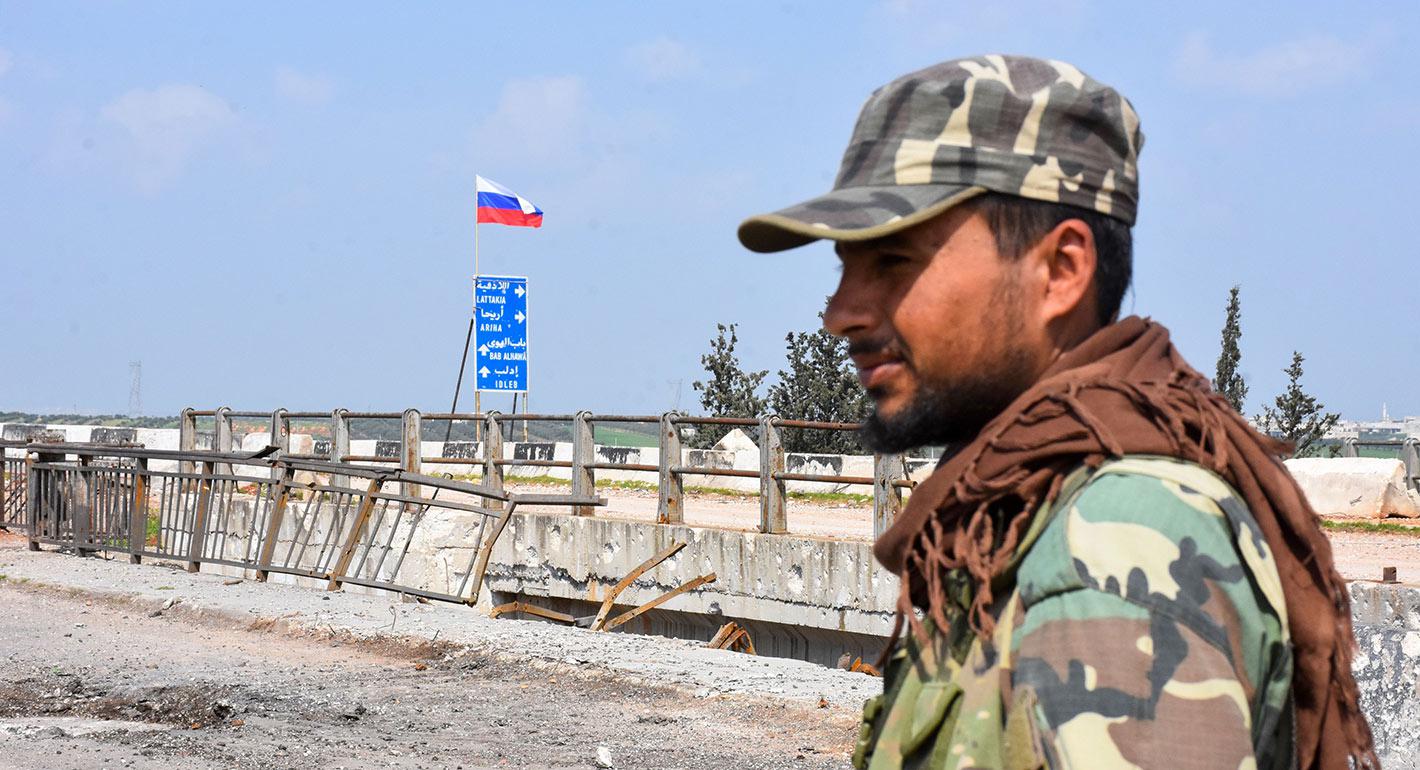
Syria’s support for the war comes in the form of support for volunteers who want to help Russia’s cause. The Syrian media hoped to instill a sense of excitement, fuel grassroots support, and encourage protesters from universities to aid Russia. To demonstrate the seriousness of their support, a contract from the Military Intelligence Division 217 was offered to volunteers. The contract included benefits such as $3,000 for volunteer fighters and $7,000 for wounded fighters. The contract also included food rations for the families of the volunteers and a $15,000 insurance payout if the volunteer dies while fighting.
However, the official claim that 40,000 mercenaries registered in a few days has not been confirmed by independent sources and does not match the reality. The civilians who spontaneously presented themselves to the Russian embassy in Damascus and the military airbase of Hmeimim were turned away, as the Russian army explained that it delegated the task to various private partners. For example, Al-Sayyad, a guard and protection services company, opened recruitment on March 12. Only around 30 men have been registered, even though two hundred were expected. Hani Abu Shammout, the former leader of Al-Ahdat Al-Omaria brigade and translator for Russian forces in Damascus region, oversaw the recruitment of volunteers from several towns, including in the oriental sector of Homs, but he has not published the results of his recruitment efforts. Additionally, Nabil Abdallah, commander of the paramilitary National Defense Forces, offered the use of his men, claiming that they are experienced in urban combat. In reality, they are not experienced. His troops are poorly equipped and have never excelled on the battlefield.
The hypothesis that Russia could use Syrian mercenaries as cannon fodder in urban combat was not plausible. Moscow hoped to discourage the Ukrainian people by creating a wave of foreign fighters, breaking civilian resilience, and depriving Kyiv’s army of its popular support. However, Russia’s strategy has suffered from tactical inconsistencies. If Syrian fighters were essential to Russia’s strategy in Ukraine, the solution would have been to recruit from the armed groups it supports, such as the 8th Brigade which consists of professional soldiers who are equipped with individual weapons, paid regularly, and accustomed to working with Russian officers. However, Moscow has never demonstrated a willingness to use this military capability.
In addition, the historic lack of non-commissioned officers (NCOs) to maintain a strong chain of command in the field combined with the Russians’ inexperience in commanding Syrian troops under fire has hindered the Russian campaign. Russia knows how to finance and equip an armed group and how to bomb a city, but not how to coordinate operations on the front lines with auxiliary forces. At a minimum, Syrian recruits could have taken over menial tasks such as guarding, handling, and cleaning at a lower cost to the Russian army.
Despite the mobilization efforts of the Damascus government and private partners, Russia’s goal to flood Ukraine with foreign fighters failed. U.S. Marine Corps General McKenzie confirmed that there has not been a flow of Syrian fighters up to this point. Those who have volunteered are not producing the desired effect, as the military skills of the volunteers are generally weak, and they are mostly motivated by money. Armed groups with solid experience and specific knowledge—including those with snipers and training in explosives handling—have stayed away from the conflict. They are decidedly hostile to the Syrian regime and its Russian ally.
Thus, Putin’s assembling of volunteers appears to have been an automatic response to Zelensky’s call, without a thorough assessment of potential downfalls. The failure of the recruitment campaign confirms the Syrian regime’s great weakness—its main ally. The cautious silence of other Arab countries is also telling. No one offered aid to Russia. As the days pass, the conduct of military operations nullifies twenty years of Moscow’s diplomatic efforts to rehabilitate its partnerships in the Arab world. The fact that Putin engaged in this war without consulting Russia’s partners and risked destabilizing Arab countries via the threat of wheat shortage and the challenge in finding new energy routes will certainly impact future diplomatic relations.
The next Arab League summit in Algiers in November was expected to be a success from the Russian perspective. Syria’s return to the regional stage would have been a personal achievement for President Putin, but that is now compromised. Ahmed Aboul Gheit, the Secretary-General of the Arab League, consulted with its members on the matter, and the few clues of a consensus that seemed to exist at the beginning of the year vanished.
In the end, the Ukrainian affair has increased the Damascus regime’s reliance on Moscow, but Bashar al-Assad's eagerness to support the invasion could result in him becoming collateral damage in the end. While al-Assad seeks to break the diplomatic isolation of his regime, his main ally is now facing its own isolation, hampering Syria’s attempts to extricate itself from its long-running political predicament.
Pierre Boussel, PhD is a columnist and an associate researcher at the Foundation for Strategic Research (FRS-Paris). His work focuses on armed groups in the Arab world and Islamism/political Islam/Islamic-inspired extremism.
About the Author
Pierre Boussel
Carnegie does not take institutional positions on public policy issues; the views represented herein are those of the author(s) and do not necessarily reflect the views of Carnegie, its staff, or its trustees.