

{
  "authors": [
    "Hannan Hussain"
  ],
  "type": "commentary",
  "blog": "Sada",
  "centerAffiliationAll": "dc",
  "centers": [
    "Carnegie Endowment for International Peace"
  ],
  "collections": [],
  "englishNewsletterAll": "menaTransitions",
  "nonEnglishNewsletterAll": "",
  "primaryCenter": "Carnegie Endowment for International Peace",
  "programAffiliation": "MEP",
  "programs": [
    "Middle East"
  ],
  "projects": [],
  "regions": [],
  "topics": []
}
Source: Getty
Economic Costs of Iraq’s Intra-Shia Power Struggle
The economic consequences of political deadlock serve neither the interests of rival political blocs nor the Iraqi public.
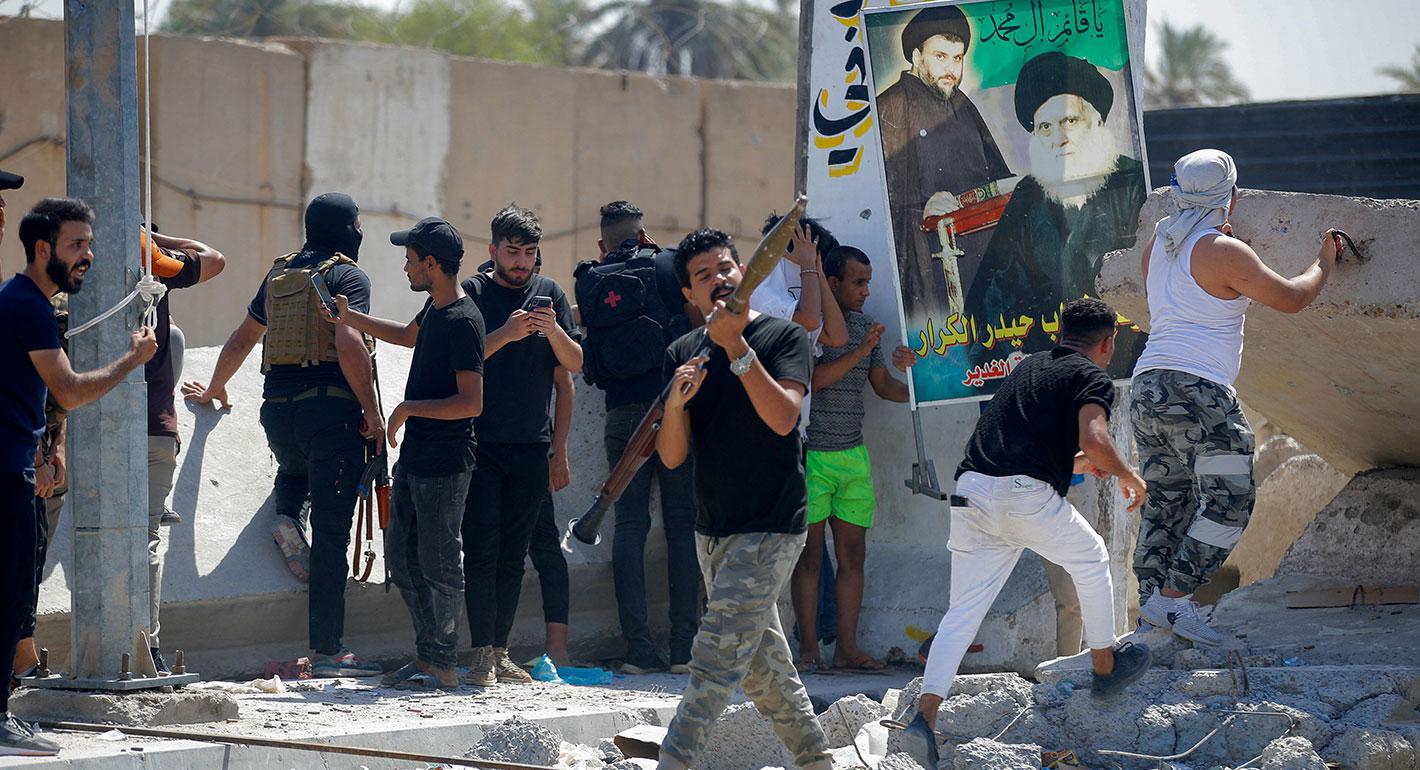
Baghdad witnessed its deadliest violence in years after powerful cleric Muqtada al-Sadr announced his resignation from Iraqi politics, paving the way for a hunger strike until “violence and the use of weapons” ends. But putting an end to Iraq’s economic crisis will be harder.
It shows in an intensifying political rivalry between supporters of al-Sadr and rival Shia parties which has raised the cost of economic reform. Refusal by both camps to close ranks behind a new coalition government has weakened the case for a functional budget, hampered headway on much-needed infrastructure spending, and delayed Iraq’s pursuit of urgent economic reforms.
Among the first casualties of Iraq’s post-election deadlock is sufficient support to address dire public services and widespread unemployment. Both considerations made a brief appearance in the $17 billion emergency food security legislation passed in June, but complex bureaucratic arrangements raised questions about its transparent implementation. Now as rival Shia blocs push to control the country’s resources—including record-breaking oil revenue—it is an uphill task to redirect spending towards job creation and improved healthcare. After all, Iraq’s unemployment rate sits in double-digits, and about a third of its youth population is neither in employment nor training.
In the past, international support has been a major variable in Iraq’s push for economic and administrative reforms. In 2017, for example, Iraqi government officials and academics partnered with global specialists to draft “Economic Vision 2030.” The Vision aimed to address gaps in income and wealth distribution and prepare the ground for long-term infrastructure spending, but it eventually lost traction due to sustained political instability. Now, key donors with a firm stake in Iraq’s strategic planning have grown silent as the country’s protracted political crisis drags on. Rival blocs are also less willing to resolve sharp disputes over revenue-sharing.
To be clear, Iraq’s economy has shown some positive signs in recent months. Oil and non-oil growth is projected to reach pre-pandemic levels, and the economy is forecasted to clock an average growth rate of 5.4 percent per year between 2022 and 2024. However, one of the key constraints on Iraq’s macroeconomic outlook is the delayed formation of a new government.
It is here that some $60 billion in record oil revenue during the first half of the year merits concern. Its transparent utilization demands firm ownership, and the absence of a functional government challenges that very prospect. Additionally, neither al-Sadr nor his rivals are interested in advancing legislation to diversify revenue towards improved public service delivery.
It would serve the interests of both rival Shia blocs to set aside political infighting and base competition on urgent economic reforms. Look no further than Sadr’s own post-election rise: he underscored the need for gradual reform at a time of rampant poverty and corruption and insisted on representation from all communities in state institutions. Thus, a movement carried on the back of economic despair has strong incentive to campaign against it, particularly when Sadr’s base is comprised of millions of people from a poorer population segment.
Internal disagreements over government formation mechanisms have also not paid off for rival Shia groups. These differences helped sustain Iraq’s longest run without a functional government in nearly two decades, and left al-Sadr’s supporters more empowered than before. Nearly 370,000 families are left cashless, and fears of unrest loom large over some of the groups’ own constituencies. As prospects of reconciliation between al-Sadr and the Coordination Framework remain bleak, Iraqis will bear the brunt of economic neglect yet again.
Hannan Hussain is an international affairs commentator, author, and recipient of the Fulbright Award at the University of Maryland. His research interests include counterterrorism, conflict resolution, and inter-state relations in the Middle East and South Asia.
About the Author
Hannan Hussain
Carnegie does not take institutional positions on public policy issues; the views represented herein are those of the author(s) and do not necessarily reflect the views of Carnegie, its staff, or its trustees.