

{
  "authors": [
    "Tamer Badawi"
  ],
  "type": "commentary",
  "blog": "Sada",
  "centerAffiliationAll": "dc",
  "centers": [
    "Carnegie Endowment for International Peace"
  ],
  "collections": [],
  "englishNewsletterAll": "menaTransitions",
  "nonEnglishNewsletterAll": "",
  "primaryCenter": "Carnegie Endowment for International Peace",
  "programAffiliation": "MEP",
  "programs": [
    "Middle East"
  ],
  "projects": [],
  "regions": [],
  "topics": []
}
Source: Getty
Iran’s Security Anxiety in Iraqi Kurdistan
Iraq-based Iranian Kurdish insurgents are becoming the epicenter of a coordinated Iran-led campaign to force the Kurdistan Regional Government (KRG) to toe its security policy.
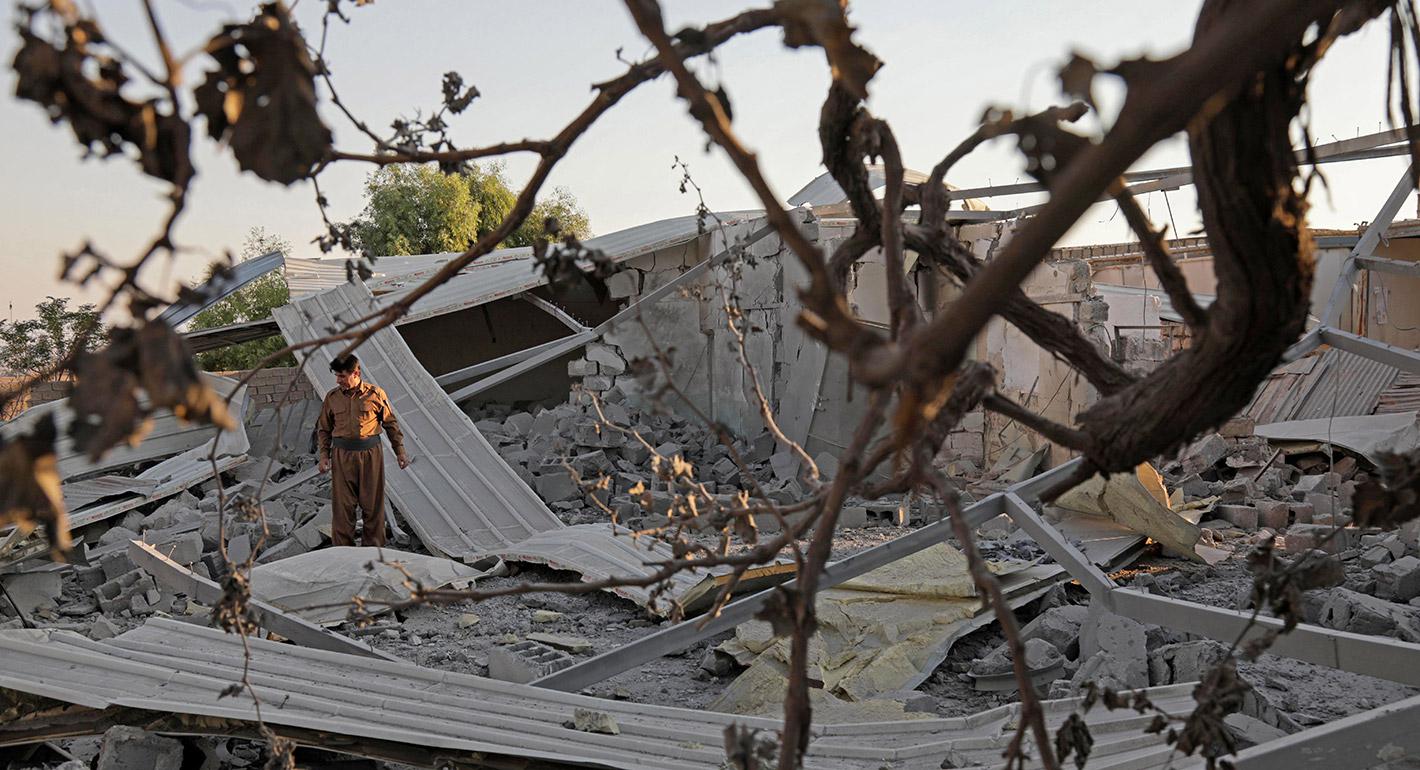
Amidst protests in northwest Iran over Mahsa Amini’s death, Iran’s Islamic Revolutionary Guards Corps (IRGC) attacked sites of dissident Iranian Kurdish groups stationed between the governorates of Erbil and Sulaymaniyah in the Kurdish Region of Iraq (KRI). Iran accuses exiled Iranian Kurdish insurgent groups of fueling the recent insurrection in the country’s northwest. The resulting attacks using precision-missiles and suicide drones left 14 dead, including a US citizen, and 58 wounded. The unification of the Kurdistan Democratic Party—Iran (KDP-I)—and the Democratic Party of Iranian Kurdistan (PDKI) in August 2022 has likely signaled to Tehran potential insurgent escalation.
Between January 2019 and October 2022, Iran’s share of attacks on Iranian Kurdish insurgents in the KRI were a tiny fraction compared to Turkish aerial attacks against the Kurdistan Workers' Party (PKK) in northern Iraq (figure 1).1 Based on data from the Armed Conflict Location & Event Data Project (ACLED), Iranian counterinsurgent attacks roughly constituted 1.7 percent of all foreign attacks targeting Kurdish groups in the KRI.

Figure 1: Data obtained from Armed Conflict Location & Event Data Project (ACLED)
However, like Turkey, Iran has embarked on expanding militarily within the KRI to counter Kurdish insurgents. In September 2021, Iran reportedly built a military outpost on Cheekha Dar mountain, the KRI’s highest peak. Whilst Iranian counterinsurgent attacks and military outposts are quantitatively incomparable to those of Turkey, Tehran increasingly launches attacks that cause extensive collateral damage to deliver messages of deterrence.
The wider significance of Iranian counterinsurgent attacks is explained by how they are becoming part and parcel of an integrated campaign to pressure the KRG to toe Tehran’s security line and align with political allies in Baghdad. Tehran increasingly portrays political unrest at home as linked with foreign meddling campaigns. For this reason, Tehran increasingly pressures the KRG to stop providing sanctuary to Kurdish insurgent groups and reduce its military relations with Western countries. On the other hand, the KRG likely keeps Kurdish insurgent groups as a means of leverage against Tehran.
Since the US assassination of IRGC-Quds Force chief Qassem Soleimani and senior Iraqi paramilitary leader Abu Mahdi al-Muhandis in January 2020, the IRGC and Iraqi paramilitary allies have launched numerous missile and drone attacks on US-led coalition facilities in Iraq and the Kurdish region to force them out (figure 2). In March and June 2022, Iran used ballistic missiles and drones to hit facilities and vehicles in Erbil that Tehran affiliated media outlets alleged were used by Israeli espionage agents. Following the March attack, one of Iran’s closest paramilitary allies in Iraq threatened the KDP with regime change.

Figure 2: Data obtained from Armed Conflict Location & Event Data Project (ACLED)
The KDP’s political alliance with Muqtada al-Sadr after the October 2021 elections became a driver for a multi-layered campaign to destabilize the KRI’s energy sector to force the KDP to capitulate. In February 2022, a judicial ruling by the Federal Judicial Council in Baghdad deemed the KRG’s 2007 oil and gas law unconstitutional. The ruling was rejected by the KRG and perceived as politicized. Since April 2022, Iran-allied paramilitaries have been strongly suspected of conducting around seven rocket attacks on energy facilities.
Despite several attacks from Iran, the KRG’s political parties are finally coming to terms with the need to engage with Iran-allied parties in the process of government-formation. However, Western sanctions on Tehran because of its role in Ukraine and prospects of continued protests in Iran are all likely to sharpen Tehran’s offensive posture against the KRI in the region.
Tamer Badawi is an independent analyst focused on politics, and security in Iraq and the wider neighborhood. He is a PhD Candidate and Teaching Assistant in the University of Kent’s Politics and International Relations Department (Canterbury, UK) where he researches paramilitary groups in Iraq. He tweets at @Tamerbadawi1.
Notes
1. Apart from targeting the PKK, Turkey has also occasionally conducted attacks on PJAK in Sulaymaniyah governorate in June and August 2020, June and December 2021, and more recently in August 2022.
2. By “high profile attacks,” the author refers to attacks targeting energy, airport, and diplomatic infrastructure.
About the Author

Tamer Badawi
Consultant and a PhD Candidate at Kent University.
Tamer Badawi is an associate with the Middle East Directions Programme at the European University Institute, focusing on Iran’s foreign policy toward its neighbors. His research focuses on the political economy of Iran’s relations with Arab countries and with Islamist movements. He was previously a research fellow at Al Sharq Forum in Istanbul. Tamer received an M.A. in International Relations from Central European University, and a B.A. in Oriental Studies from Alexandria University.
Carnegie does not take institutional positions on public policy issues; the views represented herein are those of the author(s) and do not necessarily reflect the views of Carnegie, its staff, or its trustees.