

{
  "authors": [
    "Jihad Mashamoun"
  ],
  "type": "commentary",
  "blog": "Sada",
  "centerAffiliationAll": "dc",
  "centers": [
    "Carnegie Endowment for International Peace"
  ],
  "collections": [],
  "englishNewsletterAll": "menaTransitions",
  "nonEnglishNewsletterAll": "",
  "primaryCenter": "Carnegie Endowment for International Peace",
  "programAffiliation": "MEP",
  "programs": [
    "Middle East"
  ],
  "projects": [],
  "regions": [],
  "topics": []
}
Source: Getty
Sudan’s Reconciliation Agreement to Nowhere
Recent talks between Al-Burhan and the FFC serve only to advance Al-Burhan’s presidential ambitions.
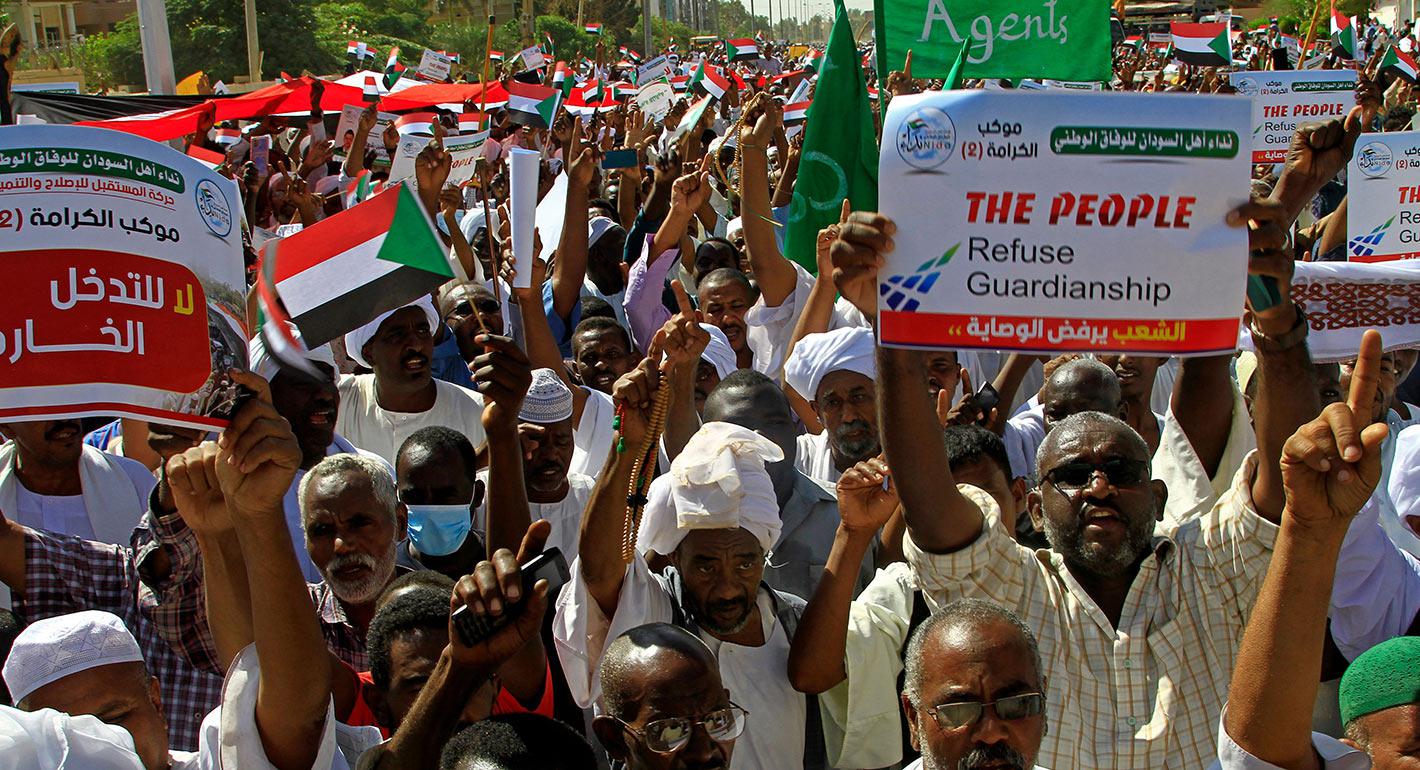
Protestors have discredited recent secret talks between Lt. General Abdel Fattah Al-Burhan, chairman of the Transitional Sovereign Council (TSC) and commander of the Sudanese Armed Forces (SAF), and the Forces of Freedom and Change (FFC), calling them illegitimate. Many of these protestors believe that the talks pave the way for a new partnership with the military rather than the transfer of power from the military to a civilian government.
It is widely believed that the military is using the talks to undermine the FFC’s efforts to rebuild its credibility with the protest movement, which was launched after the coup of October 25, 2021. The FFC did not participate in the Sudan People’s Call initiative, a dialogue of Sufi religious leader Tayib al-Jid, because they believed that the dialogue would legitimize the rule of Al-Burhan and his allies, as al-Jid is believed to have close ties with figures from the Bashir regime. The move was also an attempt to gain some credibility with civilians. Despite their attempts to rehabilitate their relationship with the protest movement, the FFC faces challenges from civilian groups like the communist-dominated Alliance of Forces for Radical Change (AFRC) and the resistance committees. These groups will not accept a new partnership with the military even though Al-Burhan and his allies are open to an agreement.
An agreement with the FFC serves Al-Burhan in two key ways. First, Al-Burhan has been implicated in crimes and is strategically using these dialogues to cement his leadership over factions of the former regime who want to protect their political and economic interests. Without their support, Al-Burhan runs the risk of being prosecuted for any crimes he has allegedly committed. Second, Al-Burhan fears the ability of agents from the former regime to remove him from power through a military coup. In order to keep his power, Al-Burhan needs to involve these potential spoilers in any government transition.1
Notably, Al-Burhan’s efforts to shore up support have come at a crucial time with presidential elections planned for 2024. Al-Burhan will face several members of the former Bashir regime in the race for the post-transition presidency. These contenders include Ibrahim Ghandour, the former acting head of the NCP, Amin Hassan Omer of the Islamic Current, and Ali Karti, the current head of the Sudanese Islamists Movement (SIM). The former regime has 500,000 supporters who control the economy and state institutions, supplying them with considerable funds and organizing power to win the election. This support also presents them with the opportunity to rig the election as they have done in the past.
In addition to opponents from the Bashir regime, Al-Burhan will face contenders from his own coalition. One of the candidates is Gibril Ibrahim, the current minister of finance and economic planning and leader of the Justice and Equality Movement (JEM), who has been working to unite the former regime and the Popular Congress Party (PCP) to support his presidential ambitions. Lt. General Mohamed Hamdan Dagalo “Hemedti” has also been shoring up support in Darfur through the reconciliation of Arab and African tribes.
The multitude of candidates in the race for the presidency is an encouraging sign—and one that has perhaps pushed Al-Burhan to continue talks with the FCC. These talks, however, have served to further divide the FCC, which is already struggling with a lack of vision for the future. Although it is yet to be seen whether an agreement will be reached, what is certain is that the FFC needs to demonstrate resilience. Al-Burhan and his allies will continue to try to undermine the FFC at every juncture in order to maintain the status quo. The FFC and other civilian groups must present a united front against the military and the former regime if there is any prospect for a civilian democratic government in Sudan.
Jihad Mashamoun is a researcher and political analyst of Sudan affairs. He holds a doctorate in Middle East Politics from the Institute of Arab and Islamic Studies at the University of Exeter. Follow him on Twitter: @ComradeJihad.
Note:
1. Phone interview with Nazar Abdel Aziz, a secretary general of the National Broad Front, on August 10, 2022.
About the Author
Jihad Mashamoun
University of Exeter
Jihad Mashamoun is a PhD candidate in Middle East Politics at the Institute of Arab and Islamic Studies, University of Exeter. He has authored and co-authored numerous articles on the Sudanese uprisings and Sudanese affairs.
Carnegie does not take institutional positions on public policy issues; the views represented herein are those of the author(s) and do not necessarily reflect the views of Carnegie, its staff, or its trustees.