

{
  "authors": [
    "Mohammed Al-Hakimi"
  ],
  "type": "commentary",
  "blog": "Sada",
  "centerAffiliationAll": "dc",
  "centers": [
    "Carnegie Endowment for International Peace"
  ],
  "collections": [],
  "englishNewsletterAll": "menaTransitions",
  "nonEnglishNewsletterAll": "",
  "primaryCenter": "Carnegie Endowment for International Peace",
  "programAffiliation": "MEP",
  "programs": [
    "Middle East"
  ],
  "projects": [],
  "regions": [],
  "topics": []
}
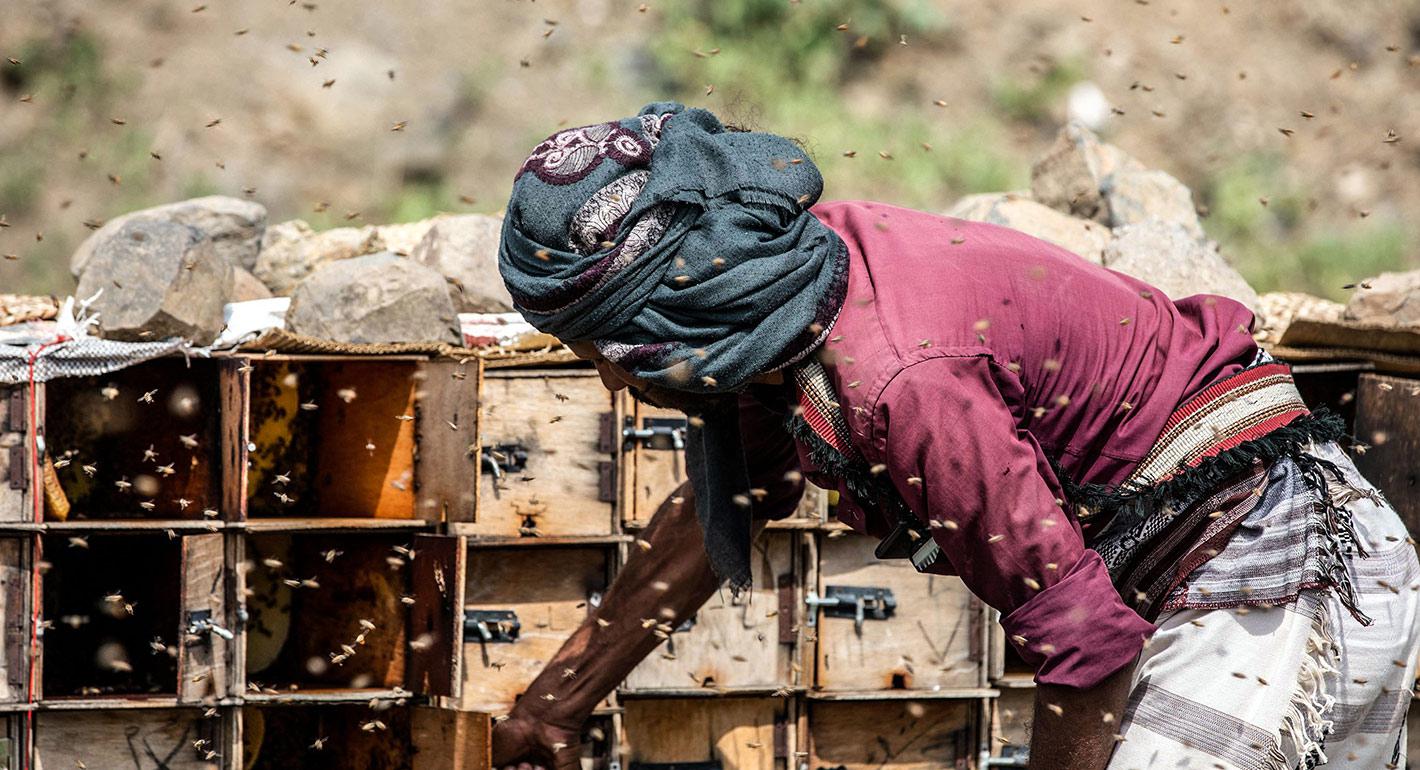
Source: Getty
Yemeni Beekeepers Confront Climate Threats
The honey industry in Yemen faces enormous challenges due to climate change, and beekeepers are exposed to persistent threats.
Beekeeping and honey production have been practiced in Yemen since ancient times, and according to some studies, Yemeni beekeeping dates back to the 10th century BC. Yemeni honey is considered to be one of the finest and most expensive types of honey in the world.
The Yemeni beekeeping industry depends on the constant movement of local beekeepers throughout the year from one region to another, in search of pastures and flowers. This makes their honey crops highly vulnerable to climatic and environmental factors.
More than 10 years ago, at the onset of unrest in Yemen, the deterioration of economic and living conditions, and the subsequent outbreak of civil war in the country, Laila Sinan chose, with great passion, to work as a beekeeper. Pursuing honey production as a source of income, she entered an economic sector that had long been dominated by men. From her home in Yemen’s capital, Sana’a, Laila began her beekeeping business with a single beehive that she brought from her university. After obtaining her bachelor’s degree in agriculture, Laila was able to gain experience in beekeeping and start honey production. Despite her success as a honey producer and beekeeping trainer, Laila faces increasing challenges in maintaining her bees. Like those of other beekeepers, many of her beehives have been damaged by fluctuations in weather patterns and the effects of climate change.
More than 90,000 beekeepers, across 21 governorates, work in honey production in Yemen. According to the UNDP, there are about 100,000 Yemeni families who depend on beekeeping as their only source of income, and data from the Department of Agricultural Statistics shows that Yemen’s honey production reached about 2,823 tons in 2020. However, this production is fluctuating and declining as a result of climatic conditions.
Ali Mahrez, the Campaign Director at the General Department of Plant Protection at the Ministry of Agriculture in Sana’a says, “The trading volume of the Yemeni honey market is about 500 million USD annually.” However, Mahrez added that this figure is expected to drop about 30 percent because of the war, floods, and torrential rains that wash away thousands of beehives.
Over the last decade, beekeeping in Yemen has been impacted by the effects of climate change, including rainfall fluctuation, rising temperatures, increased human activity, especially in urban areas, as well as the repercussions of the ongoing conflict. These factors have affected bee pastures and agricultural fields, posing severe challenges to beekeepers.
In her interview, Laila said, “One of the difficulties facing beekeepers is that when it rains for days, the bees cannot leave the hive or swarm. Thus, we have to start feeding the bees and providing them with water inside the hive. This, of course, harms and tires the bees.” The floods have exacerbated the food security crisis and land degradation, thus decreasing vegetation cover and bee pastures in the country.
On the other side of Al-Dabab, an area in the countryside of Taiz governorate, Mohammed Farea has been working for more than two decades in beekeeping and honey production. Today, however, he faces bitter challenges, owing to the scarcity of rain and the drought in the southwestern and desert regions over the past two years.
By the beginning of 2022, rainfall rates were below average in a number of regions of the country, exacerbating the dilemma for beekeepers during the Yemeni honey production season. “Last year I lost 150 beehives, and this year, I lost 200 beehives due to drought. All I have left today are about 150 beehives,” Mohammed remarked.
Climate change in Yemen has posed a new challenge for beekeepers to manage in addition to the challenges of Yemen’s ongoing war. Mohammed noted that, from 2011 to now, honey production has significantly decreased due to a shortage of rainfall, a lack of flowers, and the environmental pollution caused by the ongoing war and pesticides. According to Mohammed, in the beginning of summer 2022, it did not rain, so they had to move to a new area every eight or ten days.
The negative effects of climate change on Yemen’s honey sector have prompted international humanitarian organizations, like the ICRC, to warn of the severity of the threat facing Yemeni beekeepers. A case study published by the ICRC noted that severe changes in the environment have disrupted the bees’ ecosystem, which has adversely affected the pollination process.
The effects of climate change impact beekeepers across Yemen, like Laila and Mohammed. Their suffering is shared, and the consequences are harsh for all Yemenis. Thousands of beekeepers watch their bees die, and they are left defenseless in the face of extreme weather conditions.
Mohammed Al-Hakimi is a Yemeni journalist and editor-in-chief of Holm Akhdar (Green Dream), an online environmental platform that focuses on climate change and environmental issues in Yemen.
About the Author
Mohammed Al-Hakimi
Carnegie does not take institutional positions on public policy issues; the views represented herein are those of the author(s) and do not necessarily reflect the views of Carnegie, its staff, or its trustees.