

{
  "authors": [
    "Ghousoon Bisharat"
  ],
  "type": "commentary",
  "blog": "Sada",
  "centerAffiliationAll": "",
  "centers": [
    "Carnegie Endowment for International Peace"
  ],
  "collections": [],
  "englishNewsletterAll": "",
  "nonEnglishNewsletterAll": "",
  "primaryCenter": "Carnegie Endowment for International Peace",
  "programAffiliation": "",
  "programs": [],
  "projects": [
    "Shrinking Civic Spaces for Palestine/Israel Discourse"
  ],
  "regions": [],
  "topics": []
}
Source: Getty
Education Under Occupation: The Story of a Masafer Yatta Schoolgirl
Israeli practices in the West Bank have threatened Palestinian schools, but students are determined to learn.
The Oslo II Accord divided the West Bank into three administrative divisions: Areas A, B, and C. These distinct areas were each given a different status, according to the varying degrees of self-government the Palestinians would maintain through the Palestinian Authority until a final status accord was reached. Area A is exclusively administered by the Palestinian National Authority while Area B is administered by both the Palestinian Authority and Israel. However, Area C, which includes a large number of Israeli settlements, is under full and exclusive Israeli control.
Some 60 percent of West Bank lands—which are home to approximately 300,000 Palestinians and include the major residential and development land reserves for the entire West Bank—have been classified as Area C. Israel prohibits Palestinian construction and development in Area C territory, advancing various rationales, including the claim that these areas are “state lands” and “firing zones.”
One such community that has been classified as belonging to Area C is Masafer Yatta, an area located in the South Hebron hills that is spread out over approximately 35,000 dunam of land. Agricultural communities have lived in Masafer Yatta for generations, and today, the region is home to twelve Palestinian communities which number approximately 2800 residents.
In the 1980s, the Israeli authorities designated a part of Masafer Yatta as “Firing Zone 918,” which is defined as a closed military zone. Since then, communities in Masafer Yatta have been subject to several waves of demolitions and evictions. Challenging this injustice, in 1999, the residents of Masafer Yatta, represented by human rights organizations, appealed to Israeli courts in order to reverse the designation.
Yet, after more than two decades of litigation, Israel’s Supreme Court ruled in May 2022 that the state does indeed have the power to designate Masafer Yatta a firing zone, and that the members of these communities are not permanent residents. This decision effectively placed residents of Masafer Yatta at the imminent risk of forced evictions, arbitrary displacement, and forcible transfer.
Since the court ruling, Israeli authorities have intensified demolitions, conducted several military trainings, and imposed tougher movement restrictions in Masafer Yatta.
A School Faces Threats
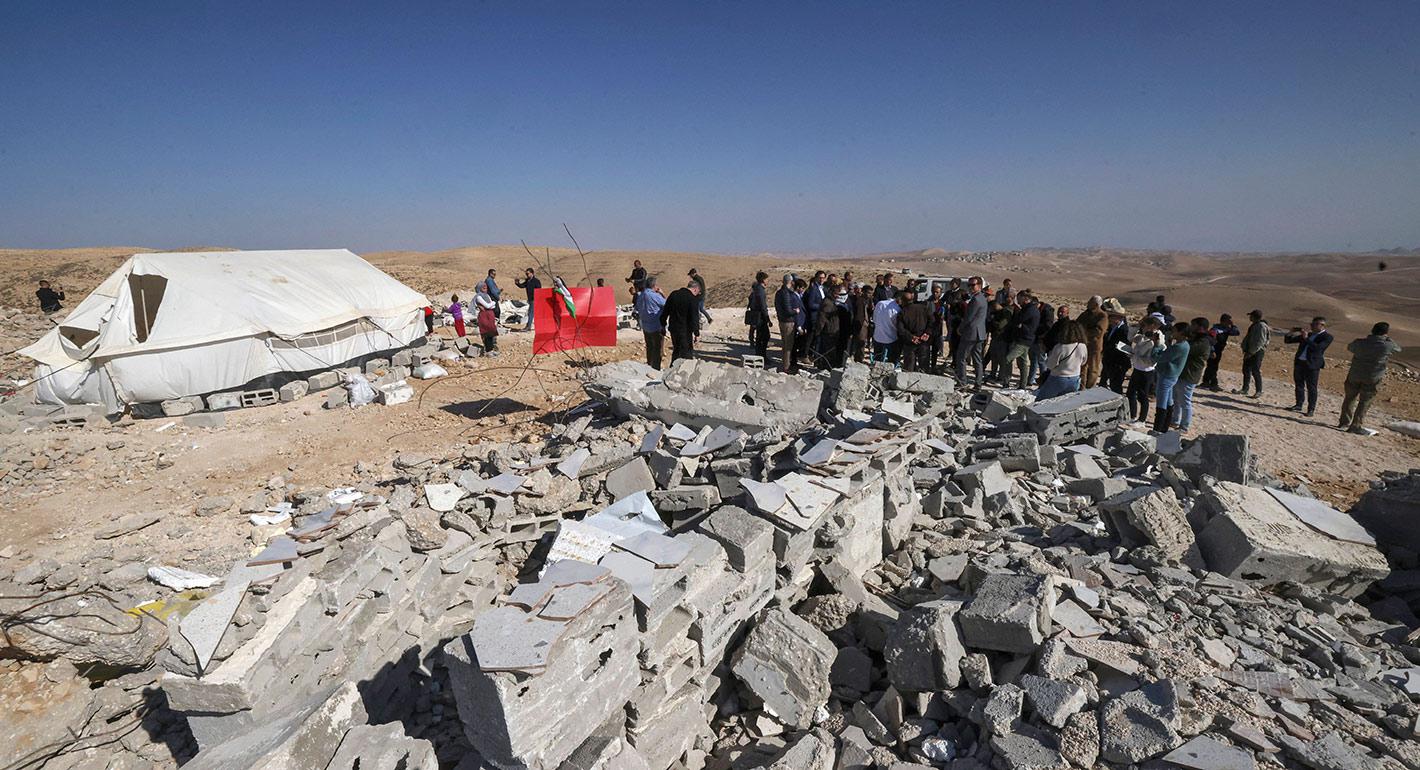
One of the latest demolitions made its way to the global headlines and received significant international diplomatic attention. In November 2022, the Israeli army demolished an elementary school in the village of Isfey al-Fauqa. This donor-funded school served 22 children from three surrounding communities and was constructed as a humanitarian project to address the longstanding challenges related to accessing education in the area. Before the school’s construction, students were forced to travel much longer distances to school, leading to high drop-out rates, especially among girls. The destruction of the school will undoubtedly have disastrous consequences for the students and families who benefitted from its establishment.
Education as Resistance
Bisan Makhamra is an 18-year-old high school senior from the village of Isfey al-Fauqa—inside the firing zone. Her house is near the destroyed school. Although Bisan attends high school in another village, she said that her village school meant a lot to her, remembering that she “felt that education was obliterated. . .education is gone.” She added: “Everyone lost the appetite to study. Both those who study, and those who do not, felt that, with the school’s end, the joy of the place we live in had gone.”
Her own school, six kilometers away in al-Fakhit village, also stands within the firing zone. Interviewed at her school, Bisan mentioned that this school could be demolished any day as well. Despite the fact that both Bisan’s school and home are in the firing zone area, along with the risk of imminent expulsion that she and her family face, Bisan is studying diligently for her final high school exams in order to pursue higher education in English language and nursing at Birzeit University.
According to UNICEF’s 2022 Palestine Education Fact Sheets, an impressive 94 percent of Palestinian young women are educated—a remarkable feat considering the daily pressures of the occupation that schools and families are confronting. Listening to young women like Bisan makes this encouraging statistic come to life and demonstrates the determination of Palestinian youth, and especially young women, to fulfill their dreams. Indeed, regarding the possibility of her school’s destruction, Bisan remarked: “I am scared they will demolish the school one day, but even if it is demolished, I am certain that we will put up tents and study somehow.”
To learn more about Bisan’s story, and the situation in Masafer Yatta, watch this film.
Ghousoon Bisharat is a producer and director of documentary projects, as well as a strategic communications and international cooperation expert. She has more than 20 years of experience working with leading international broadcast news outlets and the European Union.
Note:
The film was filmed and edited by Thomas Dallal with music by Ghassan Birumi.
About the Author
Ghousoon Bisharat
Carnegie does not take institutional positions on public policy issues; the views represented herein are those of the author(s) and do not necessarily reflect the views of Carnegie, its staff, or its trustees.