

{
  "authors": [
    "Tharwa Boulifi"
  ],
  "type": "commentary",
  "blog": "Sada",
  "centerAffiliationAll": "dc",
  "centers": [
    "Carnegie Endowment for International Peace"
  ],
  "collections": [],
  "englishNewsletterAll": "menaTransitions",
  "nonEnglishNewsletterAll": "",
  "primaryCenter": "Carnegie Endowment for International Peace",
  "programAffiliation": "MEP",
  "programs": [
    "Middle East"
  ],
  "projects": [
    "Tunisia Monitor"
  ],
  "regions": [],
  "topics": []
}
Source: Getty
Tunisia, Migration, and Media Coverage
Coverage of the Tunisian president’s recent racist remarks reveals a double standard in Western media.
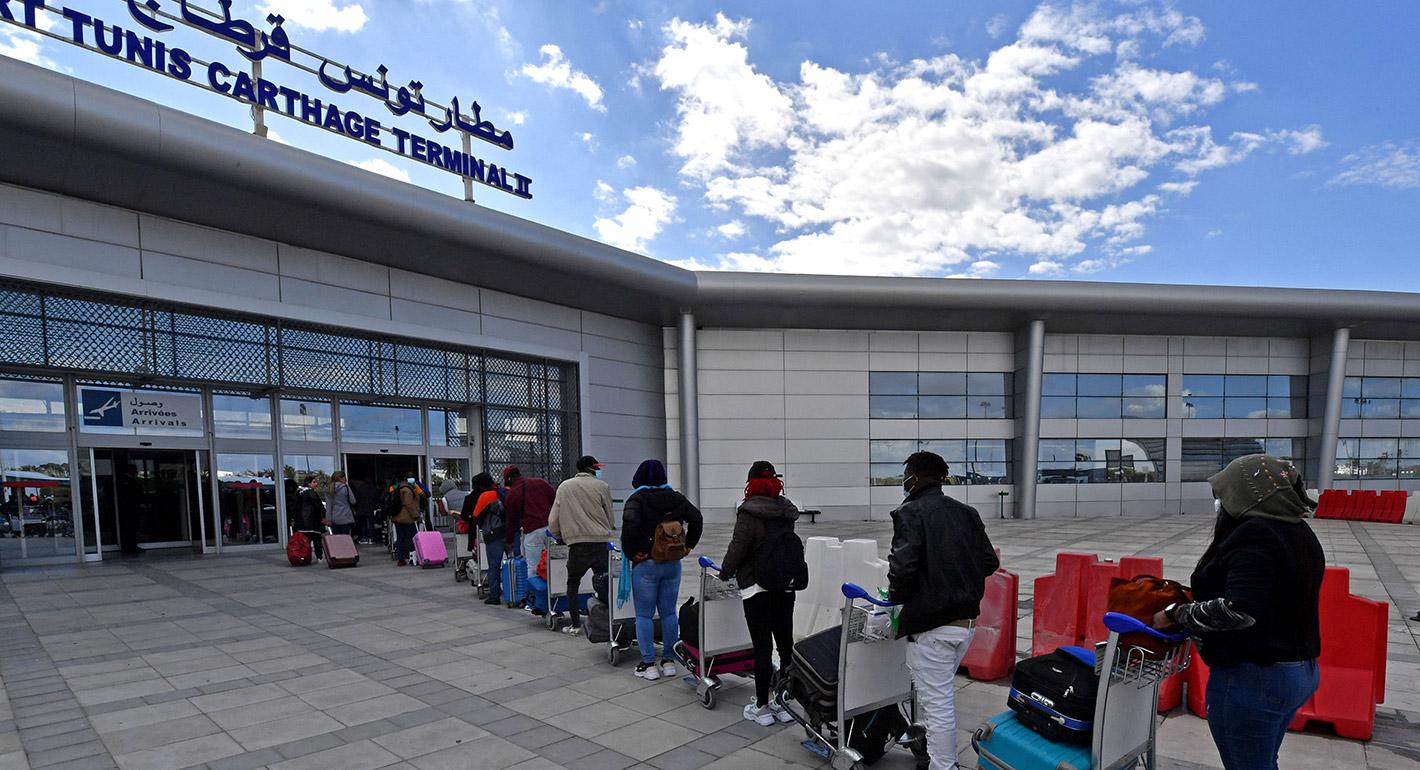
In February, President Kais Saied sparked outrage after making racist and xenophobic remarks, which alleged that the presence of undocumented Sub-Saharan migrants is part of a “criminal plan to change Tunisia’s demography.” He also asked security forces to expel undocumented migrants. Tunisian human rights organizations protested against these anti-Black policies, yet some Tunisians, including the president’s supporters, agreed with Saied. The most alarming thing was the wave of anti-Black violence unleashed by the president’s discourse; sub-Saharan migrants, physically and verbally abused, ended up camping in front of their countries’ embassies and international organizations to demand repatriation.
While this situation in Tunisia is clearly disastrous, international media outlets, especially Western ones, have arguably been covering Tunisia with a pinch of exceptionalism that does not situate recent events in a broader global context of racism and anti-migrant stances. Indeed, the analysis of some journalists and scholars is implicitly tinged with white savior-style rhetoric that centers the need for Western pressure to change Tunisia’s trajectory.
Since the 2011 revolution, the Western media’s coverage of developments in Tunisia has fluctuated. In 2011, international media covered the story of an African country becoming a democracy with much enthusiasm, and enhanced Western attention flattered Tunisians. Over time, however, and with the succession of crises, the last of which was Saied’s coup in July 2021, the Western media’s coverage became increasingly hopeless in tone, which corresponded with the frustration of its high expectations for Tunisian democracy. During these past two years of the post-coup era, Western commentators have often used catastrophic rhetoric which lacks local perspective and explains Tunisia’s future as a foregone conclusion—a direct result of a lack of representation of Tunisian analysts in prominent media outlets. This issue only adds more frustration and panic to the narrative.
Western institutions, including the World Bank, which paused upcoming work plans with Tunisia, have called out Saied’s racist statements. Additionally, human rights organizations, including Human Rights Watch, condemned the anti-Black violence in Tunisia following the president’s racist comments, and members of the European Parliament demanded a reaction from the European Union. Just this month, Josep Borrell, High Representative of the European Union for Foreign Affairs, stated that “Tunisia’s collapse would cause large flows of migration to Europe, something we want to avoid.” Despite being no less xenophobic than Saied's recent statements, such routine comments were largely ignored by the international media. In behaving this way, the media is displaying double standards, which do not hold all political leaders equally accountable for what they say.
Moreover, the West’s policy of xenophobia goes beyond words; in recent years, France reduced the number of granted visas for the Maghreb countries as an instrument of political pressure on governments. Likewise, the UK proposed a bill allowing authorities to deport refugees, and an agreement stopping the flow of asylum seekers was adopted by the United States and Canada. Yet, these measures were not discussed in the same way as recent events in Tunisia by the mainstream Western media and international community. When powerful Global North countries make such decisions, they are often rationalized and justified by the principle of border protection. Yet, when states like Tunisia adopt similar rhetoric (also unjustifiably, it should be noted), such actions are classified as racism and xenophobia. Worryingly, perhaps Saied would not have received such backlash if he had been more diplomatic in his word choice.
Prominent Western media organizations, which exert significant influence on the international narrative, hold the keys to influencing public opinion by demonizing some racist statements and actions and justifying others. This double standard only reinforces anti-West sentiments, which are already strong in the Global South.
Human rights must be more than mere ink on paper, and the media should hold all countries—Tunisia among them—equally accountable for their abuses.
Tharwa Boulifi is a freelance writer and journalist based in Tunisia. You can follow her on Twitter: @TharwaBoulifi.
About the Author
Tharwa Boulifi
Carnegie does not take institutional positions on public policy issues; the views represented herein are those of the author(s) and do not necessarily reflect the views of Carnegie, its staff, or its trustees.