

{
  "authors": [
    "Selçuk Aydın"
  ],
  "type": "commentary",
  "blog": "Sada",
  "centerAffiliationAll": "dc",
  "centers": [
    "Carnegie Endowment for International Peace"
  ],
  "collections": [],
  "englishNewsletterAll": "menaTransitions",
  "nonEnglishNewsletterAll": "",
  "primaryCenter": "Carnegie Endowment for International Peace",
  "programAffiliation": "MEP",
  "programs": [
    "Middle East"
  ],
  "projects": [],
  "regions": [],
  "topics": []
}
Source: Getty
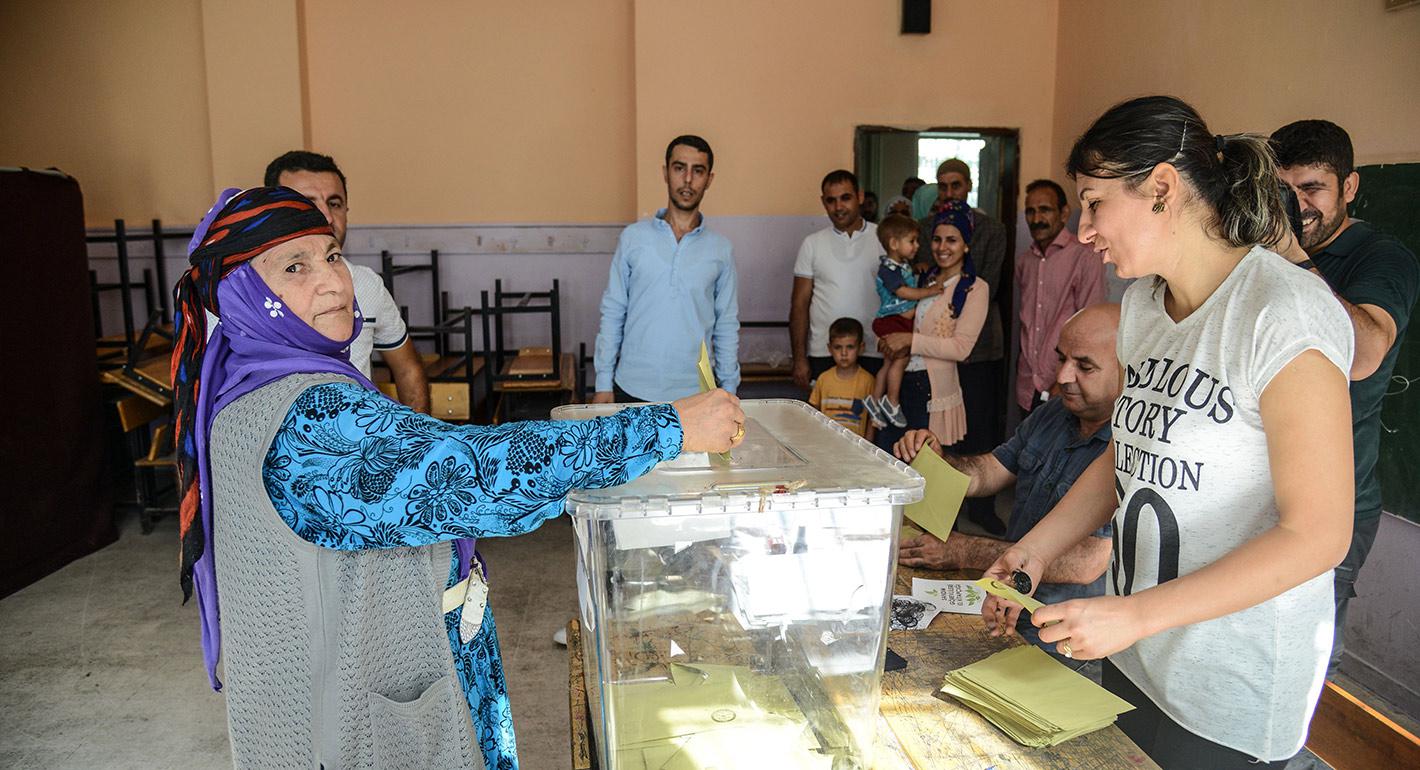
The Kurdish Vote and the Turkish Election
The pro-Kurdish HDP has come out of the shadows to support Kemal Kilicdaroglu’s candidacy.
Under President Recep Tayyip Erdogan’s leadership, the AKP (Justice and Development Party) dominated Türkiye’s politics for about two decades until the party arrived at a vulnerable stage in 2019, losing municipal elections in two important provinces, Ankara and Istanbul. These provinces were lost to the opposition CHP (Republican People’s Party) with the open support of the right-wing and Turkish nationalist IYIP (The Good Party) in addition to the silent support of the HDP (Peoples’ Democratic Party).
From Silent Kingmaker to Determinant of Opposition Candidate
In 2019 municipal elections, the HDP tacitly supported the CHP-IYIP alliance and proved instrumental in aiding the CHP to wrest control of the two major provinces from the AKP.
Fast forward to 2023, the HDP has shunned its behind-the-scenes maneuvering and come forward as a determined political force against Erdogan. Unlike previous elections, the HDP was quick to openly declare support for Kemal Kilicdaroglu’s presidential bid. When Kilicdaroglu’s candidacy was presented to the Nation Alliance, also known as the Table of Six, the CHP and the other four parties were supportive, except for Meral Aksener, leader of the IYIP, who supported the candidacy of either Ankara mayor Mansur Yavas or Istanbul mayor Ekrem Imamoglu.
Aksener’s disapproval of Kilicdaroglu’s candidacy caused a short-term crisis within the opposition bloc. She believed Yavas and Imamoglu were more popular in opinion polls. The issue was eventually resolved by the offer of a vice president position to both Yavas and Imamoglu if Kilicdaorglu is elected.
The entire saga reflected a power struggle within the anti-Erdogan opposition bloc between the HDP and the IYIP.
Kilicdaroglu as a Game-Changer
Kilicdaroglu took the reins of the CHP after the resignation of veteran politician Deniz Baykal in 2010. Since then, he has transformed the party from being a fiercely secular nationalistic front that viewed religious conservatism with disdain to a more inclusive and liberal organization and cadre.
Many political observers perceive Kilicdaroglu as the main architect of the anti-Erdogan opposition bloc. Though the bloc leaders differ on a range of issues, they have succeeded in drawing a political roadmap.
To tap into a conservative vote bank, Kilicdaroglu promised helallesme, a Turkish concept that refers to acknowledging past mistakes and fixing them in the present. Here, the outreach is tailored to Turkey’s conservative population—the AKP’s backbone—and the past wrongs he refers to include the infamous headscarf ban and other forms of discrimination conservative people faced at the hands of past CHP rulers. The concept of helallesme might even apply to Kurds, as Kurdish people are asking what Kilicdaroglu is going to offer Kurds.
Obstacles of Kilicdaroglu’s Candidacy
To defeat Erdogan, Kilicdaroglu needs the HDP, the IYIP, and secular nationalists from within the Nation Alliance on his side. But many IYIP pioneers cannot make peace with Kilicdaroglu’s pivot toward the HDP.
The main source of contention between the HDP and nationalist parties like the IYIP is that the latter accuses the former of being sympathetic towards and maintaining relations with the PKK, which is internationally recognized as a terrorist organization. This situation has also caused a legitimacy crisis for Kilicdaroglu’s presidential campaign among the Turkish nationalists.
Indeed, prominent Turkish nationalist politician MP Yavuz Agiralioglu openly criticized Kilicdaroglu’s candidacy process and recent visit to the HDP headquarters. In protest, he resigned from the IYIP where he previously served as a deputy chairman. Moreover, Muharrem Ince, a former presidential candidate of the CHP and current candidate of the Memleket Party, is able to increase his popularity among the secular nationalists.
Thus, the biggest obstacle of Kilicdaroglu’s candidacy is not the support of the pro-Kurdish HDP whose voters are more politicized and have fallen in line with their party’s decision. Rather, it could be the Turkish nationalists who refrain from voting for Kilicdaroglu.
Beyond the difficulty of finding a balance between the HDP and the IYIP for Kilicdaroglu’s presidential candidacy, Erdogan has historically managed to preserve his vote in predominantly Kurdish areas. In the last two presidential elections held in 2014 and 2018, he received more than 40 percent of the vote in these areas even while his Kurdish policy has changed significantly from peace process to security-oriented policies. Moreover, Erdogan has strong synergy in the People’s Alliance, with the Turkish nationalist MHP (Nationalist Movement Party), and has added the Kurdish conservative HUDAPAR (Free Cause Party) to the Alliance.
Selçuk Aydın holds a PhD from King’s College in the School of Security Studies. He has conducted projects and published articles, book chapters and opinions on Turkey's history, Turkish diaspora, Kurdish Studies, and Middle East politics. He is currently a lecturer at Giresun University.
About the Author
Selçuk Aydın
Carnegie does not take institutional positions on public policy issues; the views represented herein are those of the author(s) and do not necessarily reflect the views of Carnegie, its staff, or its trustees.