

{
  "authors": [
    "Batu Coşkun"
  ],
  "type": "commentary",
  "blog": "Sada",
  "centerAffiliationAll": "dc",
  "centers": [
    "Carnegie Endowment for International Peace"
  ],
  "collections": [],
  "englishNewsletterAll": "menaTransitions",
  "nonEnglishNewsletterAll": "",
  "primaryCenter": "Carnegie Endowment for International Peace",
  "programAffiliation": "MEP",
  "programs": [
    "Middle East"
  ],
  "projects": [],
  "regions": [],
  "topics": []
}
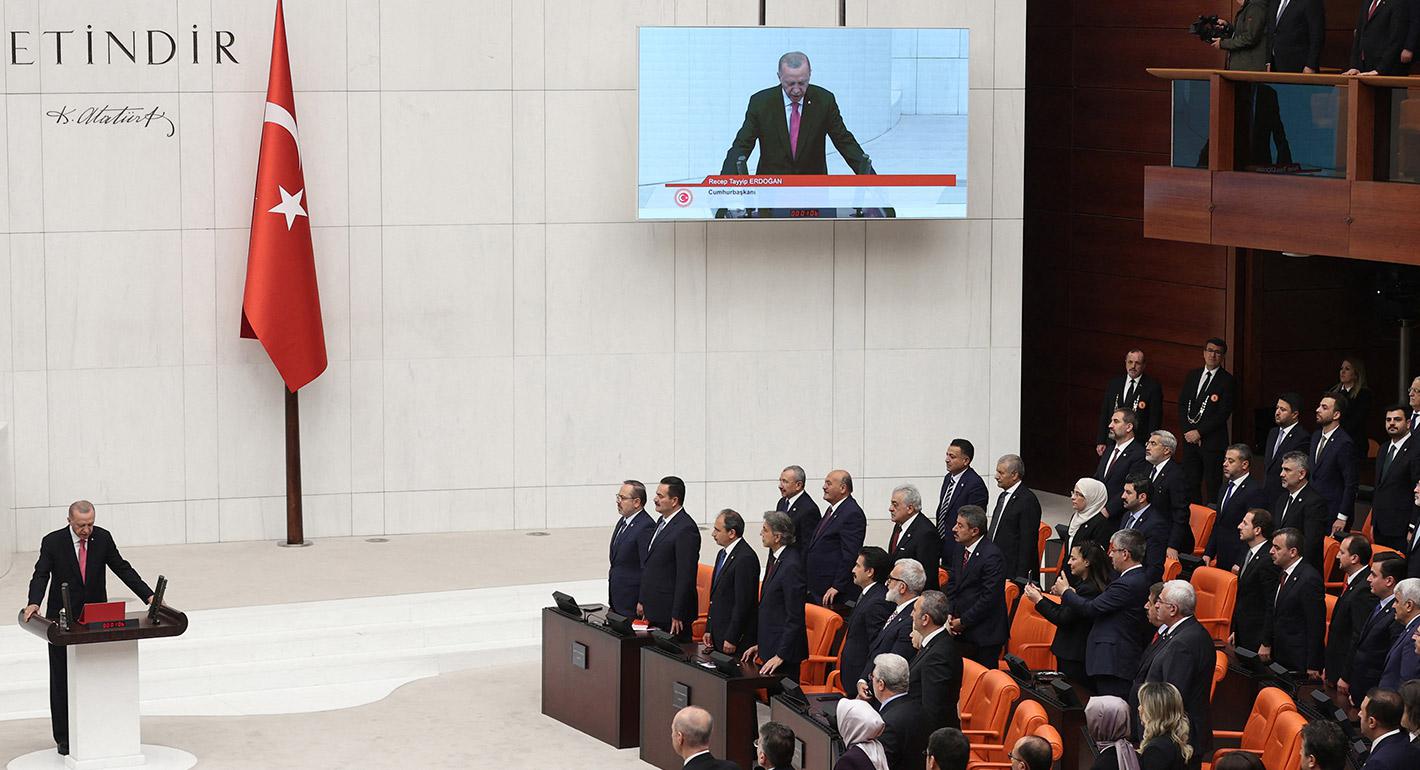
Source: Getty
Erdoğan’s Republic: The Next Five Years
This will likely be Erdogan’s last term, as his electoral alliance is not large enough to hold a constitutional referendum to extend presidential term limits.
President Erdoğan has been elected for another five-year term as president of Türkiye. Despite the Turkish opposition’s historically strong alliance, favorable opinion polling, and deteriorating economic conditions and persistent trends of poor governance under Erdoğan’s rule, they failed to oust the incumbent. In essence, Erdoğan’s victory was assured after the first round of elections on May 14, which firmly secured the Turkish right’s control of parliament and left him only about 300 thousand votes short of the presidency in an electorate of over 60 million. In the second round on May 28, Erdoğan scored more than 2 million votes over his opponent Kemal Kılıçdaroğlu, marking a decisive win.
On the same night, Erdoğan addressed his supporters from the Presidential Complex in Ankara, standing alongside members of his electoral coalition. Among them was the most recent addition to the cohort: Sinan Oğan. Oğan was the third-placed presidential candidate in the first round of elections, and is a significant member of the Turkish nationalist movement who pledged his support to Erdoğan in the second round.
Oğan’s endorsement was a testament to the fact that Erdoğan has consolidated the overwhelming majority of the Turkish right under the “People’s Alliance”, a coalition of political parties that has secured the uninterrupted continuation of his legislative and executive agendas. This alliance has ensured that even disgruntled voters weary of Erdoğan remain in the fold, even if they do not vote for his Justice and Development Party (AKP). Indeed, the AKP lost over 2 million votes compared to the 2018 elections, but over 1.5 million of those were compensated through the alliance’s inclusion of a minor Islamist political party, the New Welfare Party (YRP). The AKP also benefitted from the performance of its junior coalition partner, the Nationalist Movement Party (MHP), which captured 10 percent of the electorate in the parliamentary elections—twice the size of projected estimates.
Erdoğan’s acute command of the Turkish right has sustained his rule without any real obstacles. This has further disincentivized him from branching outside of his traditional base. Simply, Erdoğan’s appeal to conservative and nationalist voters is sufficient for victory, given Türkiye’s conservative societal skew. By consolidating right-wing votes and including potential rivals in his alliance, Erdoğan has established a lasting scheme for holding onto the reigns of state power.
For the post-Erdoğan era, too, this new style of right-wing alliance politics has critical implications. Since Erdoğan’s electoral alliance is not large enough to trigger a constitutional referendum that could potentially extend term limits, this will likely be his last term in office. Thus the next five years in Turkish politics will be about the question of Erdoğan’s successor. The president has yet to suggest a particular name, and any speculation at this point is guesswork.
Erdoğan’s challenge will be to nominate someone who can continue consolidating the right and ensuring that the system designed by his ruling coalition remains intact. Currently, the opposition-aligned nationalist IYI Party remains the only formidable right-wing force opposing Erdoğan. However, IYI remains a potential addition to his coalition. With the defeat of the Turkish opposition, it is now more likely that any major political change in Erdoğan’s republic will come from within his ever-expanding ruling alliance.
Batu Coşkun is a political risk analyst on Turkish affairs and research fellow at the Sadeq Institute. He tweets at @BatuCoskunn.
About the Author
Batu Coşkun
Carnegie does not take institutional positions on public policy issues; the views represented herein are those of the author(s) and do not necessarily reflect the views of Carnegie, its staff, or its trustees.