

{
  "authors": [
    "Faysal Abbas Mohamad"
  ],
  "type": "commentary",
  "blog": "Sada",
  "centerAffiliationAll": "dc",
  "centers": [
    "Carnegie Endowment for International Peace"
  ],
  "collections": [],
  "englishNewsletterAll": "menaTransitions",
  "nonEnglishNewsletterAll": "",
  "primaryCenter": "Carnegie Endowment for International Peace",
  "programAffiliation": "MEP",
  "programs": [
    "Middle East"
  ],
  "projects": [],
  "regions": [],
  "topics": []
}
Source: Getty
The Astana Process Six Years On: Peace or Deadlock in Syria?
The end of meetings in the Kazakh capital offers an opportunity to reevaluate the forum and assess its relevance for the future of the Syrian conflict.
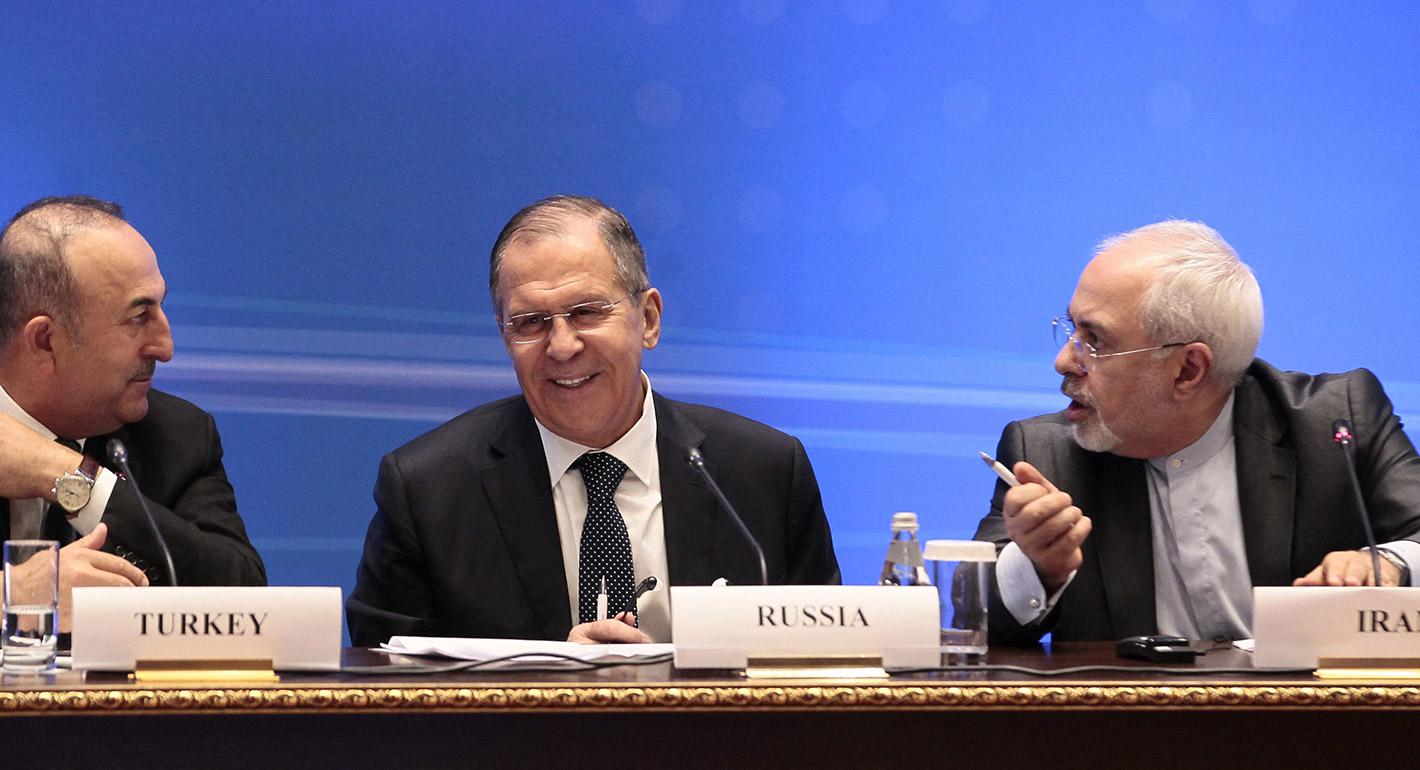
June 21 marked the first day of the twentieth round of the Astana talks, a trilateral forum sponsored by Russia, Türkiye, and Iran, and hosted by Kazakhstan. Launched in January 2017, Astana ostensibly aimed to end the armed conflict in Syria and “jumpstart the convening of the formal political negotiating process,” as optimistically proclaimed by the then-United Nations Special Envoy Staffan de Mistura.
From the outset, Syrians were skeptical about the forum’s lofty goals. After the first round of talks, Al Jazeera interviewed a number of Syrians living in opposition-controlled areas in northwest Syria. One activist criticized the lack of input from Syrians themselves: “We have no say, because Russia and Türkiye impose what they want…And then the [opposition’s] brigades impose that on the people. The others sold themselves to the sponsors. And the price of that was our revolution.” These interviews captured the sense of disillusionment with the military and political leaders of the Syrian opposition, who caved in to Turkish and Russian pressure and compromised the goals of the Syrian revolution.
Conducted under UN auspices, Astana was justified by de Mistura, as well as his successor Geir Otto Pedersen, as an avenue for achieving peace. Instead, however, it gave the guarantors the necessary cover to divide Syria into four “de-escalation zones” intended to contain the conflict, while they negotiated their respective interests.
“De-escalation” proved one-sided. Between 2018 and 2019, Syrian regime forces, supported by their Russian and Iranian allies, violated the agreement and seized the first three zones and parts of the fourth, leaving the armed opposition and 4.5 million Syrians—including hundreds of thousands of displaced civilians—squeezed in a narrow swath of land in north and northwest Syria along the Turkish borders. Content with the consolidation of its military presence in northwest Syria, Ankara did little to curtail the regime’s instrumental assaults on its Syrian allies, save for the occasional bout of coercive diplomacy. However, successive military offensives by the regime and its allies, and the ensuing ceasefires negotiated with Ankara, enabled Syria to redraw demarcation lines.
At the talks this past June, the Kazakh representative abruptly announced that his country was no longer willing to host the meetings, claiming that they had successfully achieved their goals. The troika issued a joint statement at the end of the meetings that stressed that the talks would resume later this year, suggesting that the Astana template would simply continue outside the Kazakh capital.
This insistence on the Astana format reveals its true modus operandi: a mechanism for normalizing the military presence of its sponsors, while minimizing interstate friction. Ankara’s strategy is one of containment, seeking to mitigate further refugee flows into its territory while curbing the political and coercive power of the autonomous Kurdish-led administration in northeast Syria, which it deems an existential threat. Moscow and Tehran have acquiesced to Turkish military build up in these areas. In return, they seek to limit the ability of Turkish-backed rebels to pose any genuine threat to the Assad regime’s hold on power. The regime’s survival is seen by Moscow and Tehran as a strategic lifeline that is key to pursuing their wider regional interests, particularly in the Levant. Through Astana, Moscow and Tehran appear to have won assurances to this effect.
However, beyond the sponsors’ shared desire to strangle Kurdish separatist ambitions in Syria (as underlined in the joint statement) and regionally, significant gaps remain between their respective objectives. The presence of Turkish military outposts, Türkiye’s patronage of Syrian proxy groups and its ambiguous relationship with Hay’at Tahrir al-Sham, the involvement of pro-Iran militias, and the destabilizing impact of regime assaults on rural Idlib persist as points of contention.
The resumption of the Astana process will not restore its legitimacy, nor will it necessarily preclude active opposition to it. The continued participation of representatives of some Syrian opposition factions in the forum is far from assured, as their involvement may jeopardize whatever remains of their credibility among Syrians.
Regardless of the precise shape or location of Astana 2.0, it will surely be affected by recent regional developments. Assad’s readmission to the Arab League, the Turkish bid for normalization with Syria and other key Arab players, such as Saudi Arabia and the United Arab Emirates, and Russia and Iran’s continued international isolation are all significant factors that will determine the forum’s dynamics—and whether it remains relevant.
Faysal Abbas Mohamad is a retired Syrian-Canadian professor of Middle Eastern politics and international relations, as well as a longtime dissident who was an eyewitness to the Syrian uprising. His articles have appeared in New Lines Magazine, the New Arab, and various other outlets. Follow him on Twitter @fmohamad2.
Note:
1. This article was written before it was reported on June 29 that Kazakhstan unexpectedly agreed to host the 21st session of the Astana talks, to be held before the end of the year.
About the Author
Faysal Abbas Mohamad
Carnegie does not take institutional positions on public policy issues; the views represented herein are those of the author(s) and do not necessarily reflect the views of Carnegie, its staff, or its trustees.