

{
  "authors": [
    "Maria Gloria Polimeno"
  ],
  "type": "commentary",
  "blog": "Sada",
  "centerAffiliationAll": "dc",
  "centers": [
    "Carnegie Endowment for International Peace"
  ],
  "collections": [],
  "englishNewsletterAll": "menaTransitions",
  "nonEnglishNewsletterAll": "",
  "primaryCenter": "Carnegie Endowment for International Peace",
  "programAffiliation": "MEP",
  "programs": [
    "Middle East"
  ],
  "projects": [],
  "regions": [],
  "topics": []
}
Source: Getty
Egyptian Elections and Elite Dynamics
As part the Egypt Vision 2030 development agenda, elections were a necessary measure for the regime to demonstrate unity among the country's political and military elite.
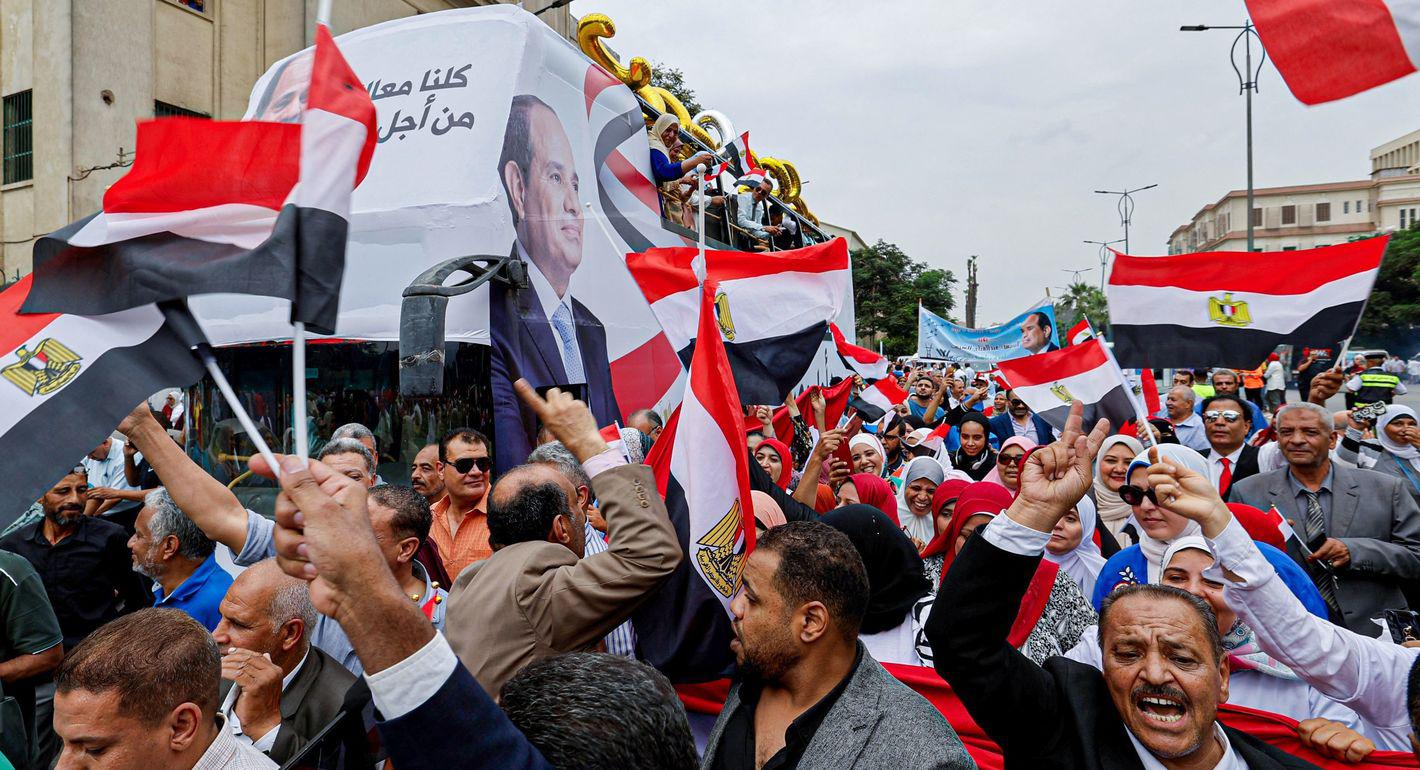
This week, Egyptians headed to the polls to cast their ballots in the 2023 presidential election. When the results are announced on December 18, Egyptian President Abdel Fattah al-Sisi is largely expected to secure a third term in office. The elections took place at a time of economic turmoil that has dragged on for the past two years, accelerating in early 2023 as a result of the exponential rise in the inflation rate. This crisis has come on top of the austerity measures and the devaluation of the currency that already deeply affected the country during the height of the COVID-19 pandemic in 2020.
Many have argued that the 2023 elections were part of al-Sisi’s move to reassert his political legitimacy prior to embarking on a new package of austerity measures. But this implies that al-Sisi already obtained and renewed a social mandate to rule in previous elections. Political legitimacy has many interpretations, but in its most basic as a “social mandate” to rule, it involves political pluralism—a precondition that is nowhere to be found in Egypt. Instead, the 2023 elections should be understood through the lens of Egyptian intra-elite politics, which is closely intertwined with the government’s program of transitioning to a green economy, part of Egypt Vision 2030.
A set of amendments to the penal code introduced between 2014 and 2017 have been detrimental to civil society, shutting down spaces for political debate and pluralism. During the past eight years, al-Sisi’s government has suppressed or banned political opposition—religious and secular alike—and imprisoned human rights defenders, forcing many to flee the country. Political parties have been eclipsed by the regime, to the point that the Wafd Party, the oldest and most influential in Egypt, backed al-Sisi in the 2018 elections.
During the current round of presidential elections, the outspoken opposition candidate and former Egyptian parliamentarian Ahmed Al-Tantawi, was harassed by the military and forced to end his presidential run in October. Now facing trial for “circulating unauthorized endorsement forms,” Al-Tantawi and his candidacy reveals the complex relationship between al-Sisi, the armed forces, and the silenced opposition. As discussed in my forthcoming book, the Egyptian military is not a unified actor, and the cohesion of the military elite depends on a variety of social, political, and economic factors. Even if it is unlikely that al-Tantawi would have won the elections, his candidacy could have attracted dissenting voices and mobilized a large, if deeply unorganized, opposition. Indirectly, this could have opened rifts within the military, thus exposing the political authority to risks.
The remaining three opponents included Abdel Sanad Yamama of the Wafd Party, Omar Hazem of the Republican People’s Party, and Farid Zahran of the Egyptian Social Democratic Party. A former chairman of the Foreign Relations Committee in Egypt’s Senate, Hazem also oversees an Egyptian tourism development company, while Zahran maintains connections to Abbas Kamel, Director of Egyptian General Intelligence. Yamama does not have specific relations with Egypt’s network of political or business elites, but he has never criticized al-Sisi for his political or economic reforms.
While the legal structure that ensures the absence of any true opposition has remained unchanged since the 2018 elections, when al-Sisi won 97 percent of the vote, the shift to these three “symbolic” candidates reveals a change in the regime’s political strategy. The goal of elections has been to prevent any fractures from the within the elite which could undermine Egypt Vision 2030: rather than proving political legitimacy, the presidential authority needs a pledge of allegiance by the elite, particularly amidst growing criticisms about the envisioned model of “green” development. Al-Sisi’s survival entirely depends on the success of Egypt Vision 2030—and thus the opposition candidates, despite the election results, have performed a critical political role for the regime.
Dr Maria Gloria Polimeno is Research Fellow at SOAS University of London and the author of Egypt and the rise of fluid authoritarianism: political ecology, power and crisis of legitimacy, forthcoming from Manchester University Press. She is also a Fellow of the Royal Society of the Arts.
About the Author
Maria Gloria Polimeno
Carnegie does not take institutional positions on public policy issues; the views represented herein are those of the author(s) and do not necessarily reflect the views of Carnegie, its staff, or its trustees.