

{
  "authors": [
    "Abdul Moiz Khan"
  ],
  "type": "commentary",
  "blog": "Sada",
  "centerAffiliationAll": "dc",
  "centers": [
    "Carnegie Endowment for International Peace"
  ],
  "collections": [],
  "englishNewsletterAll": "menaTransitions",
  "nonEnglishNewsletterAll": "",
  "primaryCenter": "Carnegie Endowment for International Peace",
  "programAffiliation": "MEP",
  "programs": [
    "Middle East"
  ],
  "projects": [],
  "regions": [],
  "topics": []
}
Source: Getty
The India-Middle East-Europe Economic Corridor (IMEC): Too Little, Too Late?
Even before the outbreak of war in Gaza, the U.S. plan for regional economic integration was unable to accomplish its primary goal: countering Chinese influence in the Middle East.
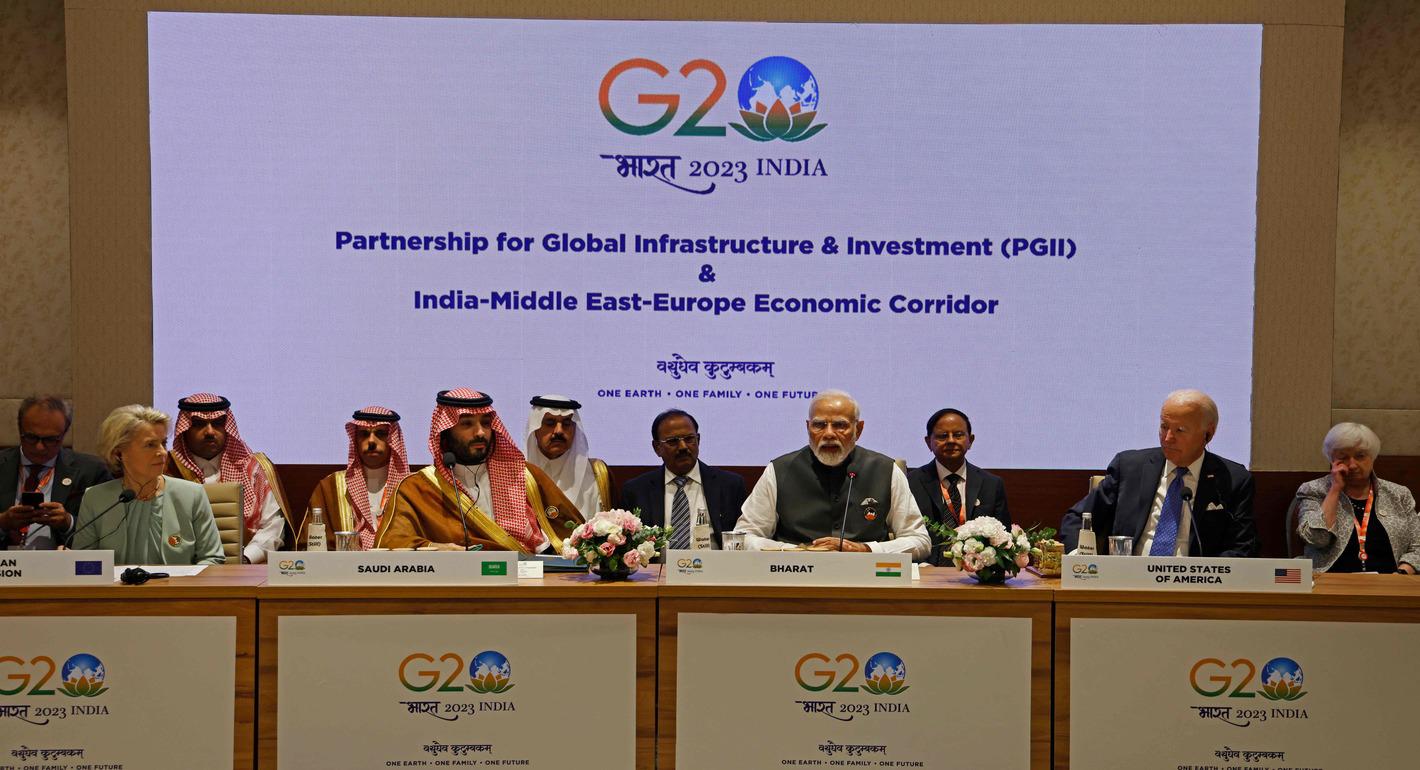
During the G20 summit in New Delhi in September, world leaders unveiled plans for a India-Middle East-Europe Economic Corridor (IMEC). Saudi Arabia, the European Union, India, the United Arab Emirates (UAE), France, Germany, Italy, and the United States all signed a Memorandum of Understanding, committing to work together to advance the project.
While details of the corridor are still scant, the MOU revealed the basic outline of a ship-to-rail transit network that will supplement existing maritime and road transport routes. The project’s physical infrastructure includes railway lines connecting the UAE to Israel via Saudi Arabia and Jordan, as well as electric cables to enhance digital connectivity and pipes for clean hydrogen export.
The United States is pushing for IMEC as a counter to the Chinese Belt Road Initiative (BRI). However, China already has considerable influence along the proposed route of IMEC. An important link in IMEC is the Greek port of Piraeus—the largest port in Eastern Europe—which will receive cargo coming from the Haifa port in Israel. The Chinese shipping company Cosco has been the majority stakeholder in the port since 2016, when the Greek government sold the company two-thirds stakes. In other words, this Chinese company has all the powers to decide the future of the port and control the piers and terminals. At this point, it is unclear whether India and the United States overlooked this important strategic consideration, or if they will attempt to buy stakes in Piraeus and shift the balance of power away from Cosco.
Moreover, the deep financial ties between China and the Arab Gulf limits the ability of IMEC or any similar development project to challenge Beijing’s influence in the region. Trade between China and Saudi Arabia stood at more than $106 billion in 2022, almost double the value of US-Saudi trade. China has also acquired a minority twenty percent stake in Red Sea Gateway Terminal, the largest port in Saudi Arabia. The value of non-oil China-UAE trade exceeded $72 billion in 2022 alone, and China has already invested in multiple development schemes. These include the Etihad Rail project, which aims to connect the northeastern city of Fujairah to the border with Saudi Arabia. It would be the largest railway artery across the country, linking major industrial centers, manufacturing bases, logistic hubs, and key ports of the UAE.
The Hamas attacks of October 7 and the ongoing Israeli assault on Gaza present the latest challenge to the IMEC. Normalization talks between Tel Aviv and Riyadh have been paused for the foreseeable future, although the war has yet to undermine Israel’s economic relations with the UAE. Any project connecting Jordan with Israel will face strong opposition from the Jordanian public, especially the Palestinian population, and the government has taken a firm stance against Israel’s bombardment of Gaza. IMEC may end up like other infrastructure projects, such as the proposed freight rail link between Israel, Jordan, and Saudi Arabia, that were dead on arrival. However, based on India’s recent voting behavior in the United Nations General Assembly in favor of Israel, the current crisis will likely not affect relations between New Delhi and Tel Aviv.
IMEC offers a plethora of potential economic benefits both regionally and internationally, especially by cutting the cost and increasing the speed of cargo shipment. However, to achieve such goals, potential political challenges to the project have to be addressed. China has already expanded its influence in the region, and it is not clear that the United States will be able to counter it. More immediately, however, as Tel Aviv continues to bombard Gaza, it will be difficult for Arab states to even sit at a table with Israel—let alone plan for regional integration projects.
Abdul Moiz Khan is a Research Officer at the Center for International Strategic Studies in Islamabad. He is pursuing his MPhil in International Relations from Quaid-e-Azam University, and his work has been published in the South China Morning Post, The Diplomat, Stimson Center, and BASIC, among others. Follow him on X @kmoizsays.
About the Author
Abdul Moiz Khan
Carnegie does not take institutional positions on public policy issues; the views represented herein are those of the author(s) and do not necessarily reflect the views of Carnegie, its staff, or its trustees.