

{
  "authors": [
    "Alexandre Kateb"
  ],
  "type": "commentary",
  "blog": "Sada",
  "centerAffiliationAll": "dc",
  "centers": [
    "Carnegie Endowment for International Peace"
  ],
  "collections": [],
  "englishNewsletterAll": "menaTransitions",
  "nonEnglishNewsletterAll": "",
  "primaryCenter": "Carnegie Endowment for International Peace",
  "programAffiliation": "MEP",
  "programs": [
    "Middle East"
  ],
  "projects": [],
  "regions": [],
  "topics": []
}
Source: Getty
BRICS+ and the Arab Gulf: The Perks of Membership
As a matter of economic policy, Saudi Arabia and the UAE have much to gain by joining the bloc.
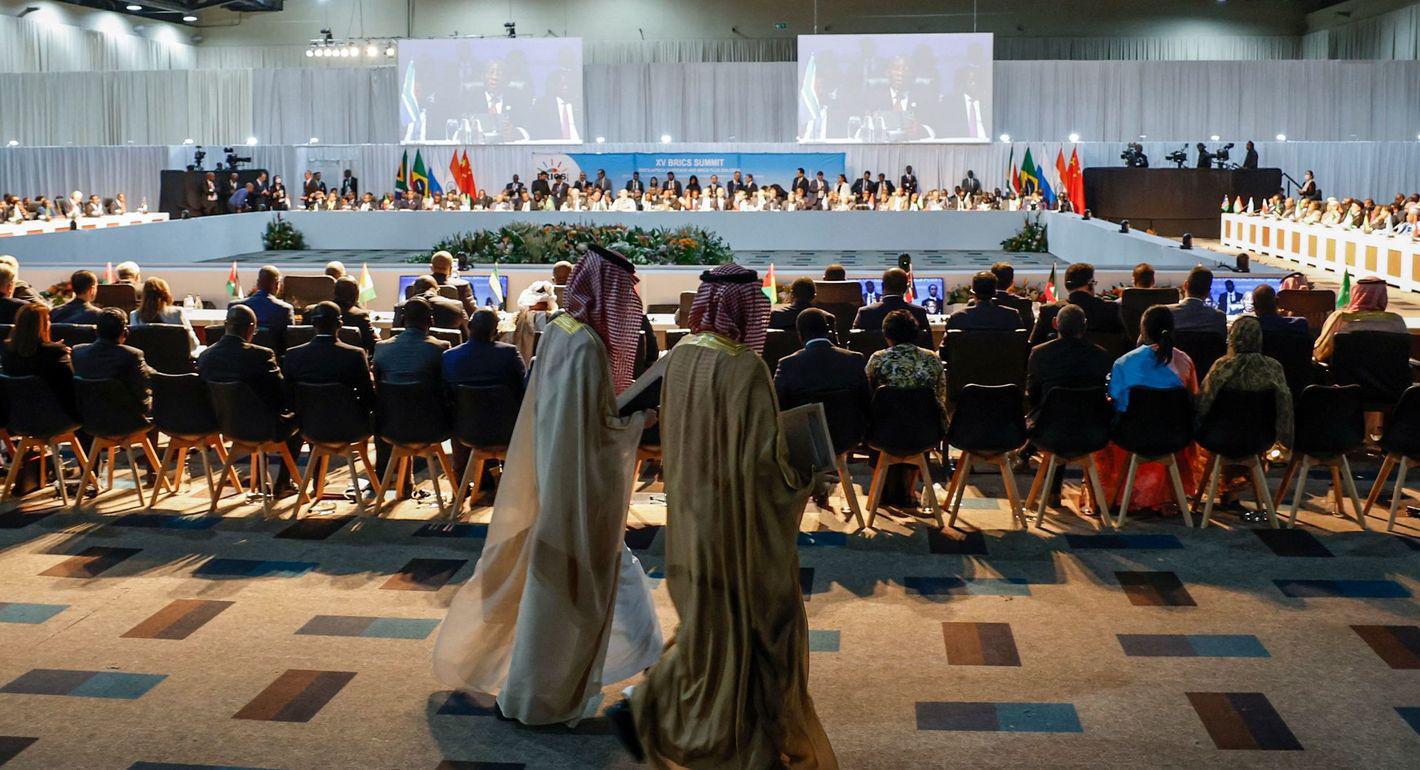
Following its summit in Johannesburg this past August, the BRICS group extended invitations to five nations in the Middle East and North Africa—Saudi Arabia, the United Arab Emirates (UAE), Iran, Egypt, Ethiopia— as well as to Argentina. As of January 1, these five countries have been officially welcomed into the bloc. This move towards an expanded BRICS+ came during discussions about new initiatives to de-dollarize trade and financial transactions, notably through the use of the Chinese Renminbi and other local currencies.
There are several incentives underlying Saudi Arabia and the UAE's decision to join BRICS+. First and foremost is the perceived need to rebalance and hedge their economic and geopolitical alignments in a rapidly shifting global environment. Following the demise of the Bretton Woods system in the 1970s, Saudi Arabia and other Middle Eastern oil exporters were nudged to bolster the US dollar's continued dominance as the global reserve currency and preferred medium for international trade. This involved linking their currencies to the dollar, channeling their dollar surpluses from oil sales back into the US economy, and lending these surpluses to other nations—leading to the creation of the petrodollar system.
As the new millennium dawned, the United States became a net exporter of oil and gas and Asia emerged as the predominant purchaser of Middle Eastern oil, with China at the forefront. BRICS+ membership for Saudi Arabia and the UAE may thus recalibrate the dynamics of this buyer-seller relationship with China within a single multilateral framework, and lead a better understanding of mutual interests, especially in terms of price setting and supply chains. And alongside membership in the New Development Bank—established in 2014 by BRICS members, and which the UAE has already joined—BRICS+ may also help these two capital-rich countries to benefit from investment opportunities related to China’s Belt and Road Initiative (BRI).
Saudi Arabia and the UAE may also expand economic partnerships with India, which has been critical of China's Belt and Road Initiative and the use of the Renminbi in international trade. Through BRICS+, the UAE and Saudi Arabia can facilitate and coordinate their investments both in India, which seeks capital for developing its infrastructure and manufacturing sector, and in India-sponsored cross-border schemes, such as the recently proposed India-Middle East-Europe economic corridor. More broadly, the inclusion of Saudi Arabia and the UAE in BRICS+, which India lobbied for, may rebalance China’s dominance within the bloc and help pacify relations between New Delhi and Beijing.
An expanded BRICS+ could enhance the power of other non-Western alliances in global economic fora, ultimately reshaping them to better align with an emerging multipolar world. The Gulf Cooperation Council (GCC), for instance, stands to benefit from their two most prominent members joining BRICS+, given the latter’s growing role within the G20 as a counterbalance to the G7 bloc. Integrating nations like Indonesia or Malaysia into BRICS+ could further elevate this cooperative endeavor, linking the Association of Southeast Asian Nations (ASEAN), the GCC, and the African Union within a single non-Western controlled multilateral framework.
Beyond these shared incentives, both Saudi Arabia and the UAE possess unique rationales for BRICS+ membership. While the UAE doesn’t boast a trillion-dollar economy, it plays a disproportionately significant role in international energy, trade, and finance—and its inclusion in BRICS+ serves as a testament to its stature as a global hub. For Saudi Arabia, joining BRICS+ signifies a pivotal transition: from a nation primarily aligned with the United States to an independent regional force with international influence, mirroring the trajectory observed in neighboring Turkey over the past twenty years.
As it expands beyond its “minilateral” origins, the alliance may help member states to circumvent some of the barriers that curtail their influence within a predominantly Western-led multilateral system. In the long term, the aim is to rewrite the rules of this system and introduce innovative mechanisms for global cooperation, capitalizing on new digital technologies and enhanced physical connectivity. For countries like Saudi Arabia and the United Arab Emirates, BRICS+ membership offers a chance to take an active role in shaping this emerging landscape.
Alexandre Kateb is an Economist and a Chartered Financial Analyst (CFA). He is the founder and chairman of The Multipolarity Report, which he founded after twenty years of experience as an economist, policy advisor, and investment strategist. Follow him on X @AlexandreKateb.
About the Author

Alexandre Kateb
Alexandre Kateb is an Economist and a Chartered Financial Analyst (CFA). He is the founder and chairman of The Multipolarity Report, which he founded after twenty years of experience as an economist, policy advisor, and investment strategist.
Carnegie does not take institutional positions on public policy issues; the views represented herein are those of the author(s) and do not necessarily reflect the views of Carnegie, its staff, or its trustees.