

{
  "authors": [
    "Henri J. Barkey",
    "Ian Lesser"
  ],
  "type": "event",
  "centerAffiliationAll": "dc",
  "centers": [
    "Carnegie Endowment for International Peace"
  ],
  "collections": [],
  "englishNewsletterAll": "democracy",
  "nonEnglishNewsletterAll": "",
  "primaryCenter": "Carnegie Endowment for International Peace",
  "programAffiliation": "DCG",
  "programs": [
    "Democracy, Conflict, and Governance",
    "Middle East"
  ],
  "projects": [],
  "regions": [
    "Türkiye"
  ],
  "topics": [
    "Political Reform",
    "Democracy"
  ]
}
Turkey: Aftermath of the Political Crisis
Fri, September 5th, 2008
Washington, D.C.
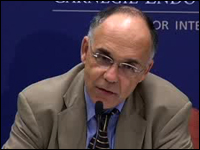
Turkey narrowly avoided a political crisis in August with the Constitutional Court deciding to abstain from banning the ruling Justice and Development Party. However, the crisis has badly shaken Turkey’s political establishment. To better understand the implications the crisis has on the future of the Turkish state and its ruling party, Henri Barkey, a Nonresident Senior Associate at the Carnegie Endowment and Ian Lesser, a Senior Transatlantic Fellow at the German Marshall Fund, held a discussion on the matter in an event moderated by Thomas Carothers, vice president for studies at the Carnegie Endowment.
Barkey warned that Turkey has yet to overcome its political crisis because the court case has weakened the state’s secular institutions including the military, judiciary, and parliament. At the same time, the case woke the AKP out of its political slumber and forced it to realize the necessity of addressing the military’s role as a strong opposition force. In order to avoid further complications to the crisis, the AKP needs to allow a reorganization of the party hierarchy, include women more visibly in the political process, change its agenda to address domestic and international issues more directly, and take advantage of the Kurdish vote.
Lesser pointed out that Turkey’s foreign policy is one that has in recent times been operating more in width rather than depth, reflecting the government’s aim to make Turkey a major international player. Encouraged by a relatively permissible political environment, this approach risks becoming too defused and unsustainable. Therefore, it is necessary for Turkey to reorient itself and address its upcoming challenges, such as its relations with Russia and Europe in light of the Georgian crisis, and the debate to join the EU. Equally important are Turkey’s relations with the United States, whose assistance it will need on the Iraqi-Kurdish file, and with whom security talks may become relevant again.
In the question and answer session Barkey and Lesser further addressed the challenge of reforming the constitution and the need for a more open political environment. They also addressed Turkey’s relations with Armenia in light of President Gul’s unofficial visit to the country, and Turkey’s relations with Israel and Iran.
Carnegie does not take institutional positions on public policy issues; the views represented herein are those of the author(s) and do not necessarily reflect the views of Carnegie, its staff, or its trustees.
Event Speakers
Former Visiting Scholar, Middle East Program

Barkey served as a member of the U.S. State Department Policy Planning Staff, working primarily on issues related to the Middle East, the Eastern Mediterranean, and intelligence from 1998 to 2000.
Ian Lesser