


Cold Shoulder to Warm Embrace: The Spectrum of Africa’s Global Partnerships
Amid shifts in U.S. policy, African countries are pursuing other global partnerships.
February 2026
Here at the Carnegie Africa Program, we are actively tracking how U.S. policy and legislative shifts are already reshaping Africa’s strategic landscape. In January, the briefly expired African Growth and Opportunity Act secured a one-year renewal. As Kholofelo Kugler and Georgia Schaefer-Brown write in their recent analysis and explain in a video, its renewal may not be a long-term win for the continent. The AGOA renewal came on the heels of the Trump Administration’s release of their National Security Strategy (NSS), which resets US-Africa policy with key implications noted by Carnegie scholars Frances Z. Brown and Jane Munga. Program scholars have also been involved in key policy discussions on Capitol Hill: this month, nonresident scholar Christian-Géraud Neema testified at a subcommittee hearing on the DRC and Rwanda.
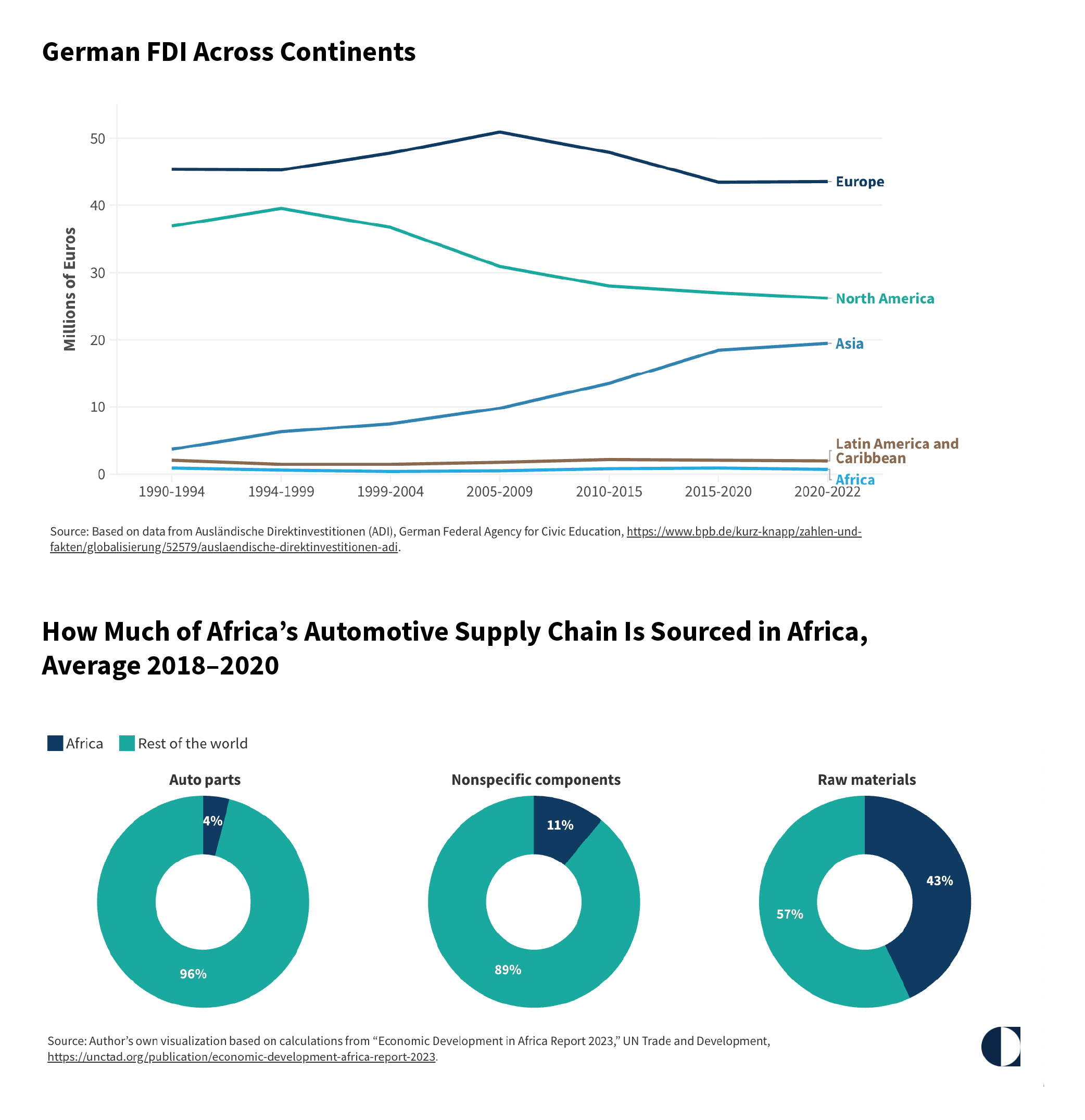
Amid shifts in U.S. policy, African countries are pursuing other global partnerships. In the context of the recent India AI Impact Summit, Lakshmee Sharma and Jane Munga explore possibilities for South-South AI Collaboration. Europe is one other possible partner with whom African countries can deepen collaboration. Writing for Carnegie, Hannah Grupp and Paul M. Lubeck argue that an increase in German FDI to African countries could be a win-win for all partners seeking structural transformation. For our Chart(s) of the Month, we’re highlighting two figures that demonstrate the disparity and potential of German FDI in localizing Africa’s automotive supply chain. Meanwhile, scholars from across Carnegie and beyond contributed to the newly released Russia in Africa Compendium, which examines the complexity of Moscow’s influence alongside the agency and interests of West and Southern African stakeholders.
Democratic trajectories across Africa remain in flux. Frances Z. Brown and Saskia Brechenmacher outline the year’s key democratic trends and what to watch out for in 2026.
Finally, closer to home, we are thrilled to announce that Dr. Fonteh Akum will be leading the Carnegie Africa Program as our new senior fellow and director. He comes to Carnegie from the Institute for Security Studies, and brings a wide-ranging background as a researcher, leader, and practitioner. We look forward to welcoming him when he starts this spring.
Charts of the Month
Features
Russia in Africa: Examining Moscow’s Influence and Its Limits
As Moscow looks for opportunities to build inroads on the continent, governments in West and Southern Africa are identifying new ways to promote their goals—and facing new risks.
By Nate Reynolds, ed., Frances Z. Brown, ed., Frederic Wehrey, ed., Andrew S. Weiss, ed.
South-South AI Collaboration: Advancing Practical Pathways
The India AI Impact Summit offers a timely opportunity to experiment with and formalize new models of cooperation.
By Lakshmee Sharma and Jane Munga
International AI Safety Report 2026
The report represents the largest global collaboration on AI safety to date.
Contributor (Senior Advisor): Jane Munga
Africa’s Democratic Kaleidoscope: Trends to Watch in 2026
Supporters of democracy within and outside the continent should track these four patterns in the coming year.
By Saskia Brechenmacher and Frances Z. Brown
AGOA’s Short-Term Renewal May Not Be a Long-Term Win
African countries need to adapt to a new era of U.S. trade relations.
By Kholofelo Kugler and Georgia Schaefer-Brown
Unpacking Trump’s National Security Strategy
Carnegie scholars examine the crucial elements of a document that’s radically different than its predecessors.
By Frances Z. Brown, Jane Munga, and numerous Carnegie scholars across programs
Sub-Saharan African Migrants in Morocco: Security Concerns and the Test of Human Rights
Is Morocco’s migration policy protecting Sub-Saharan African migrants or managing them for political and security ends? This article unpacks the gaps, the risks, and the paths toward real rights-based integration.
By Soufiane Elgoumri
Lack of Finance Is Not the Only Constraint on Global Development
Global development needs imagination to update the purposes, structures, and systems of outmoded institutions to make them fit for today’s world.
By David McNair
The Middle Power Moment
Middle powers have an important role to play in reviving international cooperation at this dawning moment of a new multipolar world.
By Stewart Patrick
‘Good Enough’ Drones Have Become Geopolitical Chips
In Sudan and elsewhere, regional powers have used the weapons for leverage.
By Steven Feldstein
Read the Argument in Foreign Policy
From the Archive
In April 2023, writing for Carnegie, Ronak Gopaldas published “Will the Invasion of Ukraine Change Russia-Africa Relations?, examining the potential decline of Moscow’s influence on the continent. This week, as Russia’s war in Ukraine enters its fifth year, scholars from Carnegie and beyond published the compendium “Russia in Africa: Examining Moscow’s Influence and Its Limits.”
In November 2024, Aubra Anthony, Jane Munga, and Sharmista Appaya published “From the margins to the center: Africa’s role in shaping AI governance” on World Bank Blogs. This piece’s exploration of Africa’s key potential in shaping the future of AI is continuously relevant as insights emerge from the recent India AI Impact Summit.
Carnegie does not take institutional positions on public policy issues; the views represented herein are those of the author(s) and do not necessarily reflect the views of Carnegie, its staff, or its trustees.