• Research
  • Strategic Europe
  • About
  • Experts
Carnegie Europe logoCarnegie lettermark logo
EUUkraine
  • Donate
{
  "authors": [
    "Nathan J. Brown"
  ],
  "type": "other",
  "centerAffiliationAll": "",
  "centers": [
    "Carnegie Endowment for International Peace"
  ],
  "collections": [
    "Arab Awakening"
  ],
  "englishNewsletterAll": "",
  "nonEnglishNewsletterAll": "",
  "primaryCenter": "Carnegie Endowment for International Peace",
  "programAffiliation": "",
  "programs": [
    "Middle East"
  ],
  "projects": [],
  "regions": [
    "Middle East",
    "North Africa",
    "Egypt"
  ],
  "topics": [
    "Political Reform",
    "Democracy",
    "Security",
    "Military"
  ]
}
Other

The Transition: From Mubarak’s Fall to the 2014 Presidential Election

In the forty months between Mubarak’s departure and the inauguration of President Abdel Fattah el-Sisi, the numerous contradictions of Egypt’s revolution have exploded with full force.

Link Copied
By Nathan J. Brown
Published on Jan 12, 2016

Source: Taylor & Francis

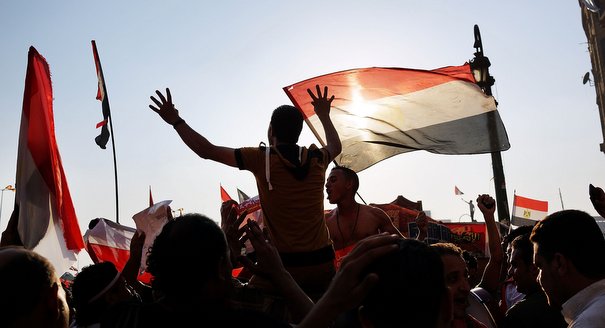
The forced departure of Egypt’s long-time president, Hosni Mubarak, on 11 February 2011 was widely hailed as a popular revolution, not only in Egypt, but worldwide. And in many respects it was: a cascading series of demonstrations suddenly rendered the country ungovernable by a president whose tenure had extended almost three decades and who appeared to be slowly arranging his own succession. But the legal form his deposition took was a ‘constitutional declaration’ by the country’s Supreme Council of the Armed Forces (SCAF)—a body nominally headed by the president himself but in effect operating independently—that Mubarak was no longer president and that the SCAF would oversee a transition to a new political system. That announcement, which all political forces that had supported the uprising welcomed and all state institutions accepted, contained many underappreciated contradictions. A democratic transition was supposed to be combined with unchecked military rule; a popular uprising decided happily to leave the state apparatus intact; a non-ideological movement simply chose at first to ignore the deep divisions within its own ranks.

The 40 months between Mubarak’s departure and the inauguration of President Abdel Fattah el-Sisi saw all these contradictions explode with full force. In the end, certain mechanical aspects of democracy did indeed emerge, and the memory of the uprising retained some political force and some established patterns that subsequent protest movements could draw on. But the tensions that were overlooked in February 2011 were resolved, at least for the moment, by the reassertion of a strong presidency and an unaccountable and authoritarian state apparatus—the very targets of the uprising...

This article was originally published by Taylor & Francis.

Read full text
Nathan J. Brown
Nonresident Senior Fellow, Middle East Program
Nathan J. Brown
Political ReformDemocracySecurityMilitaryMiddle EastNorth AfricaEgypt

Carnegie does not take institutional positions on public policy issues; the views represented herein are those of the author(s) and do not necessarily reflect the views of Carnegie, its staff, or its trustees.

More Work from Carnegie Europe

  • Commentary
    Strategic Europe
    New Tricks and AI Tools in Hungary’s High-Stakes Election

    Hungarian Prime Minister Viktor Orbán faces his most serious challenge yet in the April 2026 parliamentary elections. All of Europe should monitor the Fidesz campaign: It will use unprecedented methods of electoral manipulation to secure victory and maintain power.

      Zsuzsanna Szelényi

  • Trump speaking to a room of reporters
    Commentary
    Emissary
    Unpacking Trump’s National Security Strategy

    Carnegie scholars examine the crucial elements of a document that’s radically different than its predecessors.

      • Cecily Brewer
      • +18

      James M. Acton, Saskia Brechenmacher, Cecily Brewer, …

  • Commentary
    Strategic Europe
    Europe Faces the Gone-Rogue Doctrine

    The hyper-personalized new version of global sphere-of-influence politics that Donald Trump wants will fail, as it did for Russia. In the meantime, Europe must still deal with a disruptive former ally determined to break the rules.

      Thomas de Waal

  • Commentary
    Europe’s American Predicament

    Between Greenland and U.S. interference in Europe’s democracies, transatlantic relations risk rising to an unprecedented level of crisis. Amid continued arguments on how Brussels should react, tough times lie ahead for European leaders.

      Marc Pierini

  • Commentary
    Strategic Europe
    Taking the Pulse: What Issue Is Europe Ignoring at Its Peril in 2026?

    2026 has started in crisis, as the actions of unpredictable leaders shape an increasingly volatile global environment. To shift from crisis response to strategic foresight, what under-the-radar issues should the EU prepare for in the coming year?

      Thomas de Waal

Get more news and analysis from
Carnegie Europe
Carnegie Europe logo, white
Rue du Congrès, 151000 Brussels, Belgium
  • Research
  • Strategic Europe
  • About
  • Experts
  • Projects
  • Events
  • Contact
  • Careers
  • Privacy
  • For Media
  • Gender Equality Plan
Get more news and analysis from
Carnegie Europe
© 2026 Carnegie Endowment for International Peace. All rights reserved.