

Commentary
As European leadership prepares for the sixteenth EU-India Summit, both sides must reckon with trade-offs in order to secure a mutually beneficial Free Trade Agreement.
Dinakar Peri
{
  "authors": [
    "Evan A. Feigenbaum"
  ],
  "type": "legacyinthemedia",
  "centerAffiliationAll": "",
  "centers": [
    "Carnegie Endowment for International Peace",
    "Carnegie India"
  ],
  "collections": [],
  "englishNewsletterAll": "",
  "nonEnglishNewsletterAll": "",
  "primaryCenter": "Carnegie Endowment for International Peace",
  "programAffiliation": "",
  "programs": [
    "Asia"
  ],
  "projects": [
    "Technology and Society"
  ],
  "regions": [
    "North America",
    "United States",
    "South Asia",
    "East Asia",
    "China"
  ],
  "topics": [
    "Foreign Policy",
    "Technology"
  ]
}
Technonationalists, whatever their nationality, take a strategic view of industry and technology. They view it as fundamental to national security and economic competitiveness and take on faith that economic policies must have strategic underpinnings.
In a pointed speech on October 24, US Vice President Mike Pence warned that Beijing has “smashed the barriers between civilian and military technological domains.” Pence then offered this flatly contradictory statement of policy: “People sometimes ask whether the Trump Administration seeks to ‘de-couple’ from China. The answer is a resounding ‘no.’”
Here’s the problem: If Pence is right that Beijing leverages all technology for military purposes, then the United States should have no interest in enabling flows of capital, people, hardware, and software that might aid the military modernization of a strategic competitor.
But Beijing is not the only government that takes an increasingly integrated view of technology. And technonationalism everywhere threatens to disrupt flows of technology and talent that have enabled decades of innovation.
Of course, governments never stopped trying to integrate national security with development and industrial goals. Even Mao Zedong’s China—the archetype of a country isolated from the world—used China’s relative standing on the international stage as a benchmark to guide domestic technology investments.
Technonationalists, whatever their nationality, take a strategic view of industry and technology. They view it as fundamental to national security and economic competitiveness and take on faith that economic policies must have strategic underpinnings. They argue that technology must be diffused—but held closely.
From the 1940s-60s, this was all straightforward enough. The era’s foundational technologies emerged from weapons innovations, particularly the “war babies” of British radar, American atomic bombs, German rocketry, and American computers that historian Walter MacDougall has termed “command technology.”
Weapons innovation yielded “spinoff” innovation in the economy. Yet it enabled a substantial role for government and tended to refract technological competitiveness through the prism of national security priorities. Even Silicon Valley, today’s archetype of private entrepreneurialism, owed much of its early emergence to what Harvard’s Peter Galison describes as a fortuitous combination of “plentiful sunshine and even more plentiful government money” from military electronics contracts.
But the 1960s yielded three disruptive changes: First, “spin on” replaced “spinoff” with commercial microelectronics and semiconductors becoming the drivers of weapons innovations rather than the other way around.
Second, physical production of hardware and supply chains became globalized.
Third, innovation became globalized too: Today, collaborative cross-border partnerships enable research on many next-generation technologies.
Take Google: In 2017, it opened an AI laboratory in Beijing, collaborating with its labs in the United States, Canada, and Europe. Fei-fei Li, Google Cloud’s chief scientist for machine learning, argues that “the science of AI has no borders. Neither do its benefits.”
But technologies like AI are transforming the future of industry, jobs, work, and defense. In some cases, the same hardware and software will transform all four realms simultaneously.
That has motivated a new generation of technonationalists.
Until recently, most capitals were content to allow a largely commercial prism to dominate the development of disruptive technology. For instance, acquiring technology has been central to Beijing’s economic reform goals since 1978. But until recently, its pursuit was characterized mostly by technology purchases—or in some cases, intellectual property theft.
China’s government and firms sought technology through business deals and joint ventures. They encouraged foreign firms to set up technology-intensive operations in China. Sometimes, they reverse-engineered foreign technologies and developed indigenous alternatives, helping to modernize China’s own industrial base.
But the last decade has added additional dimensions: Beijing now seeks to turn foreign technologies into Chinese technologies so it has increasingly made technology transfer a precondition for foreign firms to win contracts or do business in China.
Second, Beijing has plowed a comparatively flush balance sheet into funds and direct investments overseas, including the acquisition of foreign firms whose product suites include technologies that China hopes to leverage in its pursuit of leadership.
Third, Beijing has ramped up domestic investment, emulating plans elsewhere, including Germany’s “Industrie 4.0” and Japan’s “New Industrial Structure Vision.”
Policymakers everywhere long presumed that economic integration could lift all boats while mitigating security competition among nations. But security competition, especially between Washington and Beijing, is intensifying despite economic and technological integration. Worse, security is now bleeding back into economics, with flows of capital, people, and technology disrupted by efforts in both capitals to indigenize, reduce external dependence, and export domestic engineering standards to make them default regional and global standards.
But if every commercial technology is now viewed as central to national security, it will re-entrench past patterns of technonationalism that many believed to be relics in an era of supposedly “borderless” innovation.
To view this in relief, consider the schoolchild’s “five Ws, one H”:
WHAT technologies will shape the future?
In many capitals, including Washington, governments now share a belief that AI, 5G, quantum computing, new materials, special metals, and biotechnology will be foundational to the future of both work and defense
WHO, then, should make these things?
The technonational prism implies that “we,” not “they,” must make them. Thus training Chinese students and scholars in leading-edge engineering subjects has suddenly become politically charged in the United States.
WHERE should things be made?
Beijing’s emphasis on indigenization and Washington’s on reorienting supply chains suggests that location is increasingly the flavor of the future.
WHEN should cutting-edge technologies be ready?
Governments now talk about a “race” to win the future. For Beijing, it is to make in China by 2025, or prevail in AI by 2030. In India, it means reaching the full potential of digitization in manufacturing by 2030. In South Korea, it is to make domestic hydrogen technology standards default global standards by 2030. In the US, it includes advanced manufacturing and military goals, including the technological requisites of Air Force warfighting dominance by 2030.
WHY make things at home?
In a technonational world, governments link national interest to supply chain security. The US Defense Department has made precisely this argument to Silicon Valley about computer chips.
HOW to achieve security?
Nearly every major economy now encourages firms to adopt preferred standards and avoid dependence on standards set by rivals. Thus Washington seeks to forestall Chinese 5G exports that would make Huawei a default standard-setter.
This return of disruptive technonationalism portends changes in the way innovators and firms collaborate.
In a world of networked firms and people, Chinese entrepreneurs forged strategic alliances with engineers—many of them, expatriate Chinese—in California. They sucked in venture capital from foreign investors, and fostered collaborative projects. These developments occurred mostly beyond the scope of old-style technology planners and target-setters.
That world may now be fading.
A Chinese and Indian generation was nurtured abroad, including in the culture of Silicon Valley startups. They ensured state-backed strategic schemes weren’t the whole story of, for example, Chinese technology development.
But the state has returned front and center. And ironically, state-led approaches are being emulated, in parts, even in the United States.
That is a “new” yet eerily old world—one that could sequester technology in the name of security and permanently alter the scope of innovation.
Carnegie does not take institutional positions on public policy issues; the views represented herein are those of the author(s) and do not necessarily reflect the views of Carnegie, its staff, or its trustees.
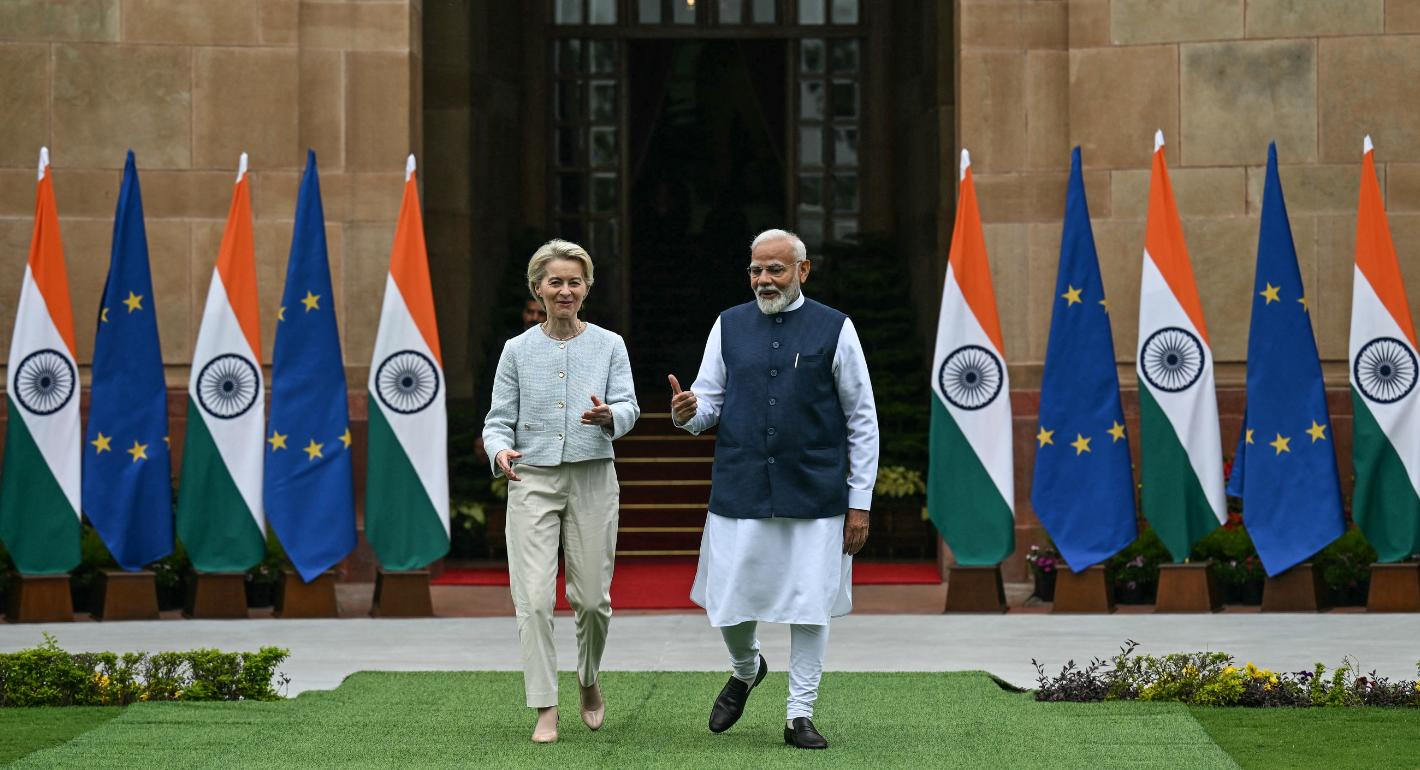
As European leadership prepares for the sixteenth EU-India Summit, both sides must reckon with trade-offs in order to secure a mutually beneficial Free Trade Agreement.

Dinakar Peri
Carnegie scholars examine the crucial elements of a document that’s radically different than its predecessors.



James M. Acton, Saskia Brechenmacher, Cecily Brewer, …

The hyper-personalized new version of global sphere-of-influence politics that Donald Trump wants will fail, as it did for Russia. In the meantime, Europe must still deal with a disruptive former ally determined to break the rules.

Thomas de Waal

Between Greenland and U.S. interference in Europe’s democracies, transatlantic relations risk rising to an unprecedented level of crisis. Amid continued arguments on how Brussels should react, tough times lie ahead for European leaders.

Marc Pierini
2026 has started in crisis, as the actions of unpredictable leaders shape an increasingly volatile global environment. To shift from crisis response to strategic foresight, what under-the-radar issues should the EU prepare for in the coming year?
Thomas de Waal