

Commentary
Judy Dempsey
{
  "authors": [
    "Judy Dempsey"
  ],
  "type": "commentary",
  "blog": "Strategic Europe",
  "centerAffiliationAll": "",
  "centers": [
    "Carnegie Endowment for International Peace",
    "Carnegie Europe"
  ],
  "collections": [],
  "englishNewsletterAll": "",
  "nonEnglishNewsletterAll": "",
  "primaryCenter": "Carnegie Europe",
  "programAffiliation": "",
  "programs": [],
  "projects": [],
  "regions": [
    "Europe"
  ],
  "topics": [
    "Climate Change",
    "EU",
    "Security"
  ]
}
Source: Getty
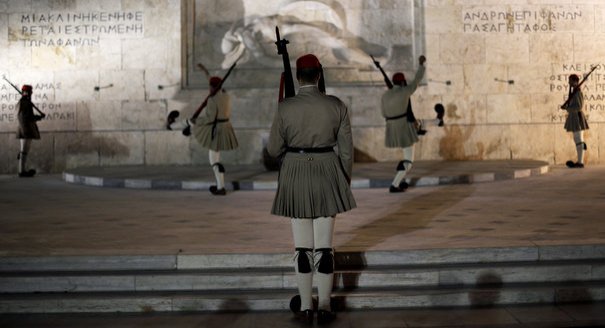
The EU should use Greece's financial crisis to push ahead with pooling and sharing resources. But it won't.
One would have imagined that the Greek government would have taken a sledgehammer to the defense budget back in 2009 when the debt crisis first took hold of this small country in the south east of Europe.
But no.
One would have thought too that the European Union and NATO might have used the euro crisis as an ideal opportunity to encourage countries to share defense equipment and cut back on wasteless duplication.
But no.
Greece went on a buying spree, purchasing submarines, fighter jets, and tanks from Germany and France. Not that they needed them. The region was stable. In 2009, almost 28 percent of its then €10 billion budget was spent on military equipment—higher than in the United States or any other NATO country.
Greece’s defense budget was 3.2 percent of gross domestic product. What a luxury for the Greek military establishment.
Some cuts were made during 2010 and again last year. Salaries for the 136,000 army personnel have been reduced and the shopping spree has come to an end.
Remarkably, however, Greek defense spending still accounts for 2.1 percent of gross domestic product, according to NATO. After the United States, Greece is the second biggest defense spender among the 27 NATO countries in relation to its GDP. That is astonishing for a country in a deep economic crisis.
Why then has the Greek government been so slow and reluctant in using the economic crisis to overhaul its armed forces?
After all, it can no longer justify that it needs all this expensive equipment and soldiers to see off any attack by Turkey. Relations with Turkey have become stable.
And if you look at Greece’s involvement in EU or NATO missions, its participation has been negligible. It has only 122 troops in Afghanistan. They are based, not out in the provinces but in the compound of Kabul International Airport.
Greece’s record in supporting EU missions has been weak too. So clearly, it is not using its soldiers to boost either EU or NATO operations.
Ironically, one reason for the delay in restructuring the armed forces has to do with the debt crisis.
The Greek government still has to pay off its contracts for the expensive equipment it purchased over the past few years. In the current situation, it does not want to anger Germany and France by leaving their bills unpaid.
The second reason is political. The Greek military has 500 military bases and 17 training centers, many of which are under-used. But their mere presence means jobs for the locals as well as political influence and patronage for the army officers and regional politicians. Closing bases and barracks, difficult at the best of times, would now particularly provoke local anger and despair.
The third reason is social. Of the 136,000 personnel, 90,000 are soldiers. That’s a huge army for a country of under 11 million people. Last year alone, with equipment expenses down, personnel costs accounted for 73.9 percent of the defense budget.
It is easier said than done to take soldiers and the supporting army personnel off the books.
And in Greece right now, it is particularly difficult. “What do you do with young men with a military training? It’s not a good idea making then unemployed,” said Samuel Pelo-Freeman, military analyst at SIPRI.
In other words, in these difficult times, the government is not prepared to introduce such radical defense cuts. The risks could be high.
It is not that the government fears a rebellion by the army, were that to happen. No defense analyst in Greece fears a return of the junta that was finally ousted in 1974.
But what they do say is that the system of patronage, a generous pension system, and consistently high defense spending is difficult to dismantle.
But is it really easier—and more just—to further cut welfare benefits and pensions for the old and the poor?
And is it really understandable that neither the EU nor NATO has eased the path for Greece to cut its defense budget in a way that would benefit both organizations?

Nonresident Senior Fellow, Carnegie Europe
Dempsey is a nonresident senior fellow at Carnegie Europe
Recent Work
Judy Dempsey
Judy Dempsey
Carnegie does not take institutional positions on public policy issues; the views represented herein are those of the author(s) and do not necessarily reflect the views of Carnegie, its staff, or its trustees.
The war in Iran proves the United States is now a destabilizing actor for Europe and the Arab Gulf. From protect their economies and energy supplies to safeguarding their territorial integrity, both regions have much to gain from forming a new kind of partnership together.

Rym Momtaz
French President Emmanuel Macron has unveiled his country’s new nuclear doctrine. Are the changes he has made enough to reassure France’s European partners in the current geopolitical context?
Rym Momtaz, ed.
European reactions to the war in Iran have lost sight of wider political dynamics. The EU must position itself for the next phase of the crisis without giving up on its principles.

Richard Youngs
Europe isn’t as weak in the new geopolitics of power as many would believe. But to leverage its assets and claim a sphere of influence, Brussels must stop undercutting itself.

Dimitar Bechev
Europe’s reaction to the war in Iran has been disunited and meek, a far cry from its previously leading role in diplomacy with Tehran. To avoid being condemned to the sidelines while escalation continues, Brussels needs to stand up for international law.

Pierre Vimont